St. Johns Bluff in Jacksonville in Duval County, Florida — The American South (South Atlantic)
Commemorating America’s French Heritage
Fort Caroline National Memorial
| — | Timucuan Ecological and Historic Preserve | — |
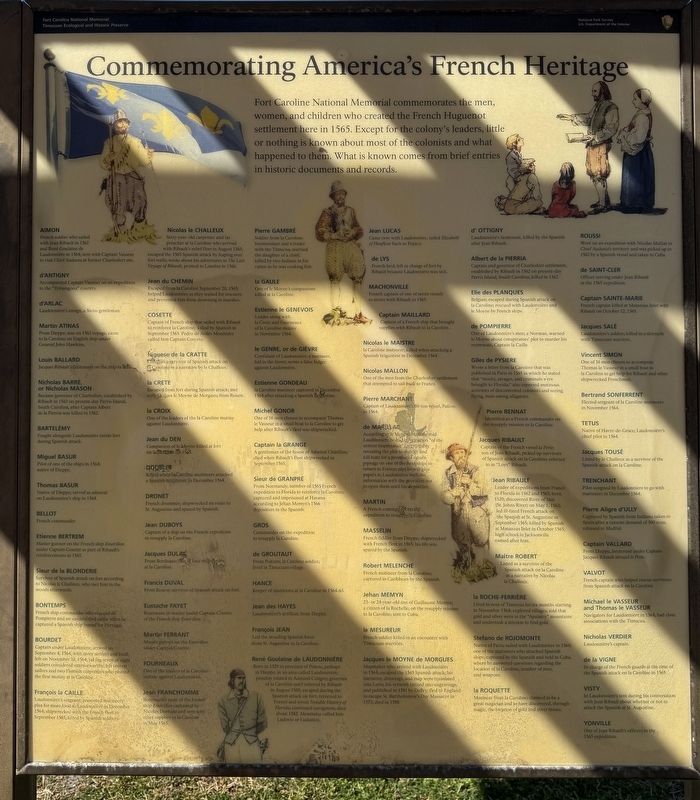
Photographed by Stephen Thomas White, February 4, 2026
1. Commemorating America’s French Heritage Marker
Aimon
French soldier who sailed with Jean Ribault in 1562 and René Goulaine de Laudonnière in 1564; sent with Captain Vasseur to visit Chief Audusta at former Charlesfort site.
d’Antigny
Accompanied Captain Vasseur on an expedition to the "Tymangoua" country.
d'Arlac
Laudonnière's ensign, a Swiss gentleman.
Martin Atinas
From Dieppe, was on 1562 voyage, came to la Caroline on English ship under General John Hawkins.
Louis Ballard
Jacques Ribault's lieutenant on the ship la Rerle.
Nicolas Barre, or Nicholas Mason
Became governor of Charlesfort, established by Ribault in 1562 on present-day Parris Island, South Carolina, after Captain Albert de la Pierria was killed in 1562.
Bartelémy
Fought alongside Laudonnière inside fort during Spanish attack.
Miguel Basur
Pilot of one of
this page online
Thomas Basur
Native of Dieppe; served as admiral on Laudonnière's ship in 1564.
Bellot
French commander
Etienne Bertrem Master gunner on the French ship Emérillon under Captain Cosette as part of Ribault's reinforcements in 1565.
Sieur de la Blonderie
Survivor of Spanish attack on fort according to Nicolas le Challeux, who met him in the woods afterwards.
Bontemps
French ship commander who rescued de Pompierre and an unidentified sailor when he captured a Spanish ship bound for Portugal.
Bourdet
Captain under Laudonnière, arrived on September 4, 1564, with more settlers and food; left on November 10, 1564, taking seven or eight soldiers considered untrustworthy; left several sailors and two Flemish carpenters who plotted the first mutiny at la Caroline.
François la Caille
Laudonniere's sergeant; presented mutineers plea for more food to Laudonniere in December 1564; shipwrecked with the French fleet in September 1565; killed by Spanish soldiers.
Nicolas le Challeux
Sixty-year-old carpenter and lay preacher at la Caroline who arrived with Ribault's relief fleet in
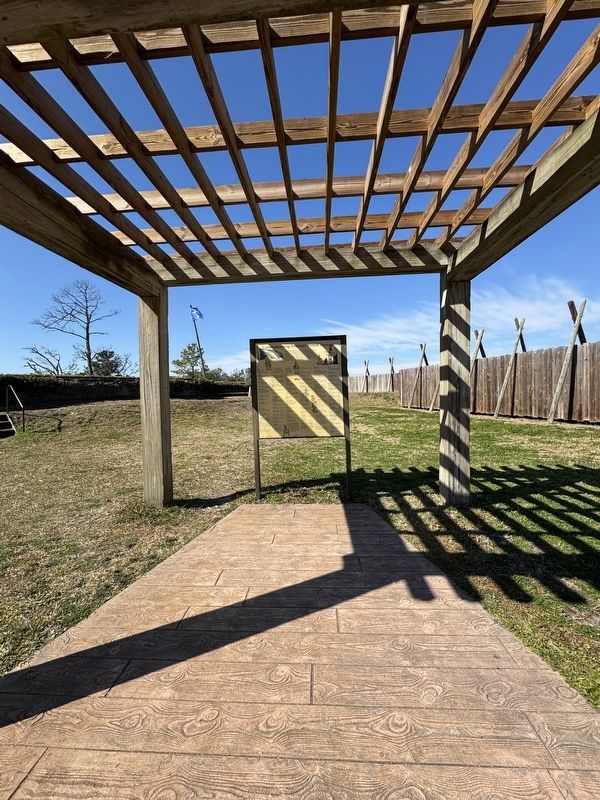
Photographed by Stephen Thomas White, February 4, 2026
2. Commemorating America’s French Heritage Marker
Jean du Chemin
Escaped from la Caroline September 20, 1565; helped Laudonnière as they waited for rescuers and prevented him from drowning in marshes.
Cosette
Captain of French ship that sailed with Ribault to reinforce la Caroline; killed by Spanish in September 1565. Pedro de Avilés Menéndez called him Captain Corceto.
Niguese de la Cratte
Listed as a survivor of Spanish attack on La Caroline in a narrative by le Challeux.
la Crete
Escaped from fort during Spanish attack; met with Jacques le Moyne de Morgues, from Rouen.
Jean du Den
Companion of le Moyne killed at fort on September 20, 1565.
Doublet
Killed when La Caroline mutineers attacked a Spanish brigantine in December 1564.
Dronet
French drummer; shipwrecked en route to St. Augustine and spared by Spanish.
Jean Duboys
Captain of a ship on the French expedition to resupply la Caroline.
Jacques Dulac
From Bordeaux, one of four trumpeters at La Caroline.
Francis Duval
From Rouen; survivor of Spanish attack on fort.
Eustache Fayet
Boatswain or master under Captain Cosette of the French ship Emérillon.
Martin Ferrant
Master gunner on the Emérillon under Captain Cosette.
Fourneaux
One of the leaders of la Caroline mutiny against Laudonnière.
Jean Franchomme
Boatswain's mate of the French ship Emerillon captained by Nicolas Dornant and sent with relief supplies to la Caroline in May 1655.
Pierre Gambré
Soldier from la Caroline; businessman and a trader with the Timucua; married the daughter of a chief; killed by two Indians in his canoe as he was cooking fish.
la Gaule
One of le Moyne's companions killed at la Caroline.
Estienne le Genevois
Leader along with la Croix and Fourneaux of la Caroline mutiny in November 1564.
le Genre, or de Giévre
Confidant of Laudonnière; a mutineer, hid in the forest; wrote a false ledger against Laudonniere.
Estienne Gondeau
la Caroline mutineer captured in December 1564 after attacking a Spanish Brigantine.
Michel Gonor
One of 16 men chosen to accompany Thomas le Vasseur in a small boat to la Caroline to help after Ribault's fleet was shipwrecked.
Captain La Grange
A gentleman of the house of Admiral Chátillon died when Ribault's fleet shipwrecked in September 1565.
Sieur de Granpré
From Normandy; member of 1565 French expedition to Florida to reinforce la Caroline captured and imprisoned at Havana according to Jehan Memyn's 1566 deposition to the Spanish.
Gros
Commander on the expedition to resupply la Caroline.
de Groutaut
From Poitiers; la Caroline soldier; lived in Timucuan village.
Hance
Keeper of munitions at La Caroline in 1564-65.
Jean des Hayes
Laudonnière's artificer, from Dieppe.
François Jean
Led the invading Spanish force from St. Augustine to la Caroline.
René Goulaine de Laudonnire
Born in 1529 in province of Poitou, perhaps in Dieppe, in an area called Laudonnière; possibly related to Admiral Coligny; governor of la Caroline until relieved by Ribault in August 1565; escaped during the Spanish attack on fort; returned to France and wrote Notable History of Florida; continued navigation; died about 1582. Menéndez called him Ludovic or Ludunice.
Jean Lucas
Came over with Laudonnière, sailed Elizabeth of Honfleur back to France.
de Lys
French lord; left in charge of fort by Ribault because Laudonnière was sick.
Machonville
French captain of one of seven vessels to arrive with Ribault in 1565.
Captain Maillard
Captain of a French ship that brought supplies with Ribault to la Caroline.
Nicolas le Maistre
la Caroline mutineer; killed when attacking a Spanish brigantine in December 1564.
Nicolas Mallon
One of the men from the Charlesfort settlement that attempted to sail back to France.
Pierre Marchant
Captain of Laudonniere’s 80-ton vessel, Falcon, in 1564.
de Martillac
According to le Moyne, Martillac told Laudonnière he had information “of the utmost Importance" (presumably revealing the plot to slander and kill him) for a promise of return passage on one of the next ships to return to France; says he will give papers to Laudonnière with the information with the provision not to open them until his departure.
Martin
A French commander on the expedition to resupply la Caroline.
Masselin
French fiddler from Dieppe; shipwrecked with French fleet in 1565; his life was spared by the Spanish.
Robert Melenche
French mutineer from la Caroline; captured in Caribbean by the Spanish.
Jehan Memyn
23- or 24-year-old son of Guillaume Memyn; a citizen of la Rochelle; on the resupply mission to la Caroline; sent to Cuba.
le Mesureur
French soldier killed in an encounter with Timucuan warriors.
Jacques le Moyne de Morgues
Mapmaker who arrived with Laudonniere in 1564; escaped the 1565 Spanish attack; his narrative, drawings, and map were translated into Latin, his artwork turned into engravings, and published in 1591 by DeBry; fled to England to escape St. Bartholomew's Day Massacre in 1572; died in 1588.
d’ Ottigny
Laudonnière's lieutenant, killed by the Spanish after Jean Ribault.
Albert de la Pierria
Captain and governor of Charlesfort settlement, established by Ribault in 1562 on present-day Parris Island, South Carolina; killed in 1562.
Elie des Planques
Belgian; escaped during Spanish attack on la Caroline; rescued with Laudonnière and le Moyne by French ships.
de Pompierre
One of Laudonnière's men; a Norman, warned le Moyne about conspirators plot to murder his roommate, Captain la Caille.
Giles de Pysiere
Wrote a letter from la Caroline that was published in Paris in 1565 in which ha stated that "moors, savages, and criminals were brought to Florida;" also reported mutinous activities of discontented colonists and seeing flying, man-eating alligators.
Pierre Rennat
Identified as a French commander on the resupply mission to la Caroline.
Jacques Ribault
Captain of the French vessel la Perle; son of Jean Ribault, picked up survivors of Spanish attack on la Caroline; referred to as "Loys" Ribault.
Jean Ribault
Leader of expeditions from France to Florida in 1562 and 1565; born 1520; discovered River of Mai (St. Johns River) on May 1, 1562; led ill-fated French attack on the Spanish at St. Augustine in September 1565; killed by Spanish at Matanzas Inlet in October 1565; high school in Jacksonville named after him.
Maitre Robert
Listed as a survivor of the Spanish attack on la Caroline in a narrative by Nicolas le Challeux.
la Roche-Ferriére
Lived in area of Timucua for six months starting in November 1564; explored villages; told that gold and silver were in the "Apalatcy" mountains and undertook a mission to find gold.
Stefano de Rojomonte
Native of Paris; sailed with Laudonnière in 1564; one of the mutineers who attacked Spanish ships; captured by the Spanish and held in Cuba, where he answered questions regarding the location of la Caroline, number of men, and weapons.
la Roquette
Mutineer from la Caroline; claimed to be a great magician and to have discovered, through magic, the location of gold and silver mines.
Roussi
Went on an expedition with Nicolas Mallon to Chief Audusta's territory and was picked up in 1562 Spanish vessel and taken to Cuba.
de Saint-Cler
Officer serving under jean Ribault in the 1565 expedition.
Captain Sainte-Marie
French captain killed at Matanzas Inlet with Ribault on October 12, 1565.
Jacques Salé
Laudonnière's soldier; killed in a skirmish with Timucuan warriors.
Vincent Simon
one of 16 men chosen to accompany Thomas le Vasseur in a small boat to Caroline to get help for Ribault and other shipwrecked Frenchmen.
Bertrand Sonferrent
Elected sergeant of la Caroline mutineers in November 1564.
Tetus
Native of Havre-de-Grace; Laudonniere's chief pilot in 1564.
Jacques Tousé
Listed by le Challeux as a survivor of the Spanish attack on la Caroline.
Trenchant
Pilot assigned by Laudonnière to go with mutineers in December 1564.
Pierre Aligre d’Ully
Captured by Spanish from Indians; taken to Spain after a ransom demand of 500 ecus; released in Madrid.
Captain Vallard
From Dieppe, lieutenant under Captain Jacques Ribault aboard le Perle.
Valvot
French captain who helped rescue survivors from Spanish attack on la Caroline.
Michael le Vasseur and Thomas le Vasseur
Navigators for Laudonnière in 1564; had close associations with the Timucua.
Nicholas Verdier
Laudonniere's captain.
de la Vigne
In charge of the French guards at the time of the Spanish attack on la Caroline in 1565.
Visty
In Laudonnière's tent during his conversation with Jean Ribault about whether or not to attack the Spanish at St. Augustine.
Yonville
One of Jean Ribault's officers in the 1565 expedition.
Erected by National Park Service, U.S. Department of the Interior.
Topics. This historical marker is listed in these topic lists: Colonial Era • Exploration • Forts and Castles • Indigenous Peoples and Communities • Parks & Recreational Areas • Settlements & Settlers. A significant historical year for this entry is 1565.
Location. 30° 23.214′ N, 81° 30.048′ W. Marker is in Jacksonville, Florida, in Duval County. It is in St. Johns Bluff. It can be reached from Fort Caroline Road half a mile north of Mt Pleasant Road, on the left when traveling north. The marker is within the grounds of Fort Caroline, approximately 300 yards northwest of the Fort Caroline Visitor Center. Touch for map. Marker is at or near this postal address: 12713 Fort Caroline Rd, Jacksonville FL 32225, United States of America. Touch for directions.

Regionally, this marker is in First Coast. It is also in the American South and on the Eastern Seaboard. Globally, it is in the North Atlantic Region, North America, a Gulf of Mexico state, the Western Hemisphere, the Western World, and the Anglosphere. Historically, it finds itself in what was once New Spain, the territory of the Mississippian Culture, one of the Confederate States of America, and the Antebellum South.
Other nearby markers. At least 8 other markers are within walking distance of this marker: Unsolved Mysteries (a few steps from this marker); Bloody Massacre (a few steps from this marker); Fort de la Caroline (within shouting distance of this marker); Building a Village in the Wilderness (within shouting distance of this marker); The Building of la Caroline (about 300 feet away, measured in a direct line); Timucuan Friends (about 700 feet away); French Memorial Trail (approx. 0.2 miles away); The River of May (approx. 0.2 miles away). Touch for a list and map of all markers in Jacksonville.
Also see . . .
1. Fort Caroline National Memorial. Timucuan Parks Foundation (Submitted on September 17, 2026, by Stephen Thomas White of Norfolk, Virginia.)
2. Fort Caroline National Memorial. National Park Service (Submitted on September 28, 2026.)
Credits. This page was last revised on September 28, 2026. It was originally submitted on September 17, 2026, by Stephen Thomas White of Norfolk, Virginia. This page has been viewed 14 times since then. Photos: 1, 2. submitted on September 17, 2026, by Stephen Thomas White of Norfolk, Virginia. • Bernard Fisher was the editor who published this page.
