Near Vienna in Dorchester County, Maryland — The American Northeast (Mid-Atlantic)
The Nature Trail at Handsell…walk the footsteps of the Native People of Chicone and find these trees
The Environment
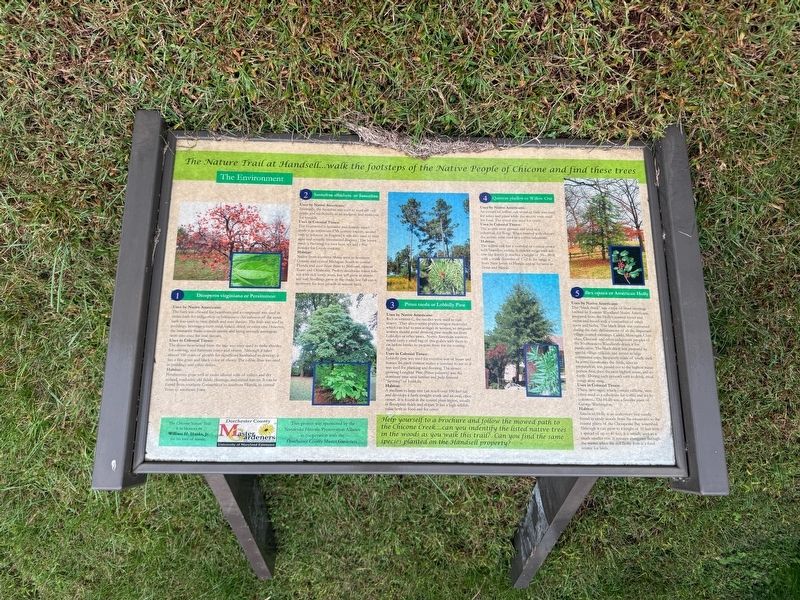
❶ Diospyros virginiana or Persimmon
Uses by Native Americans:
The bark was chewed for heartburn and a compound was used in steam bath for indigestion or biliousness. An infusion of the inner bark was used to treat thrash and sore throats. The fuit was used in puddings, beverages, corn meal, baked, dried, or eaten raw. However, the immature fruits contain tannin and being strongly astringent, were also used for sore throats. Uses in Colonial Times:
The dense heartwood from the tree was once used to make shuttles for weaving, and furniture inlays and veneer. Although it takes almost 100 years of growth for significant hardwood to develop, it has a fine grain and black color of ebony. The edible fruit was used in puddings and other dishes.
Habitat:
Persimmons grow well in moist alluvial soils of valleys and dry upland, roadsides, old fields, clearings, and mixed forests. It can be found from southern Connecticut to southern Florida, to central Texas to southeast Iowa.
❷ Sassafras albidum or Sassafras
Uses by Native Americans:
Spiritually, the Sassafras was used to ward off evil spirits and medicinally
this page online
Uses in Colonial Times:
The heartwood is beautiful and durable which made it an important 17th century export, second only to tobacco. In England it was also used to treat ague and sexually transmitted diseases. The leaves made a flavoring for root beer, tea and a fine powder for Creole cooking.
Habitat:
Native from southern Maine west to Southern Ontario and central Michigan. South to cental Florida and west from there to Missouri, eastern Texas and Oklahoma. Prefers decidious forest habitat with rich sandy loam, but will grow in almost any soil. Seedlings grow in the shade, but full sun is necessary for best growth in mature trees.
❸ Pinus taeda or Loblolly Pine
Uses by Native Americans:
Rich in vitamin C, the needles were used to cure scurvy. They also contain phytoestrogen molecules which can lead to miscarriages in women, so pregnant women should avoid drinking pine needle tea from Loblollys or other pines. Native American warriors would carry a small bag of this pollen with them to eat before battles to prepare them for the coming fight.
Uses in Colonial Times:
Loblolly
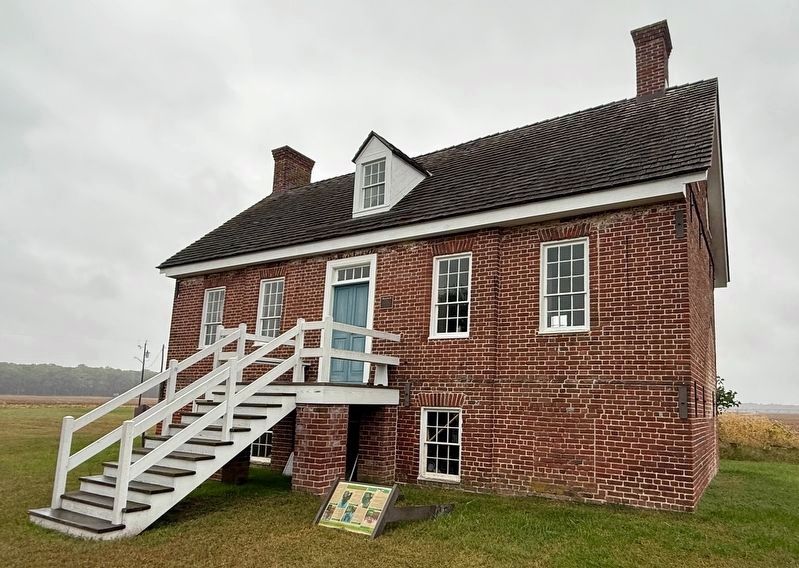
Photographed by Devry Becker Jones (CC0), October 11, 2026
2. The Nature Trail at Handsell…walk the footsteps of the Native People of Chicone and find these trees
At the time the photo was taken, the marker was removed from the ground and left upside down in front of the house.
Habitat:
A medium to large tree can reach over 100 feet tall and develops a fairly straight trunk and an oval, open crown. It is found in the coastal plain region, usually in floodplain fields and slopes. It has a high wildlife value both as food and for cover.
❹ Quercus phellos or Willow Oak
Uses by Native Americans:
An extract of willow oak wood or bark was used for aches and pains while the acorns were used for food. The wood was used for crafts.
Uses in Colonial Times:
The acorns were ground and used as a substitute for flour. When roasted with chicory the acorns were used as a coffee substitute.
Habitat:
The willow oak has a rounded or conical crown with branches ending in slender twigs with willow-like leaves. It reaches a height of 50-80 ft. with a trunk diameter of 1-2 ft. Its range is from New Jersey to Florida and as far west as Texas and Illinois.
❺ Ilex opaca or American Holly
Uses by Native Americans:
The "black drink" was a type of ritual beverage brewed by Eastern Woodland Native Americans, prepared from the Holly's roasted leaves and stems and mixed with a concoction of other roots and herbs. The black drink was consumed during the daily deliberations of all the important council meetings. Caddo, Muscogee, Cherokee, Choctaw and other indigenous peoples of the Southeastern Woodlands drank it for purification. The black drink was prepared by speical village officials and served in large communal cups, frequenlty made of whelk shell. In some ceremonies the drink, after its preparation, was passed out to the highest status person first, then the next highest status, and so forth. During each person's turn to drink, ritual songs were sung.
Uses in Colonial Times:
These beverages, which contain caffeine, were often used as a substitute for coffee and tea by colonists. The Holly was a favorite plant of George Washington.
Habitat:
American Holly is an understory tree usually found in sandy woods from the mountains to the coastal plains of the Chesapeake Bay watershed. Although it can grow to a height of 50 feet with a spread of up to 40 feet, it is usually seen as a much smaller tree. It remains evergreen through the winter when the red fleshy fruit is a food source for birds.
The Chicone Nature Trail is in Memory of William H. Hanks, Jr. for his love of nature.
This project was sponsored by the Nanticoke Historic Preservation Alliance in cooperation with Dorchester County Master Gardeners.
Help yourself to a brochure and follow the mowed path to the Chicone Creek....can you identify the listed native trees in the woods as you walk this trail? Can you find the same species planted on the Handsell property?
Erected by the Nanticoke Historic Preservation Alliance in cooperation with Dorchester County Master Gardeners.
Topics. This historical marker is listed in these topic lists: Anthropology & Archaeology • Colonial Era • Horticulture & Forestry • Indigenous Peoples and Communities.
Location. 38° 30.53′ N, 75° 48.726′ W. Marker is near Vienna, Maryland, in Dorchester County. It is on Indiantown Road 1.6 miles east of Rhodesdale Vienna Road (Maryland Route 331), on the right when traveling east. Touch for map. Marker is at or near this postal address: 4835 Indiantown Rd, Vienna MD 21869, United States of America. Touch for directions.

Regionally, this marker is on the Eastern Shore. It is also in the American Mid-Atlantic, on the Delmarva Peninsula, in the Tidewater, in the Chesapeake Bay Region, and on the Eastern Seaboard. Globally, it is in the North Atlantic Region, North America, the Western Hemisphere, the Western World, and the Anglosphere. Historically, it finds itself in what was once one of the original Thirteen Colonies and also the Antebellum South.
Other nearby markers. At least 8 other markers are within 2 miles of this marker, measured as the crow flies: The Chicone Lodge, Garden and Work Shelter… (within shouting distance of this marker); The African American Story in the Indian Town… (within shouting distance of this marker); The native people of the Chicacone Village…the Nanticokes (within shouting distance of this marker); Handsell (within shouting distance of this marker); The Nanticoke Historic Preservation Alliance (within shouting distance of this marker); Unnacokossimmon (approx. 1.7 miles away); John Smith Explores the Chesapeake (approx. 1.7 miles away); Discover: Vienna Heritage (approx. 1.8 miles away). Touch for a list and map of all markers in Vienna.
Credits. This page was last revised on October 11, 2026. It was originally submitted on October 11, 2026, by Devry Becker Jones of Washington, District of Columbia. This page has been viewed 2 times since then. Photos: 1, 2. submitted on October 11, 2026, by Devry Becker Jones of Washington, District of Columbia.
