Marshall Square in Chicago in Cook County, Illinois — The American Midwest (Great Lakes)
Jacques Marquette-Louis Jolliet Monument
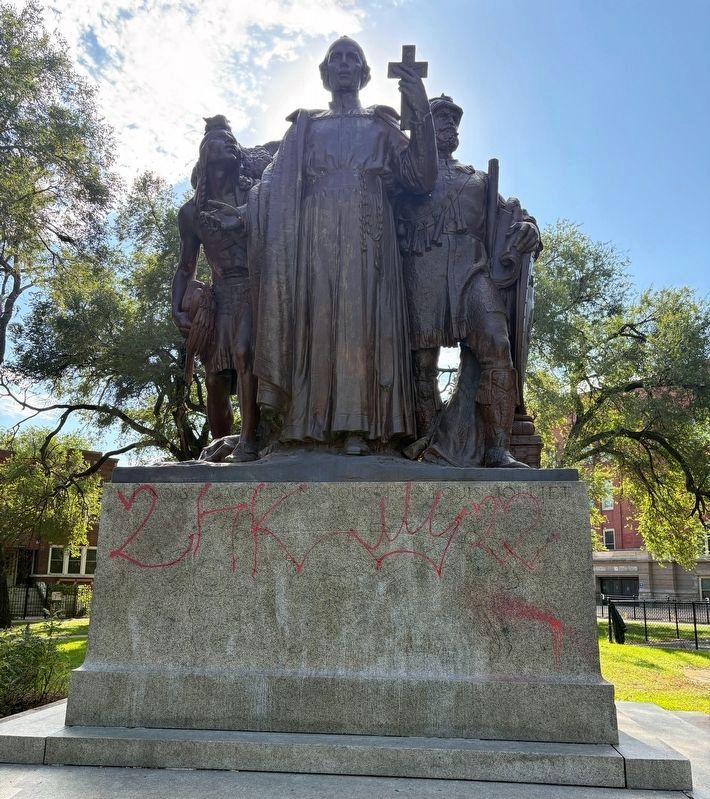
Photographed by Sean P. Flynn, October 12, 2026
1. Jacques Marquette-Louis Jolliet Monument
Dedicated MCMXXVI
[Names on the top of the statue's base, going counter-clockwise from the front:]
Illinois • Jacques Marquette • Louis Jolliet
Ottawa • Huron • Ottawa
Claude Dablon • Rene Menard • Claude Alloves
Menominee • Potawatomi
Erected 1926 by B.F. Ferguson Fund.
Topics. This historical marker and monument is listed in these topic lists: Exploration • Indigenous Peoples and Communities • Religion & Religious Structures. A significant historical year for this entry is 1673.
Location. 41° 50.869′ N, 87° 41.941′ W. Marker is in Chicago, Illinois, in Cook County. It is in Marshall Square. It is at the intersection of South Marshall Boulevard and West 24th Boulevard, on the right when traveling south on South Marshall Boulevard. While the large statue is impossible to miss while reaching the bend in the road where Marshall and 24th meet, accessing it by foot requires you to park on or near one of the side streets that ends in a cul-de-sac
this page online

Regionally, this marker and monument is on Chicago’s West Side. It is also in the American Midwest. Globally, it is in North America, on the Great Lakes, in the Western Hemisphere, in the Western World, and in the Anglosphere. Historically, it finds itself in what was once the Viceroyalty of New France, the territory of the Mississippian Culture, and the Northwest Territory.
Other nearby markers. At least 8 other markers are within one mile of this marker, measured as the crow flies: Little Village Arch (approx. 0.3 miles away); Carlos Salinas de Gortari (approx. 0.3 miles away); La Villita Natural Area (approx. ¾ mile away); Route 66 Landmark / Punto de Referencia de la Ruta 66 (approx. 0.8 miles away); Ice Cream Dream / Sueño de un Carrito de Paletas (approx. 0.8 miles away); Douglas Park (approx. 1.1 miles away); The Boulevard System (approx. 1.1 miles away); A Nation's Image (approx. 1.1 miles away). Touch for a list and map
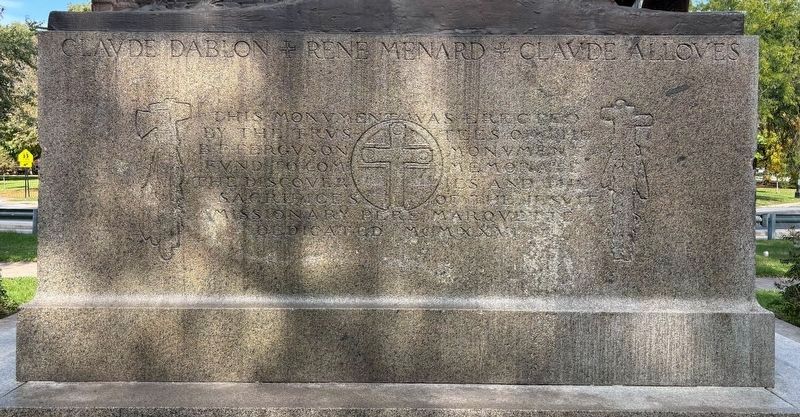
Photographed by Sean P. Flynn, October 12, 2026
2. The rear of the base of the Jacques Marquette-Louis Jolliet Monument
More about this marker. This imposing statue of Marquette, overlooking a turn in Marshall Boulevard across from Maria Saucedo Scholastic Academy (originally Carter H. Harrison Technical High School), features three figures: Father Jacques Marquette in the middle, his 1673 exploration partner Louis Jolliet on the right, and an American Indian guide on the left. It was commissioned by the estate of Benjamin Franklin Ferguson, a Chicago lumber magnate who died in 1905 and left $1 million in his will to erect statues and monuments in parks and public spaces throughout Chicago.
The rear of the statue's base includes the description printed above; the text is mostly readable, but faded in places. In the middle of the text is a cross, and on either side appear to be images of tomahawks. The front of the base, although it has faded substantially — and, during an October 2026 visit to the site, was marked with some red graffiti — appears to be etched with an image of Marquette's traveling party traversing the Chicago Portage with an upside-down canoe over their heads. The top of the base includes the names of
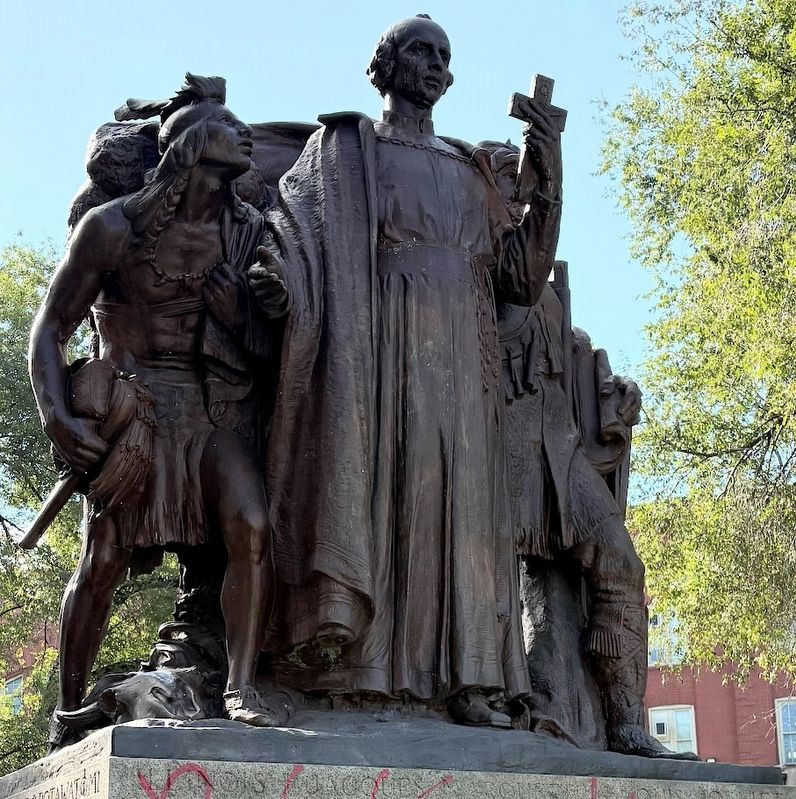
Photographed by Sean P. Flynn, October 12, 2026
3. Jacques Marquette-Louis Jolliet statue
This sculpture was officially presented to the West Park Commission (which oversaw parks on Chicago's West Side until the 1930s, when it was folded into the Chicago Park District) at a ceremony on July 20, 1926. Cyrus McCormick Jr., vice president of the Art Institute, presided over the event, according to reports in the Chicago Tribune. Rev. William H. Agnew, a Jesuit priest who was president of Loyola University in Chicago, gave a speech called "Chicago's Early Consecration," and federal judge James H. Wilkerson delivered the keynote address, titled "Marquette, the Pioneer of New France." Judge Wilkerson's speech, the newspaper reported, praised "the poetic temperament, the religious spirit, and the bravery of Marquette, and [included] an account of the debt civilization owes Louis Joliet [sic], his companion and fellow explorer."
The sculptor,
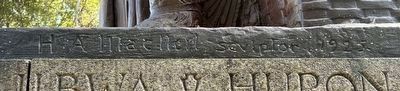
Photographed by Sean P. Flynn, October 12, 2026
4. H.A. MacNeil, sculptor, 1925
The memorial was reviewed in recent years by the Chicago Monuments Project, a city-commissioned initiative to review inequities in Chicago's public monuments and memorials. In its 2022 final report, the project called for this sculpture to be removed from Marshall Square and placed in storage. However, four years later it remains in place. Read the commentary below for more about the controversy surrounding this sculpture and others in Chicago related to Native Americans.
A second commentary
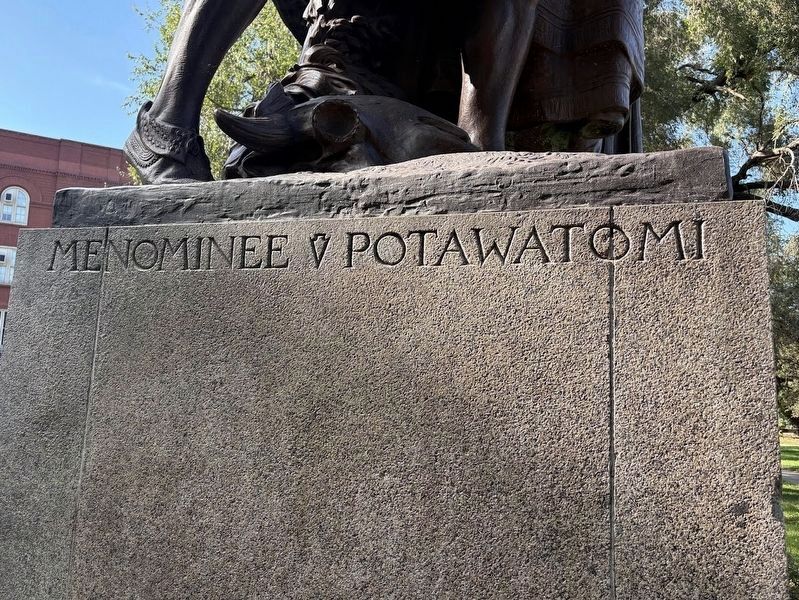
Photographed by Sean P. Flynn, October 12, 2026
5. Menominee and Potawatomi named on the side of the sculpture
Regarding Jacques Marquette-Louis Jolliet Monument. "Père" Jacques Marquette, the Jesuit priest and explorer, made two visits to the Chicago area. The first, in 1673, came at the end of his famed voyage with fur trader Louis Jolliet, when they were the first white settlers to connect the Great Lakes basin and Mississippi River. Beginning at Marquette's mission at St. Ignace on the Upper Peninsula of Michigan, their seven-person team rode two birch-bark canoes along Lake Michigan's northern and western shore to what is now Green Bay, Wisconsin. They continued west, reaching the Wisconsin River and then the Mississippi River, which they traveled all the way to the Arkansas River before turning around. On their return trip, Marquette and Jolliet came north via the Illinois River, taking it to the Des Plaines River as far as the present-day Chicago suburb of Forest View. From there, at the suggestion of a local Indian, they portaged — carried their canoes across land — to the south branch of the Chicago River, believed to be somewhere around where the modern-day Damen Avenue crosses
Photographed by Sean P. Flynn, October 12, 2026
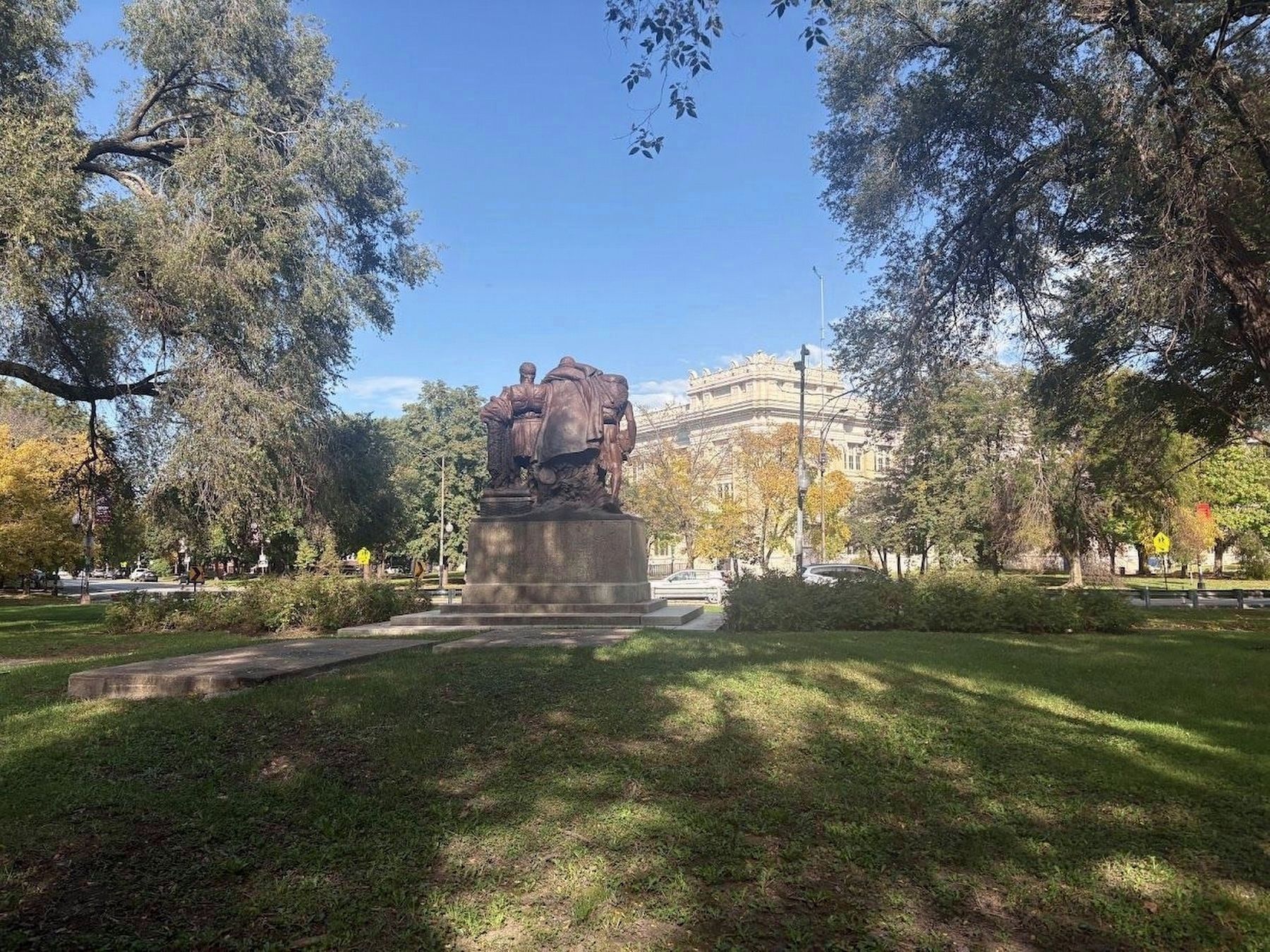
6. Jacques Marquette-Louis Jolliet Monument, rear view
The statue stands at the turn in the road where 24th and Marshall Boulevards meet, about a block west of California Avenue. The Maria Saucedo Academy (the old Harrison Technical High School) is in the rear.
About a year and a half later, in late 1674, Father Marquette returned to the Chicago area during another trip to establish a mission among a Native American tribe called the Kaskaskia. After being slowed by poor weather while traveling south from Green Bay, Marquette and his entourage reached the Chicago River and then decided to spend the winter of 1674-75 in a makeshift cabin, believed to be about a mile east of here near where the modern Damen Avenue crosses the Chicago River's south branch. The spring thaw in March 1675 flooded the area and forced Marquette and his group to resume their trip. They continued southwest to where Marquette and Jolliet had first portaged in 1673.
A few weeks later, Marquette and his party connected with the Kaskaskia and established the mission with them; Father Marquette preached an Easter mass at their settlement, close to where Starved Rock State Park
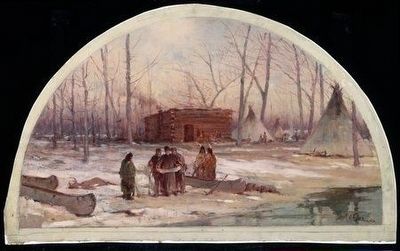
Painting by Lawrence C. Earle; Courtesy of Chicago History Museum (ICHi-062501), circa 1900
7. "The Winter Quarters of Father Marquette, 1674"
A 1900 painting by Lawrence C. Earle depicts Marquette's 1674-75 winter camp, which was located roughly where the modern Damen Avenue meets the Chicago River.
Related marker. Click here for another marker that is related to this marker. The listing for the James Marquette memorial, about a mile east of this sclupture, includes a commentary with a history of Marquette memorials in Chicago.
Also see . . .
1. Marquette Statue in Chicago. A 2010 post from a blog devoted to Hermon A. MacNeil, the sculpture's artist. (Submitted on October 12, 2026, by Sean P. Flynn of Oak Park, Illinois.)
2. Description of Existing Monuments: Monuments Under Review. The Chicago Monuments Project website has a list of the sculptures, monuments and memorials in the city that it reviewed for its 2022 report. (Submitted on October 13, 2026, by Sean P. Flynn of Oak Park, Illinois.)
3. Marquette Memorials. Starting on page 291, the April 1931 edition of the Mid-America journal, a publication by the Illinois Catholic Historical Society, offers an extensive history of Marquette memorials in the Midwest. (Submitted on October 13, 2026, by Sean P. Flynn of Oak Park, Illinois.)
Additional commentary.
1. The fate of the Marquette-Jolliet Monument
As is the case with many Chicago public art pieces depicting Native Americans, this massive monument to Fr. Jacques Marquette and his exploration partner, the fur trader Louis Jolliet, has been under increasing scrutiny in recent years.
For one thing, its subject matter about the exploration and settlement of Chicago and the Midwest by white European explorers has been criticized by some for, at the least, being Eurocentric, if not for being outright ignorant of the impact white settlement had on Native Americans in the region.
Furthermore, critics have called out this particular sculpture for the slump-shouldered American Indian standing behind Fr. Marquette. To some, it depicts the Indian as being subservient to a white master.
In 2022, the Chicago Monuments Project, a city-commissioned initiative that was formed in the wake of the protests surrounding the 2020 killing of George Floyd to review inequities in Chicago's public monuments and memorials, included a review of this memorial to Marquette and Jolliet overlooking Marshall Boulevard. In its final report, the commission wrote: "The sculpture reinforces stereotypes about American Indians and glorifies a complicated and painful history of Western expansion." The project recommended that the statue be placed in storage, or potentially loaned or donated to a private organization, and then replaced by new public art projects developed in conjunction with the Marshall Square neighborhood.
Interestingly, that fate has indeed befallen a handful of other controversial statues related to settler-native relations over the years. In the late 1990s, a South Side memorial to the Fort Dearborn Massacre, commissioned by famed industrialist George Pullman, was taken down and placed in storage, where it has remained ever since. In 2020, three different statues related to Christopher Columbus were taken down and put into storage after protests in the city following the death of George Floyd. One, located in Arrigo Park on the West Side Little Italy neighborhood, was recently loaned to an Italian-American group, which plans to display it in a new museum. The other two are in storage, with no apparent plans to re-display them. The most prominent one of these two was a 1933 statue of Christopher Columbus in Grant Park, erected during the 1993 Century of Progress World's Fair. That statue was taken down by city officials in the middle the night in July 2020, after protesters had unsuccessfully attempted to pull it down.
Yet, for whatever the reason — maybe because Marquette himself remains a relatively uncontroversial figure, or because of its proximity to where Marquette camped in 1675, or simply because it doesn't gain as much notice sitting in a South Side neighborhood that's off the beaten path for many Chicagoans — this majestic statue remains in place in the same spot it has been now for 100 years.
— Submitted October 16, 2026, by Sean P. Flynn of Oak Park, Illinois.
2. The Marquette-Jolliet Monument's name
A contemporary news report by the Chicago Tribune about the unveiling of this memorial on July 20, 1926, described it as "a monument to the memory of Pere Jacques Marquette," and the inscription on the rear of the base similarly is focused on Fr. Marquette, with fur trader Louis Jolliet named only among Marquette's travel companions at the top of the base. The statue itself features a cross-bearing Fr. Marquette front and center, with Jolliet on the rear to the right, and a somewhat-slouching Native American behind him on the left.
That being said, an official name for this memorial could not be found in contemporary reports about its erection in 1926, and nearly every modern source refers to it as the "Jacques Marquette-Louis Jolliet Monument." In particular, that name was used by the Chicago Monuments Project, a city-commissioned review of Chicago's public sculptures, memorials and monuments whose final report was published in 2022.
— Submitted October 13, 2026, by Sean P. Flynn of Oak Park, Illinois.
Credits. This page was last revised on October 17, 2026. It was originally submitted on October 12, 2026, by Sean P. Flynn of Oak Park, Illinois. This page has been viewed 25 times since then. Photos: 1, 2, 3, 4. submitted on October 12, 2026, by Sean P. Flynn of Oak Park, Illinois. 5. submitted on October 13, 2026, by Sean P. Flynn of Oak Park, Illinois. 6. submitted on October 12, 2026, by Sean P. Flynn of Oak Park, Illinois. 7. submitted on October 17, 2024, by Sean P. Flynn of Oak Park, Illinois.
