Mathews in Mathews County, Virginia — The American South (Mid-Atlantic)
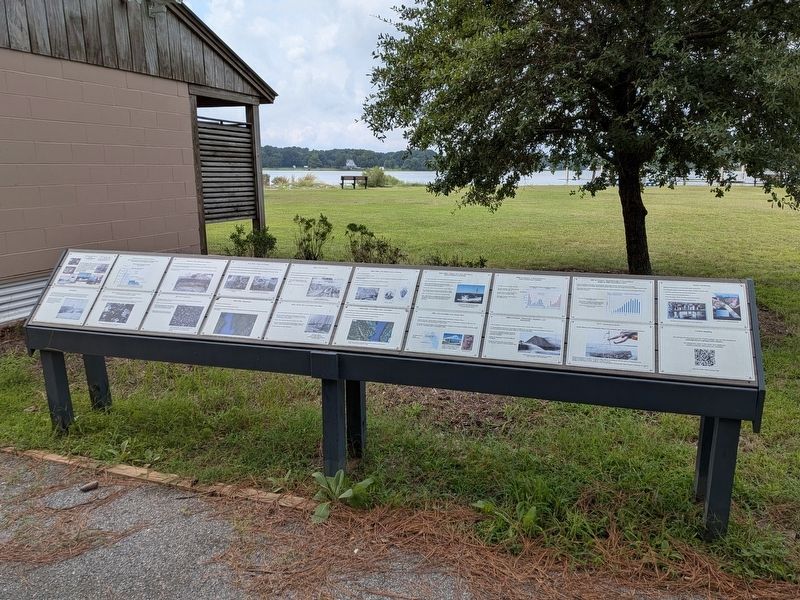
Highlights of the History of Oysters in the Chesapeake Bay
by Vic Spain, MOG
Photographed by Evan Dwyer, August 29, 2026
1. Highlights of the History of Oysters in the Chesapeake Bay Marker
"And the tragedy of the commons for the Chesapeake Bay was that men believed that the resources were available to all to exploit because the resources of the bay were inexhaustible."
Wennersten, John R.
Introduction>
The Chesapeake Bay is a unique and beautiful estuary, once a pristine and bountiful home to Native Americans as well as the European settlers of the seventeenth century. The oyster reefs were so prevalent that they were navigational hazards to the early explorers but also helped the colonists avoid starvation.
History teaches that dense human populations will exploit a common resource until it is exhausted. So we should not be too surprised by the story that follows.
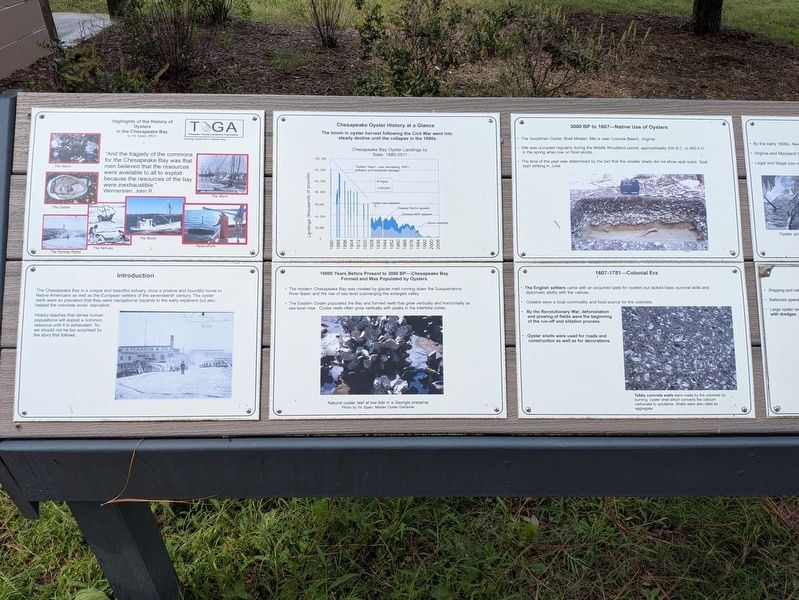
Chesapeake Oyster History at a Glance
The boom in oyster harvest following the Civil War went into steady decline until the collapse in the 1990s.
Graphic Caption: Chesapeake Bay Oyster Landings by State, 1880-2011
10000 Years Before Present to 3000 BP - Chesapeake Bay Formed and Was Populated by Oysters
• The modern Chesapeake Bay was created by glacier melt running down the Susquehanna River Basin and the rise of sea level submerging
this page online
• The Easter Oyster populated the Bay and formed reefs that grew vertically and horizontally as sea level rose. Oyster reefs often grow vertically with peaks in the intertidal zones.
Photo Caption: Natural Oyster reef at low tide in a Georgia preserve
Photo by Vic Spain, Master Oyster Gardener
3000 BP to 1607 - Native Use of Oysters
• The Gouldman Oyster Shell Midden Site is near Colonial Beach, Virginia.
• Site was occupied regularly during the Middle Woodland period, approximately 500 B.C. to 900 A.D. in the spring when low on food stocks.
• The time of the year was determined by the fact that the smaller shells did not show spat scars. Spat start striking in June.
1607-1781 - Colonial Era
• The English settlers came with an acquired taste for oysters but lacked basic survival skills and diplomatic ability with the natives.
• Oysters were a local commodity and food source for the colonists.
• By the Revolutionary War, deforestation and plowing of fields were beginning of the run-off and siltation process.
• Oyster shells were used for roads and construction as well as for decorations.
Photo Caption: Tabby concrete walls were made by the colonists by burning oyster shell which converts the calcium carbonate to quicklime. Shells were also used as aggregate.
1860s - Post Civil War
•
Photographed by Evan Dwyer, August 29, 2026
2. Highlights of the History of Oysters in the Chesapeake Bay Marker
Left third of the marker.
• End of the War brought large labor force of ex-soliders and ex-slaves.
• The dredge was reinstated in Virginia.
• The Transcontinental Railway was completed in 1869 enhancing oyster sales.
The "Boom" years were coming.
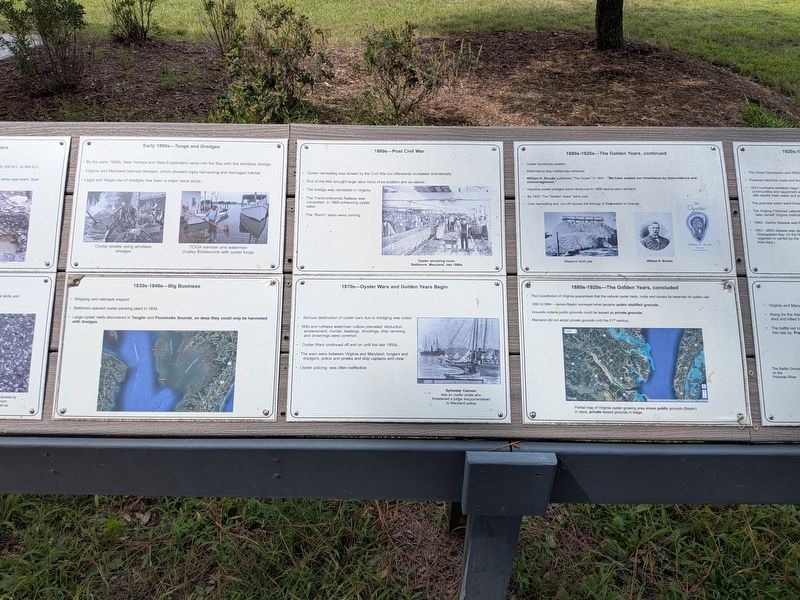
Photo Caption: Oyster shucking room, Baltimore, Maryland, late 1890s
1870s - Oyster Wars and Golden Years Begin
• Serious destruction of oyster bars due to dredging was noted.
• Wild and ruthless waterman culture prevailed. Abduction, enslavement, murder, beatings, shootings, ship ramming and drownings were common.
• Oyster Wars continued off and on until the late 1950s
• The wars were between Virginia and Maryland, tongers and dredgers, police and pirates and ship captains and crew.
• Oyster policing was often ineffective.
Photo Caption: Sylvester Cannon was an oyster pirate who threatened a judge and surrendered to Maryland police.
1880s-1920s - The Golden Years, continued
• Oyster harvesting peaked.
• Shell vital to Bay habitat was removed.
• William K. Brooks published "The Oyster" in 1891. "We have wasted our inheritance by improvidence and mismanagement."
•
Photographed by Evan Dwyer, August 29, 2026
3. Highlights of the History of Oysters in the Chesapeake Bay Marker
Center third of the marker.
• By 1920 "The Golden Years" were over.
• Over harvesting and run-off caused the biology of Bay waters to change.
Photo Captions:
Massive shell pile
William K. Brooks
1880s-1920s - The Golden Years, concluded
• The Constitution of Virginia guarantees that the natural oyster beds, rocks and shoals be reserved for public use.
• 1892 to 1894 - James Baylor surveyed what became public shellfish grounds.
• Grounds outside public grounds could be leased as private grounds.
• Maryland did not adopt private grounds until the 21st century.
Photo Caption: Partial map of Virginia oyster growing area shows public grounds (Baylor) in aqua, private leased grounds in beige.
1920s to 1960s - Golden Years End, Mini-Boom, Oyster Diseases Invade Bay
• The Great Depression and WW2 suppressed the global oyster market.
• Powered deadrise boats and buyboats replaced sailing oyster vessels.
• 1933 hurricane wreaked major damage to oyster communities and equipment and inundated oyster bars with deadly fresh water and pollution.
• The post-war years were known as the "oyster
Photographed by Evan Dwyer, August 29, 2026
4. Highlights of the History of Oysters in the Chesapeake Bay Marker
Right third of the marker.
• The Virginia Fisheries Laboratory was founded in 1940, later named Virginia Institute of Marine Science (VIMS).
• 1949 - Dermo disease was found in Chesapeake Bay.
• 1957 - MSX disease was detected in Delaware Bay then Chesapeake Bay. (In the 1990s VIMS determined MSX organism is carried by the Crassostrea gigas oyster from Asia.)
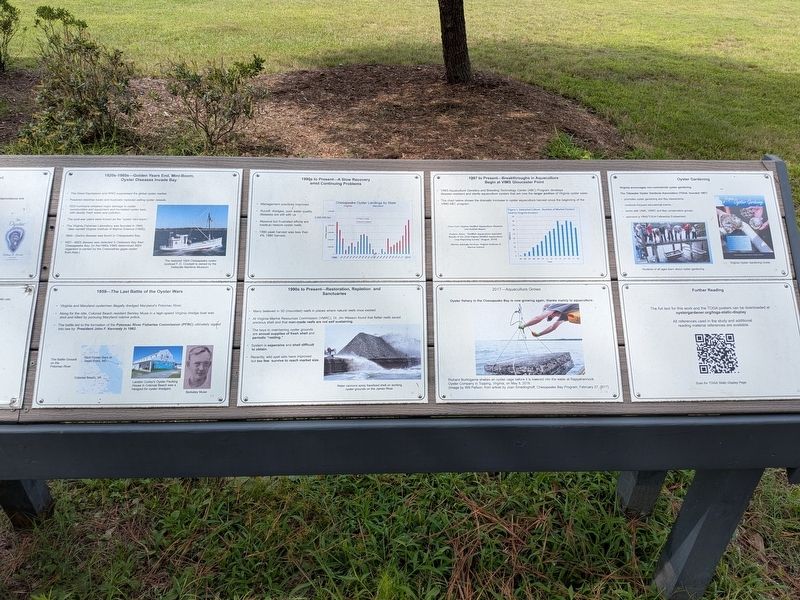
Photo Caption: The restored 1924 Chesapeake oyster buyboat F.D. Crockett is owned by the Deltaville Maritime Museum.
1959 - The Last Battle of the Oyster Wars
• Virginia and Maryland oystermen illegally dredged Maryland's Potomac River.
• Along for the ride, Colonial Beach resident Berkley Muse in a high-speed Virginia dredge boat was shot and killed by pursuing Maryland marine police.
• The battle led to the formation of the Potomac River Fisheries Commission (PFRC) ultimately signed into law by President John F. Kennedy in 1962.
Photo Captions:
The Battle Ground on the Potomac River
Landon Curley's Oyster Packing House in Colonial Beach was a hangout for oyster dredgers.
Berkeley Muse
1990s to Present - A Slow Recovery amid Continuing Problems
• Management practices improved.
•
Photographed by Evan Dwyer, August 29, 2026
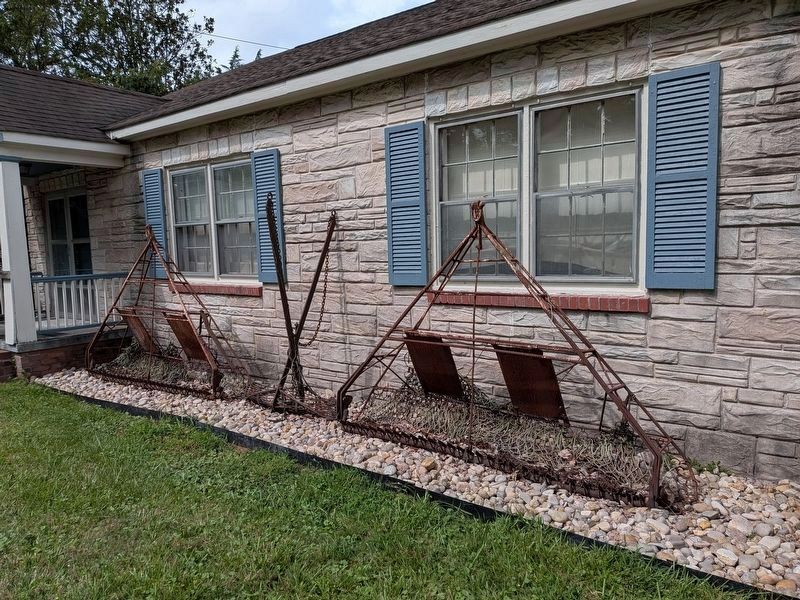
5. Oyster Dredges & Tongs
At the Mathews Maritime Museum. The tongs are the center object. The outer two artifacts are dredges.
• Massive but frustrated efforts are made to restore oyster reefs.
• 1990 peak harvest was less than 4% 1880 harvest.
Graphic Caption: Chesapeake Oyster Landings by State
1990s to Present - Restoration, Repletion and Sanctuaries
• Many believed in 3D (mounted) reefs in places where natural reefs once existed.
• At Virginia Marine Resources Commission (VMRC), Dr. Jim Wesson found that flatter reefs saved precious sheel and that man-made reefs are not self sustaining.
• The keys to maintaining oyster grounds are annual supplies of fresh shell and periodic "resting".
• System is expensive and shell difficult to obtain.
• Recently, wild spat sets have improved but too few survive to reach market size.
Photo Caption: Water cannons spray fossilized shell on working oyster grounds on the James River.
1997 to Present - Breakthroughs in Aquaculture Begin at VIMS Gloucester Point
• VIMS Aquaculture Genetics and Breeding Technology Center (ABC) Program develops disease-resistant and sterile aquaculture oysters that are now the larger portion of Virginia oyster sales.
• The chart below shows the dramatic increase in oyster aquaculture harvest since the beginning of the VIMS ABC program.
Chart Caption:
Figure 2. Intensive Culture: Number of Market Oysters Sold by Virginia Growers
Chart from Virginia Shellfish Aquaculture Situation and Outlook Report.
Hudson, Karen. "Shellfish Aquaculture Specialist Results of the 2018 Virginia Shellfish Aquaculture Crop Reporting Survey." (August, 2019)
Marine Advisory Services, Virginia Institute of Marine Science
2017 - Aquaculture Grows
Oyster fishery in the Chesapeake Bay is now growing again, thanks mainly to aquaculture.
Photo Caption: Richard Burlingame shakes an oyster cage before it is lowered into the water at Rappahannock Oyster Company in Topping, Virginia, on May 9, 2016.
(Image by Will Parson, from article by Johan Smedinghoff, Chesapeake Bay Program, February 27, 2017)
Oyster Gardening
Virginia encourages non-commercial oyster gardening.
The Tidewater Oyster Gardener Association (TOGA, founded 1997)
• promotes oyster gardening and Bay stewardship.
• conducts frequent educational events.
• works with VIMS, VMRC and Bay conservation groups.
• sponsors a VIMS/TOGA Fellowship Endowment.
Photo Captions:
Students of all ages learn about oyster gardening.
Virginia Oyster Gardening Guide.
Further Reading
The full text for this work and the TOGA posters can be downloaded at oystergardener.org/toga-static-display
All references used in the study and additional reading material references are available.
Scan for TOGA Static Display Page
Erected by Tidewater Oyster Gardeners Association.
Topics. This historical marker is listed in these topic lists: Colonial Era • Environment • Industry & Commerce • Waterways & Vessels.
Location. 37° 24.204′ N, 76° 20.708′ W. Marker is in Mathews, Virginia, in Mathews County. It is on Williams Wharf Road (Virginia Route 614) 0.4 miles west of Bertschy Lane, on the left when traveling west. Marker is at the Williams Wharf Landing public boat landing. Touch for map. Marker is at or near this postal address: 1039 Williams Wharf Road, Mathews VA 23109, United States of America. Touch for directions.

Regionally, this marker is on the Middle Peninsula and in the Hampton Roads Metropolitan Area. It is also in the American South, specifically in the Upper South, in the Tidewater, in the Chesapeake Bay Region, and on the Eastern Seaboard. Globally, it is in the North Atlantic Region, North America, the Western Hemisphere, the Western World, and the Anglosphere. Historically, it finds itself in what was once the territory of the Mississippian Culture, one of the original Thirteen Colonies, one of the Confederate States of America, and the Antebellum South.
Other nearby markers. At least 8 other markers are within 3 miles of this marker, measured as the crow flies: Williams Wharf Landing (here, next to this marker); Kingston Parish (approx. 0.7 miles away); Captain Sally L. Tompkins, C.S.A. Monument (approx. 0.7 miles away); Tompkins Cottage, circa 1820 (approx. 2.4 miles away); Fort Cricket Hill (approx. 2.4 miles away); Civil War In Mathews County (approx. 2.4 miles away); Mathews County Courthouse Square (approx. 2½ miles away); Mathews County Confederate Monument (approx. 2½ miles away). Touch for a list and map of all markers in Mathews.
Credits. This page was last revised on October 30, 2026. It was originally submitted on October 30, 2026, by Evan Dwyer of Richmond, Virginia. This page has been viewed 12 times since then. Photos: 1, 2, 3, 4, 5. submitted on October 30, 2026, by Evan Dwyer of Richmond, Virginia.
