
Halesworth in Suffolk, England, United Kingdom — Northwestern Europe (the British Isles)
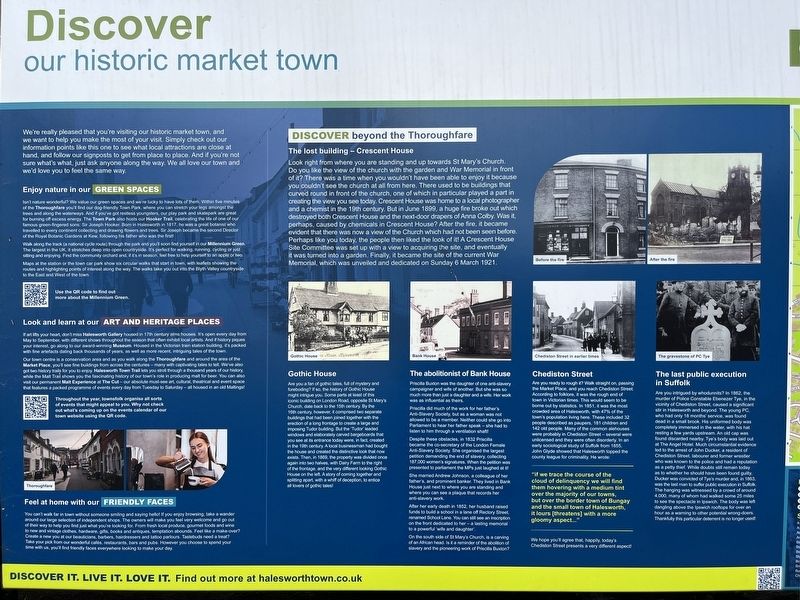
Discover our historic market town
Photographed by Ray Gurganus, April 20, 2026
1. Discover our historic market town Marker
Enjoy nature in our Green Spaces
Isn't nature wonderful? We value our green spaces and we're lucky to have lots of them. Within five minutes of the Thoroughfare you'll find our dog-friendly Town Park, where you can stretch your legs amongst the trees and along the waterways. And if you've got restless youngsters, our play park and skatepark are great for burning off excess energy. The Town Park also hosts our Hooker Trail, celebrating the life of one of our famous green-fingered sons: Sir Joseph Hooker. Born in Halesworth in 1817, he was a great botanist who travelled to every continent collecting and drawing flowers and trees. Sir Joseph became the second Director of the Royal Botanic Gardens at Kew, following his father
this page online
Walk along the track (a national cycle route) through the park and you'll soon find yourself in our Millennium Green. The largest in the UK, it stretches deep into open countryside. It's perfect for walking, running, cycling or just sitting and enjoying. Find the community orchard and, if it's in season, feel free to help yourself to an apple or two.
Maps at the station or the town car park show six circular walks that start in town, with leaflets showing the routes and highlighting points of interest along the way. The walks take you out into the Blyth Valley countryside to the East and West of the town.
Look and learn at our Art and Heritage Places
If art lifts your heart, don't miss Halesworth Gallery housed in 17th century alms houses. It's open every day from May to September, with different shows throughout the season that often exhibit local artists. And if history piques your interest, go along to our award-winning Museum. Housed in the Victorian train station building, it's packed with fine artefacts dating back thousands of years, as well as more recent, intriguing tales of the town.
Our town
Picture from the marker
2. Gothic House
Throughout the year, townsfolk organise all sorts of events that might appeal to you. Why not check out what's coming up on the events calendar of our town website using the QR code.
Feel at home with our Friendly Faces
You can't walk far in town without someone smiling and saying hello! If you enjoy browsing, take a wander around our large selection of independent shops. The owners will make you feel very welcome and go out of their way to help you find just what you're
Picture from the marker
3. Bank House
Discover beyond the Thoroughfare
The lost building - Crescent House
Look right from where you are standing and up towards St Mary's Church. Do you like the view of the church with the garden and War Memorial in front of it? There was a time when you wouldn't have been able to enjoy it because you couldn't see the church at all from here. There used to be buildings that curved round in front of the church, one of which in particular played a part in creating the view you see today. Crescent House was home to a local photographer and a chemist in the 19th century. But in June 1899, a huge fire broke out which destroyed both Crescent House and the next-door drapers of Anna Colby. Was it,
Picture from the marker
4. Chediston Street
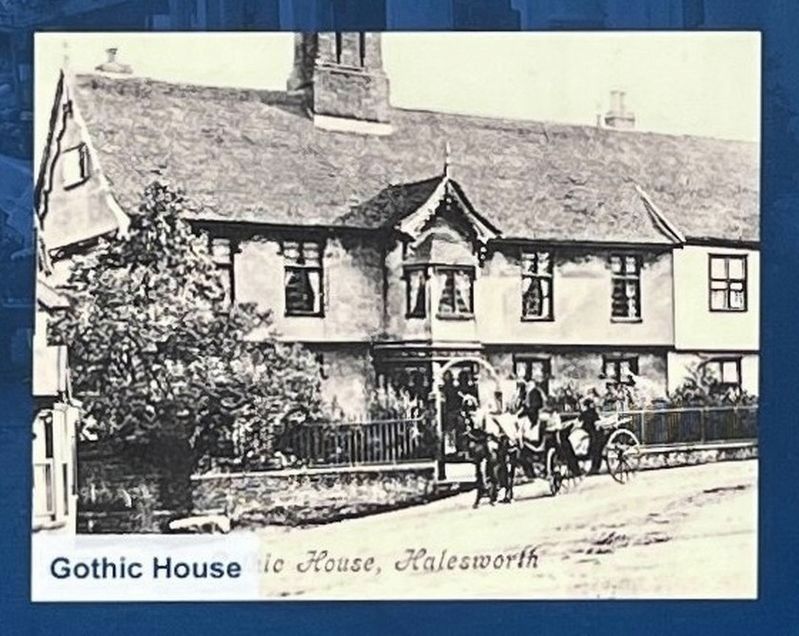
Gothic House
Are you a fan of gothic tales, full of mystery and foreboding? If so, the history of Gothic House might intrigue you. Some parts at least of this iconic building on London Road, opposite St Mary's Church, date back to the 15th century. By the 16th century, however, it comprised two separate buildings that had been joined together with the erection of a long frontage to create a large and imposing Tudor building. But the 'Tudor' leaded windows and elaborately carved bargeboards that you see at its entrance today were, in fact, created in the 19th century. A local businessman had bought the house and created the distinctive look that now exists. Then, in 1869, the property was divided once again into two halves, with Dairy Farm to the right of the frontage, and the very different looking Gothic House on the left. A story of coming together and splitting apart, with a whiff of deception, to entice all lovers of gothic tales!
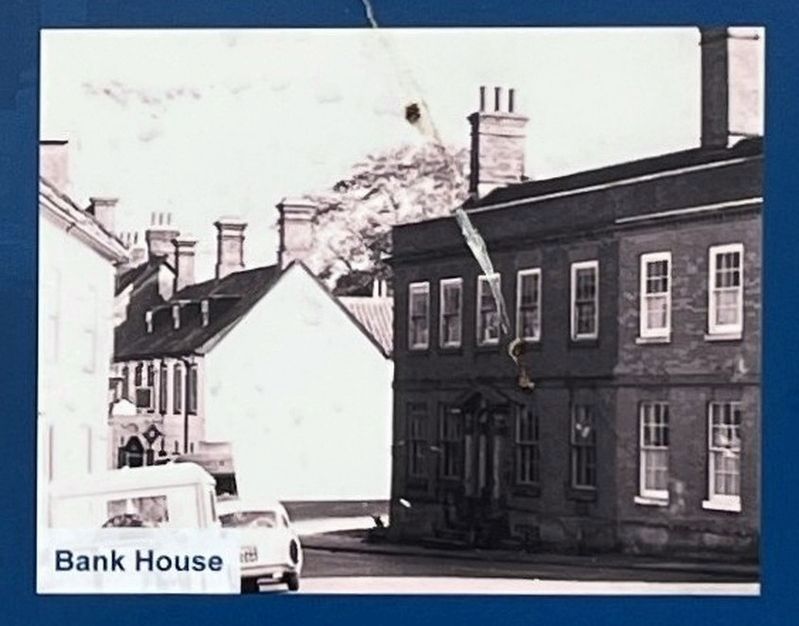
The abolitionist of Bank House
Priscilla Buxton was the daughter of one anti-slavery campaigner and wife of another. But she was so much more than just a daughter and a wife. Her work was as influential as theirs.
Priscilla did much of the work for her father's Anti-Slavery Society, but as a woman was not allowed to be a member. Neither could she go into Parliament to hear her father speak - she had to listen to him through a ventilation shaft!
Despite these obstacles, in 1832 Priscilla became the co-secretary of the London Female Anti-Slavery Society. She organised the largest petition demanding the end of slavery, collecting 187,000 women's signatures. When the petition was presented to parliament the MPs just laughed at it!
She married Andrew Johnson, a colleague of her father's, and prominent banker. They lived in Bank House just next to where you are standing and where you can see a plaque that records her anti-slavery work.
After her early death in 1852, her husband raised funds to build a school in a lane off Rectory Street, renamed School Lane. You can still see an inscription on the front dedicated to her - a lasting memorial to a powerful 'wife and daughter'.
On the south side of St Mary's Church, is a carving of an African head. Is it a reminder of the abolition of slavery and the pioneering work of Priscilla Buxton?
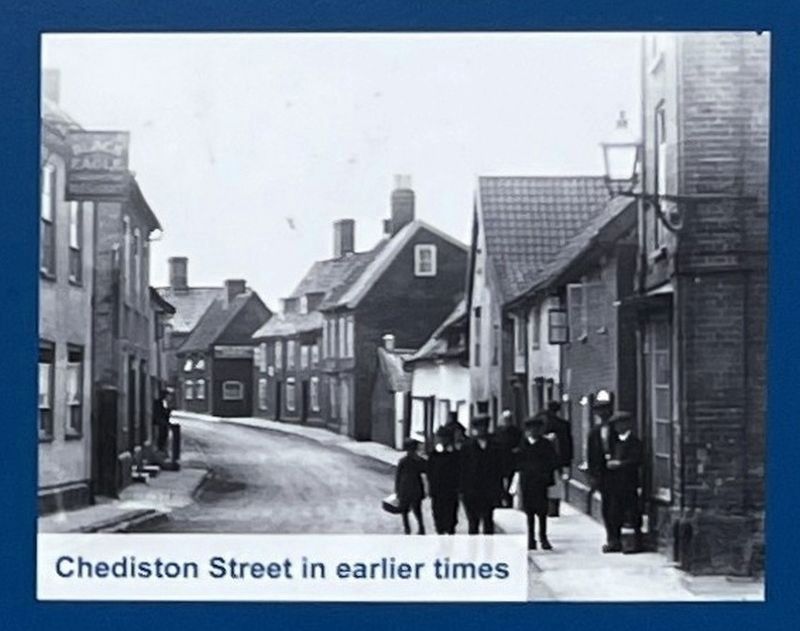
Chediston Street
Are you ready to rough it? Walk straight on, passing the Market Place, and you reach Chediston Street. According to folklore, it was the rough end of town in Victorian times. This would seem to be borne out by statistics. In 1851, it was the most crowded area of Halesworth, with 47% of the town's population living here. These included 32 people described as paupers, 181 children and 142 old people. Many of the common alehouses were probably in Chediston Street - several were unlicensed and they were often disorderly. In an early sociological study of Suffolk from 1855, John Glyde showed that Halesworth topped the county league for criminality. He wrote:
"if we trace the course of the cloud of delinquency we will find them hovering with a medium tint over the majority of our towns, but over the border town of Bungay and the small town of Halesworth, it lours [threatens] with a more gloomy aspect..."
We hope you'll agree that, happily, today's Chediston Street presents a very different aspect!
The last public execution in Suffolk
Are you intrigued by whodunnits? In 1862, the murder of Police Constable Ebenezer Tye, in the vicinity of Chediston Street, caused a significant stir in Halesworth and beyond. The young PC, who had only 18 months' service, was found dead in a small brook. His uniformed body was completely immersed in the water, with his hat resting a few yards upstream. An old cap was found discarded nearby. Tye's body was laid out at The Angel Hotel. Much circumstantial evidence led to the arrest of John Ducker, a resident of Chediston Street, labourer and former wrestler who was known to the police and had a reputation as a petty thief. While doubts still remain today as to whether he should have been found guilty, Ducker was convicted of Tye's murder and, in 1863, was the last man to suffer public execution in Suffolk. The hanging was witnessed by a crowd of around 4,000, many of whom had walked some 25 miles to see the spectacle in Ipswich. The body was left dangling above the Ipswich rooftops for over an hour as a warning to other potential wrong-doers. Thankfully this particular deterrent is no longer used!
Topics. This historical marker is listed in these topic lists: Civil Rights • Law Enforcement • Notable Places • Women.
Location. 52° 20.582′ N, 1° 30.149′ E. Marker is in Halesworth, England, in Suffolk. It is at the intersection of Thoroughfare and Angel Link, on the right when traveling east on Thoroughfare. Touch for map. Marker is at or near this postal address: 30 Thoroughfare, Halesworth, England IP19 8AP, United Kingdom. Touch for directions.

Regionally, this marker is in East Anglia. Globally, it is on the Atlantic Ocean, in the North Atlantic Region, in Europe, in Atlantic Europe, on one of the British Isles, in the Western World, and in the Anglosphere. Historically, it finds itself in what was once the Roman Empire.
Other nearby markers. At least 8 other markers are within walking distance of this marker: The Angel Yard Maltings (here, next to this marker); Over the Centuries (within shouting distance of this marker); Discover in and around the Thoroughfare (about 90 meters away, measured in a direct line); Discover in and around the Market Place (about 90 meters away); Church of St Mary the Virgin (about 90 meters away); Discover two ways to explore the town (about 210 meters away); The Old Rectory; Land Girls (about 210 meters away); Discover what used to be here (approx. 0.3 kilometers away). Touch for a list and map of all markers in Halesworth.
Credits. This page was last revised on November 19, 2026. It was originally submitted on November 15, 2026, by Ray Gurganus of Washington, District of Columbia. This page has been viewed 8 times since then. Photos: 1, 2, 3, 4. submitted on November 15, 2026, by Ray Gurganus of Washington, District of Columbia. • Andrew Ruppenstein was the editor who published this page.
Editor’s want-list for this marker. photo of the marker within its surroundings • Can you help?
