Caruthersville in Pemiscot County, Missouri — The American Midwest (Upper Plains)
Caruthersville
Photographed by Craig Swain, August 31, 2010
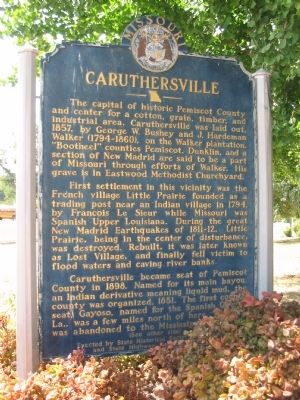
1. Caruthersville Marker
The capital of historic Pemiscot County and center for a cotton, grain, timber, and industrial area, Caruthersville was laid out, 1857, by George W. Bushey and J. Hardeman Walker (1794-1860), on the Walker plantation. "Bootheel" counties Pemiscot, Dunklin, and a section of New Madrid are said to be part of Missouri through efforts of Walker. His grave is in Eastwood Methodist Churchyard.
First settlement in this vicinity was the French village of Little Prairie founded as a trading post near an Indian village in 1794, by Francois Le Sieur while Missouri was Spanish Upper Louisiana. During the great New Madrid Earthquakes of 1811-12, Little Prairie, being in the center of disturbance, was destroyed. Rebuilt, it was later known as Lost Village, and finally fell victim to flood waters and caving river bank.
Caruthersville became seat of Pemiscot County in 1898. Named for its main bayou, an Indian derivative meaning liquid mud, the county was organized, 1851. The first county seat, Gayoso, named for the Spanish Gov. of La., was a few miles north of here. The site was abandoned to the Mississippi River.
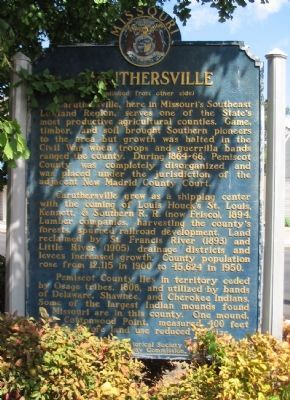
(Reverse):
this page online
Caruthersville grew as a shipping center with the coming of Louis Houck's St. Louis, Kennett, & Southern R.R. (now Frisco), 1894. Lumber companies, harvesting the county's forests, spurred railroad development. Land reclaimed by St. Francis River (1893) and Little River (1905) drainage districts and levees increased growth. County population rose from 12,115 in 1900 to 45,624 in 1950.
Pemiscot County lies in territory ceded by Osage tribes, 1808, and utilized by bands of Delaware, Shawnee, and Cherokee Indians. Some of the largest Indian mounds found in Missouri are in this county. One mound, near Cottonwood Point, measured 400 feet by 250 before land use reduced its size.
Erected 1957 by State Historical
Photographed by Craig Swain, August 31, 2010
2. Reverse of Marker
Topics and series. This historical marker is listed in these topic lists: Agriculture • Indigenous Peoples and Communities • Industry & Commerce • Railroads & Streetcars • Settlements & Settlers • War, US Civil. In addition, it is included in the Daughters of the American Revolution (DAR), and the Missouri, The State Historical Society of series lists. A significant historical year for this entry is 1857.
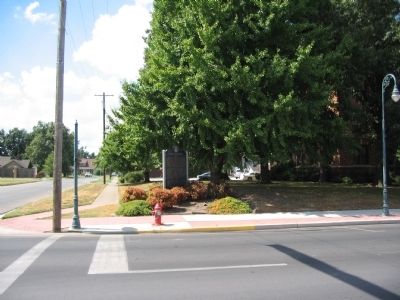
Location. 36° 11.359′ N, 89° 39.414′ W. Marker is in Caruthersville, Missouri, in Pemiscot County. It is at the intersection of Ward Avenue and 7th Street, on the right when traveling south on Ward Avenue. Located in front of the Pemiscot County Courthouse. Touch for map. Marker is in this post office area: Caruthersville MO 63830, United States of America. Touch for directions.

Regionally, this marker is in the Missouri Bootheel. It is also in the American Midwest, in the Mississippi Delta, in the Lewis & Clark Corridor, in the Corn Belt, and in the Great River Road Region. Globally, it is in North America, the Western Hemisphere, the Western World,
Photographed by Craig Swain, August 31, 2010
3. Caruthersville Marker
Other nearby markers. At least 8 other markers are within 17 miles of this marker, measured as the crow flies: Pemiscot County (within shouting distance of this marker); General John M. Riggs (approx. 0.3 miles away); Sterling Price Reynolds (approx. 0.3 miles away); American Legion Post 88 Memorial Park (approx. 0.6 miles away); Lt. Col. John B. England (approx. 1.2 miles away); Hayti School Building (approx. 5.8 miles away); General Clifton Bledsoe Cates (approx. 16.2 miles away in Tennessee); Capture of Island No. 10 (approx. 16.2 miles away in Tennessee). Touch for a list and map of all markers in Caruthersville.
Photographed by Craig Swain, August 31, 2010
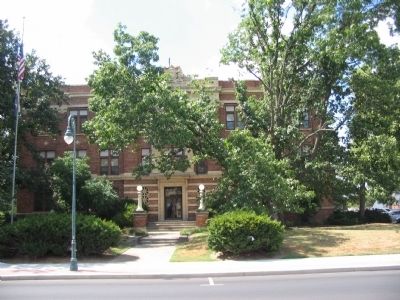
4. Pemiscot County Courthouse
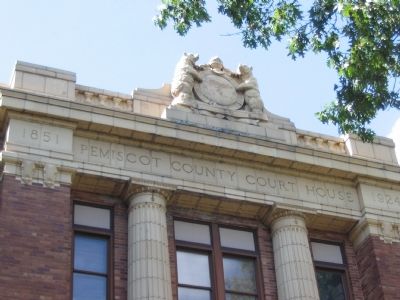
Photographed by Craig Swain, August 31, 2010
5. State Crest at top of Front of Courthouse
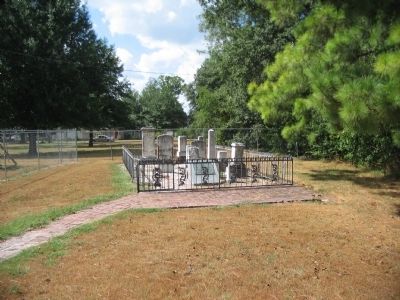
Photographed by Craig Swain, August 31, 2010
6. Methodist Church Graveyard
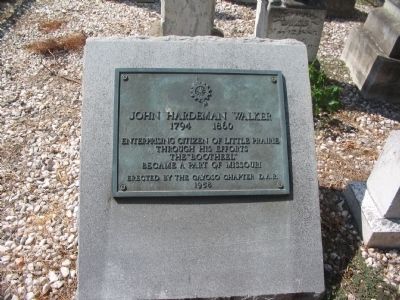
Photographed by Craig Swain, August 31, 2010
7. John Hardeman Walker
Enterprising citizen of Little Prairie
through his efforts
the "Bootheel"
became a part of Missouri
Erected by the Gayoso Chapter D.A.R.
1958
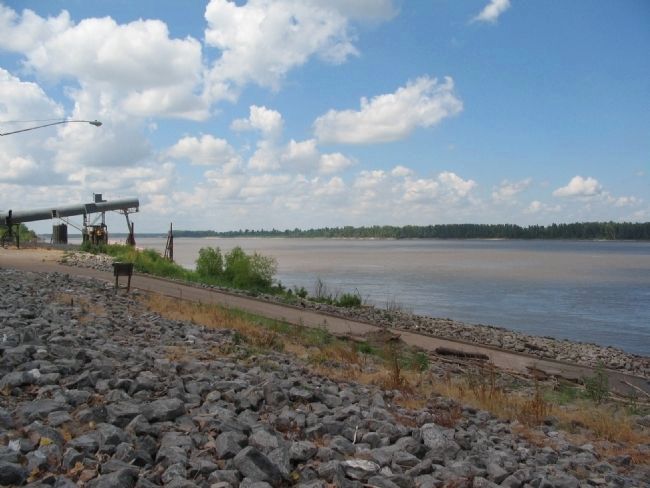
Photographed by Craig Swain, August 31, 2010
8. Mississippi River at Caruthersville
The town is still an active riverport. A elevator just over the town's levee loads grain into barges for shipment along the river.
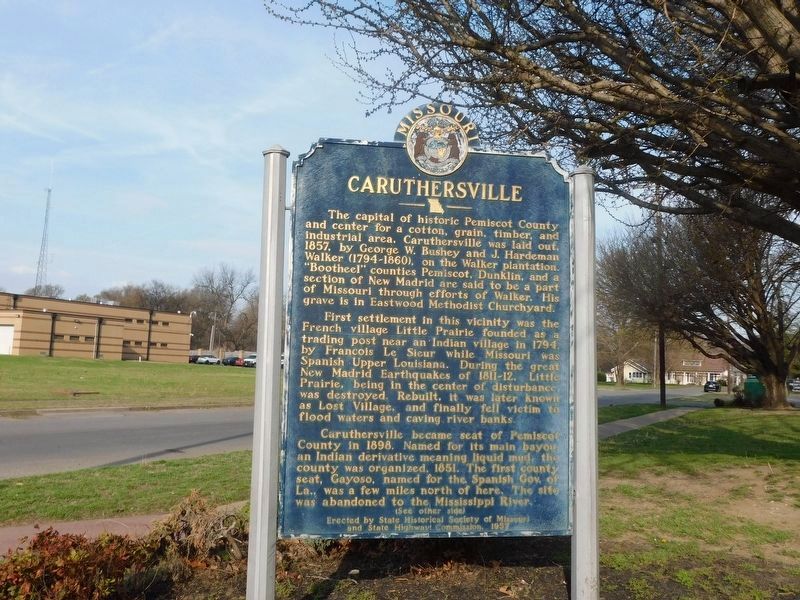
Photographed by Jimmy Emerson, March 25, 2026
9. Caruthersville Marker
Credits. This page was last revised on April 2, 2026. It was originally submitted on September 27, 2010, by Craig Swain of Leesburg, Virginia. This page has been viewed 2,935 times since then and 163 times this year. Photos: 1, 2, 3, 4, 5, 6, 7, 8. submitted on September 27, 2010, by Craig Swain of Leesburg, Virginia. 9. submitted on March 29, 2026, by Jimmy Emerson of Dalton, Georgia.
