Shockoe Bottom in Richmond, Virginia — The American South (Mid-Atlantic)
Lumpkin's Jail
| — | Richmond Slave Trail | — |
(left panel)
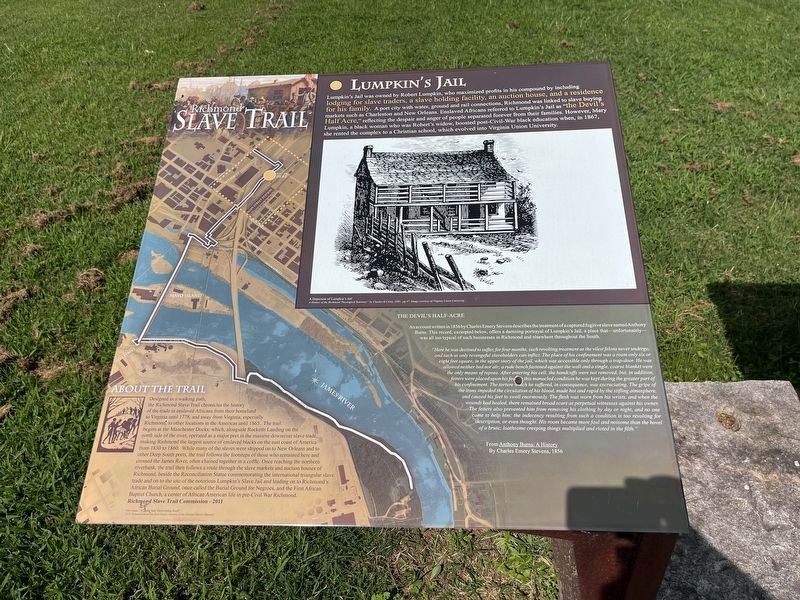
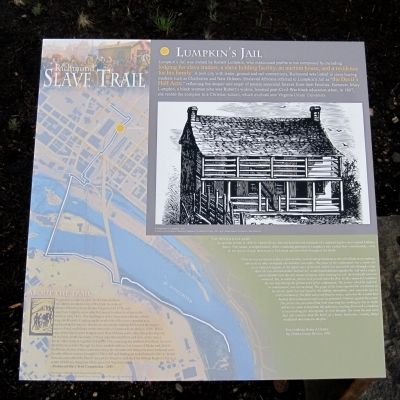
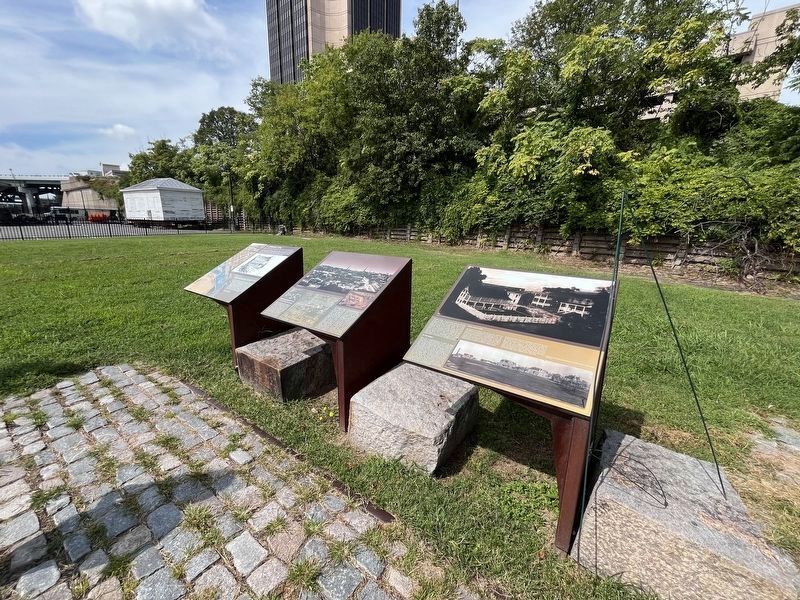
Lumpkin’s Jail was owned by Robert Lumpkin, who maximized profits in his compound by including lodging for slave traders, a slave holding facility, an auction house, and a residence for his family. A port city with water, ground and rail connections, Richmond was linked to slave buying markets such as Charleston and New Orleans. Enslaved Africans referred to Lumpkin’s Jail as “the Devil’s Half Acre,” reflecting the despair and anger of people separated forever from their families. However, Mary Lumpkin, a black woman who was Robert’s widow, boosted post-Civil-War black education when, in 1867, she rented the complex to a Christian school, which evolved into Virginia Union University.
The Devil’s Half-Acre
An account written in 1856 by Charles Emery Stevens describes the treatment of a captured fugitive slave named Anthony Burns. This record, excerpted below, offers a damning portrayal of Lumpkin’s Jail, a place that—unfortunately—was all too typical of such businesses in Richmond and elsewhere throughout the South.
“Here he was destined to suffer, for four months, such revolting treatment as the vilest felons never undergo, and such as only revengeful slaveholders can inflict. The place of his confinement was a room only six or eight feet square, in the upper story of the jail, which was accessible only through a trap-door. He was allowed neither bed nor air; a rude bench fastened against the wall and a single, coarse blanket were the only means of repose. After entering his cell, the handcuffs were not removed, but, in addition, fetters were placed upon his feet. In this manacled condition he was kept during the greater part of his confinement. The torture which he suffered, in consequence, was excruciating. The gripe of the irons impeded the circulation of his blood, made hot and rapid by the stifling atmosphere, and caused his feet to swell enormously. The flesh was worn from his wrists, and when the wounds had healed, there remained broad scars as perpetual witnesses against his owner. The fetters also prevented him from removing his clothing by day or night, and no one came to help him; the indecency resulting from such a condition is too revolting for description, or even thought. His room became more foul and noisome than the hovel of a brute; loathsome creeping things multiplied and rioted in the filth.”
FromAnthony Burns: A History
Click or scan to see
this page online
By Charles Emery Stevens, 1856
About the Trail
Designed as a walking path, the Richmond Slave Trail chronicles the history of the trade in enslaved Africans from their homeland to Virginia until 1778, and away from Virginia, especially Richmond, to other locations in the Americas until 1865. The trail begins at the Manchester Docks, which, alongside Rocketts Landing on the north side of the river, operated as a major port in the massive downriver slave trade, making Richmond the largest source of enslaved blacks on the east coast of America from 1830 to 1860. While many of the slaves were shipped on to New Orleans and to other Deep South ports, the trail follows the footsteps of those who remained here and crossed the James River, often chained together in a coffle. Once reaching the northern riverbank, the trail then follows a route through the slave markets and auction houses of Richmond, beside the Reconciliation Statue commemorating the international triangular slave trade and on to the site of the notorious Lumpkin’s Slave Jail and leading on to Richmond’s African Burial Ground, once called the Burial
(center panel)
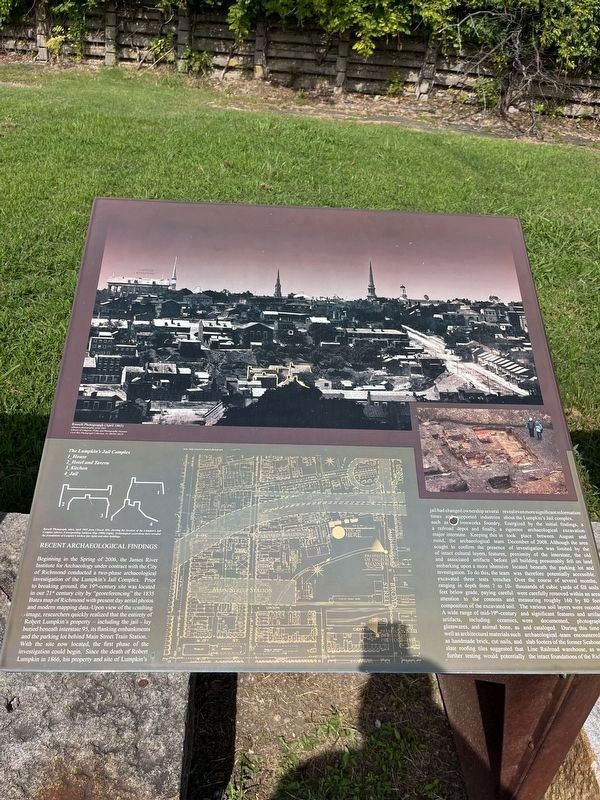
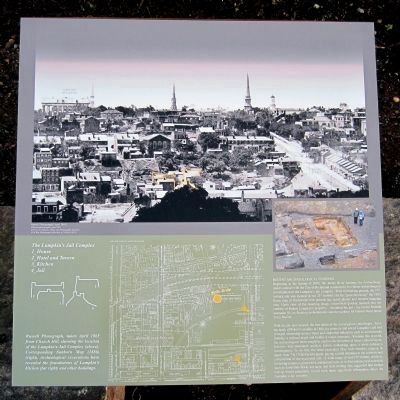
The Lumpkin’s Jail Complex
1_House
2_Hotel and Tavern
3_Kitchen
4_Jail
Russell Photograph, taken April 1865 from Church Hill, showing the location of the Lumpkin’s Jail Complex (above). Corresponding Sanborn Map (1886) (right). Archeological excavations have revealed the foundations of Lumpkin’s kitchen (far right) and other buildings.
Recent Archaeological Findings
Beginning in the Spring of 2006, the James River Institute for Archaeology under contract with the City of Richmond conducted a two-phase archaeological investigation of the Lumpkin’s Jail Complex. Prior to breaking ground, the 19th-century site was located in our 21st century city by “georeferencing” the 1835 Bates map of Richmond with present day aerial photos and modern mapping data. Upon view of the resulting images, researchers quickly realized that the entirety of Robert Lumpkin’s property – including the jail – lay buried beneath interstate 95, its flanking embankments and the parking lot behind Main Street Train Station.
Energized by the initial findings, a rigorous archaeological excavation took place between August and December of 2008. Although the area of investigation was limited
Photographed by Bernard Fisher, April 16, 2011
4. Lumpkin's Jail Marker (left panel, original version)
While the information is identical, the formatting is slightly different from the current version of the marker.
(right panel)
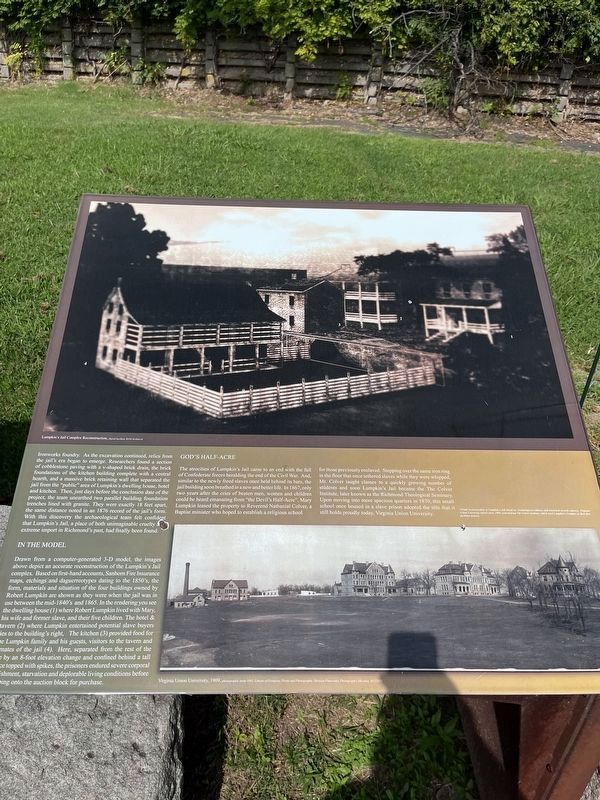
…Ironworks foundry. As the excavation continued, relics from the jail’s era began to emerge. Researchers found a section of cobblestone paving with a v-shaped brick drain, the brick foundations of the kitchen building complete with a central hearth, and a massive brick retaining wall that separated the jail from the “public” area of Lumpkin’s dwelling house, hotel and kitchen. Then, just days before the conclusion date of the project, the team unearthed two parallel building foundation trenches lined with granite. They were exactly
Photographed by Bernard Fisher, April 16, 2011
5. Lumpkin's Jail Marker (center panel, original version)
While the information is identical, the formatting is slightly different from the current version of the marker.
In the Model
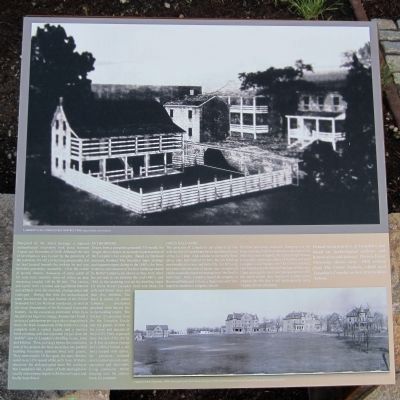
Drawn from a computer-generated 3-D model, the images above depict an accurate reconstruction of the Lumpkin’s Jail complex. Based on first-hand accounts, Sanborn Fire Insurance maps, etchings and daguerreotypes dating to the 1850’s, the form, materials and situation of the four building owned by Robert Lumpkin are shown as they were when the jail was in use between the mid-1840’s and 1865. In the rendering you see the dwelling house (1) where Robert and lived with Mary, his wife and former slave, and their five children. The hotel & tavern (2) where Lumpkin entertained potential slave buyers lies to the building’s right, The kitchen (3) provided food for the Lumpkin family and his guests, visitors to the tavern and inmates of the jail (4). Here, separated from the rest of the site by an 8-foot elevation change and confined behind a tall fence topped with spikes,
Photographed by Bernard Fisher, April 16, 2011
6. Lumpkin's Jail Marker (right panel, original version)
While the information is identical, the formatting is slightly different from the current version of the marker.
God’s Half-Acre
The atrocities of Lumpkin’s Jail came to an end with the fall of Confederate forces heralding the end of the Civil War. And, similar to the newly freed slaves once held behind its bars, the jail building soon breathed in a new and better life. In 1867, only two years after the cries of beaten men, women and children could be heard emanating from “the Devil’s Half-Acer”, Mary Lumpkin leased the property to Reverend Nathanial Colver, a Baptist minister who hoped to establish a religious school for those previously enslaved. Stepping over the same iron ring in the floor that once tethered slaves while they were whipped, Mr. Colver taught classes to a quickly growing number of students and soon Lumpkin’s Jail became The Colver Institute, later known as the Richmond Theological Seminary. Upon moving into more spacious quarters in 1870, this small school once housed in a slave prison adopted the title it still holds proudly today, Virginia Union University.
Virtual reconstruction of Lumpkin’s Jail based on Archeological evidence and historical records (above). Virginia Union University, shown circa 1909, evolved from The Colver Institute, which used Lumpkin’s Complex as their first facilities (below).
Erected 2011
Topics and series. This historical marker is listed in these topic lists: Abolition & Underground RR • African Americans • Education • Law Enforcement. In addition, it is included in the Historically Black Colleges and Universities series list. A significant historical year for this entry is 1856.
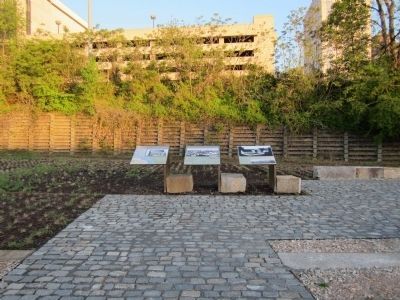
Location. 37° 32.196′ N, 77° 25.712′ W. Marker is in Richmond, Virginia. It is in Shockoe Bottom. It can be reached from East Franklin Street east of North 15th Street, on the left when traveling east. These markers are located in a parking lot between E Franklin St and Broad St just east of I-95. Touch for map. Marker is in this post office area: Richmond VA 23219, United States of America. Touch for directions.

Regionally, this marker is in Central Virginia. It is also in the American South and specifically in the Upper South. Globally, it is in North America, the Western Hemisphere, the Western World, and the Anglosphere. Historically, it finds itself in what was once the territory of the Mississippian Culture, one of the original Thirteen Colonies, one of
Photographed by Bernard Fisher, April 16, 2011
8. Lumpkin's Jail Markers
Other nearby markers. At least 8 other markers are within walking distance of this marker: Winfree Cottage (within shouting distance of this marker); Gabriel Prosser Execution Site (within shouting distance of this marker); Execution of Gabriel (about 300 feet away); Richmond’s African Burial Ground (about 600 feet away); First African Baptist Church (about 700 feet away); a different marker also named First African Baptist Church (about 700 feet away); Kahal Kadosh Beth Shalome (about 800 feet away); The Triangle (approx. 0.2 miles away). Touch for a list and map of all markers in Richmond.
Other markers no longer nearby. Lumpkins Jail (was within shouting distance of this marker but has been reported to have been replaced with another marker now near it); The Slave Trade In Richmond (was within shouting distance of this marker but has been reported to have been replaced with another marker now near it); Old Negro Burial Ground (was about 300 feet away, measured in a direct line but has been replaced with another marker now near it); a different marker also named
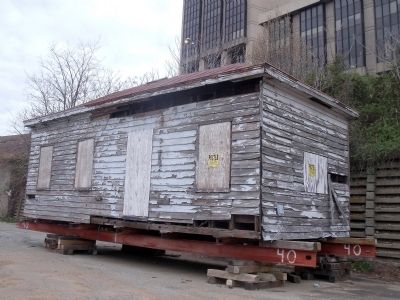
Photographed by Bernard Fisher, March 5, 2011
9. Winfree Cottage at Lumpkin's Jail Site
Winfree Cottage, the only remaining Slave Cottage in Richmond, is scheduled for renovation as an exhibit.
Related markers. Click here for a list of markers that are related to this marker. Old Markers At This Location titled "The Slave Trade In Richmond" and "Lumpkins Jail".
Also see . . .
1. Lumpkin's Slave Jail, City of Richmond, Virginia. James River Institute for Archaeology (Submitted on November 12, 2021.)
2. Lumpkin's Jail. Wikipedia (Submitted on September 9, 2024.)
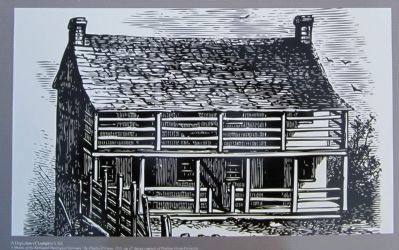
10. A depiction of Lumpkin’s Jail
A History of the Richmond Theological Seminary” by Charles H. Covey, 1895, pg. 47. Image courtesy of Virginia Union University
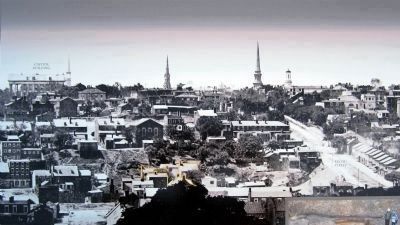
11. Russell Photograpgh (April 1865)
albumen photographic print 1865, Library of Congress, Prints and Photographic Division, Civil War Photograph Collection, LC-B8184-10228
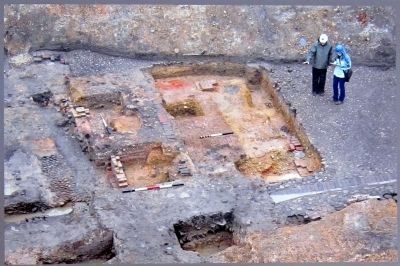
12. Foundations of Lumpkin’s kitchen
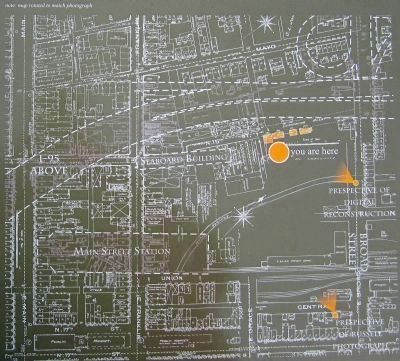
13. Sanborn Map (1886)
note: map rotated to match photograph
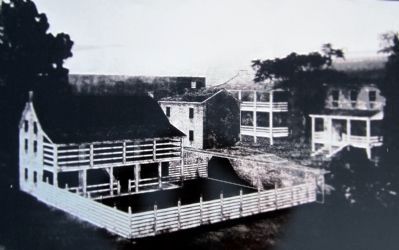
14. Lumpkin’s Jail Complex Reconstruction, digital medium, BAM Architects
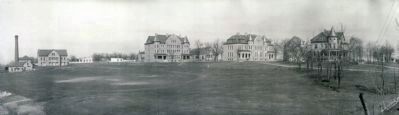
Photographed by Haines Photo Co., circa 1909
15. Union University, Richmond, Va.
Virginia Union University, 1909, photographic print 1865, Library of Congress, Prints and Photographic Division Panoramic Photograph Collection, H127833
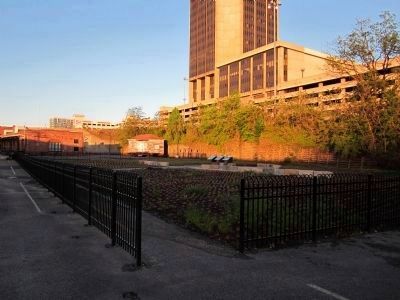
Photographed by Bernard Fisher, April 16, 2011
16. Lumpkin's Jail Site
Winfree Cottage can be seen in the background
Credits. This page was last revised on September 9, 2024. It was originally submitted on April 20, 2011, by Bernard Fisher of Richmond, Virginia. This page has been viewed 4,246 times since then and 291 times this year. Photos: 1, 2, 3. submitted on September 9, 2024, by Devry Becker Jones of Washington, District of Columbia. 4, 5, 6. submitted on April 20, 2011, by Bernard Fisher of Richmond, Virginia. 7. submitted on September 9, 2024, by Devry Becker Jones of Washington, District of Columbia. 8, 9, 10, 11, 12, 13, 14, 15, 16. submitted on April 20, 2011, by Bernard Fisher of Richmond, Virginia.
