Shockoe Slip in Richmond, Virginia — The American South (Mid-Atlantic)
Reconciliation Statue
Dedicated 2007 CE
| — | Richmond Slave Trail | — |
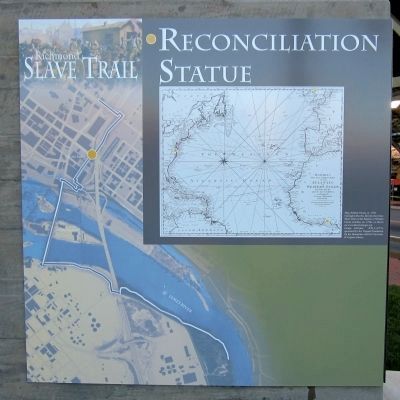
Photographed by Bernard Fisher, April 16, 2011
1. Reconciliation Statue Marker (south panel)
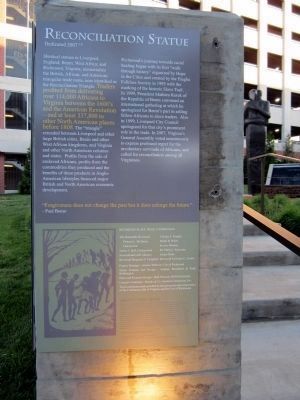
Identical statues in Liverpool, England; Benin, West Africa; and Richmond, Virginia, memorialize the British, African, and American triangular trade route, now identified as the Reconciliation Triangle. Traders profited from delivering over 114,000 Africans to Virginia between the 1600’s and the American Revolution – and at least 337,800 to other North American places before 1808. The “triangle” extended between Liverpool and other large British cities, Benin and other West African kingdoms, and Virginia and other North American colonies and states. Profits from the sale of enslaved Africans, profits from the commodities they produced and the benefits of these products in Anglo-American lifestyles financed major British and North American economic development.
Richmond’s journey towards racial healing began with its first “walk through history” organized by the Elegba Folklore Society in 1993 with the marking of the historic Slave Trail. In 1999, President Mathieu Kerek of the republic of Benin convened an international gathering at which he apologized for Benin’s part in selling fellow Africans to slave traders. Also
this page online
"Forgiveness does not change the past but it does enlarge the future." - Paul Boese
Richmond Slave Trail Commission
The Honorable Reverend Delores L. McQuinn, Chairperson • Janine Y. Bell, Chairperson • Nessa Baskerville • Johnson • Reverend Benjamin P. Campbell • Charles S. Vaughan • Ralph R. White • Kennis Wooten • Dr. Philp J. Schwartz • Jennie Dotts • Reverend Sylvester L. Turner • Project Manager – Jeannie Welliver, City of Richmond • Statue Sculptor and Design – Stephen Broadbent & Faith Bebbington • Plaza and Fountain Design – Burt Pinnock, BAM Architects • General Contractor – Brooks & Co. General Contractors, Inc.
This installation made possible by the generosity and cooperation of the Commonwealth of Virginia and the City of Richmond.
About the Trail
Designed as a walking path, the Richmond Slave Trail chronicles the history of the trade in enslaved Africans
Photographed by Bernard Fisher, April 16, 2011
2. Reconciliation Statue Marker (east panel)
Title image: “After the Sale: Slaves Going South”, 1853, Painted from live by Eyre Crowe, courtesy the Chicago History Museum
Erected 2011
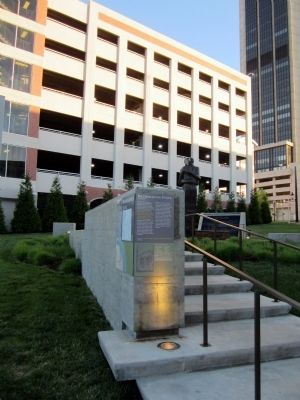
Photographed by Bernard Fisher, April 16, 2011
3. Reconciliation Statue at E Main St & N 15th St
Topics. This historical marker is listed in these topic lists: African Americans • Colonial Era • Industry & Commerce • Peace. A significant historical year for this entry is 1808.
Location. This marker has been replaced by another marker nearby. It was located near 37° 32.085′ N, 77° 25.825′ W. Marker was in Richmond, Virginia. It was in Shockoe Slip. It was at the intersection of East Main Street (U.S. 60) and North 15th Street, on the left when traveling east on East Main Street. Touch for map. Marker was in this post office area: Richmond VA 23219, United States of America. Touch for directions.

Regionally, this marker was in Central Virginia. It was also in the American South and specifically in the Upper South. Globally, it was in North America, the Western Hemisphere, the Western World, and the Anglosphere. Historically, it found itself in what was once the territory of the Mississippian Culture, one of the original Thirteen Colonies, one of the Confederate States of America, and the Antebellum South.
Other nearby markers. At least 8 other

4. Map, Atlantic Ocean, ca. 1794
Carrington Bowles, Bowles New One-Sheet Chart of the Atlantic or Western Ocean (London, ca. 1794). As shown on www.slaveryimages.org (image reference JCB_C-6717), sponsored by the Virginia Foundation for the Humanities and the University of Virginia Library.
Other markers no longer nearby. Slave Trade Reconciliation Triangle (was here, next to this marker but has been reported to have been replaced with another marker now near it); Odd Fellows Hall (was within shouting distance of this marker but has been replaced with another marker now near it); Slave Auction Site (was within shouting distance of this marker but has been confirmed missing); Davenport Trading Company (was about 500 feet away, measured in a direct line but has been replaced with another marker now near it).
Related marker. Click here for another marker that is related to this marker. Old Marker At This Location titled "Slave Trade Reconciliation Triangle".
Credits. This page was last revised on September 7, 2024. It was originally submitted on April 20, 2011, by Bernard Fisher of Richmond, Virginia. This page has been viewed 3,285 times since then and 78 times this year. Photos: 1, 2, 3, 4. submitted on April 20, 2011, by Bernard Fisher of Richmond, Virginia.
