
Canton in Norfolk County, Massachusetts — The American Northeast (New England)
Ponkapoag Plantation
1630 - 1930
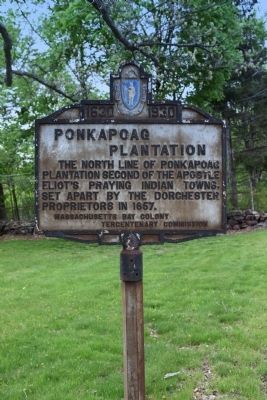
Photographed by Russell C. Bixby, May 9, 2011
1. Ponkapoag Plantation Marker
The north line of Ponkapoag Plantation second of the Apostle Eliot's Praying Indian towns, set apart by the Dorchester Proprietors in 1657.
Erected 1930 by Massachusetts Bay Colony-Tercentenary Commission.
Topics and series. This historical marker is listed in these topic lists: Colonial Era • Indigenous Peoples and Communities • War, French and Indian. In addition, it is included in the King Philip's War 1675-1676 series list. A significant historical year for this entry is 1657.
Location. 42° 11.932′ N, 71° 7.152′ W. Marker is in Canton, Massachusetts, in Norfolk County. It is on Washington Street (Massachusetts Route 138) south of Homans Lane, on the right when traveling south. Touch for map. Marker is at or near this postal address: 2496 Washington Street, Canton MA 02021, United States of America. Touch for directions.

Regionally, this marker is in Greater Boston. It is also in the American Northeast and in New England. Globally, it is in the North Atlantic Region, North America, the Western Hemisphere, the Western World, and the Anglosphere. Historically, it finds itself in what was once one of the original Thirteen Colonies.
Other nearby markers. At least 8 other markers are within 5 miles of this marker, measured as the crow flies: 54th Infantry / 55th Infantry / 5th Cavalry (approx. 2.6 miles away); Town of Randolph (approx. 3.1 miles away); Canton Viaduct (approx. 3.3 miles away); Canton (approx. 3.4 miles away); Birthplace of U.S. Copper Industry (approx. 3.4 miles away); Fairbanks House (approx. 4 miles away); Vietnam War Memorial
this page online
Another marker is no longer nearby. Dedham (was approx. 4.3 miles away but has been confirmed missing).
Related markers. Click here for a list of markers that are related to this marker. To better understand the relationship, study each marker in the order shown.
Also see . . .
1. Historical Markers Erected by Massachusetts Bay Colony. (Submitted on May 9, 2011, by Russell Chaffee Bixby of Bernardston, Massachusetts.)
2. Deer Island National Park.
Prior to European colonization, Indigenous communities accessed Deer Island seasonally for thousands of years. The colonists pressured Indigenous peoples to convert to Christianity, and those who did moved into separate ‘praying communities.’ Just five months after [King Philips] war began [in 1675], colonists set up an internment camp on Deer Island to relocate "Christianized" Indigenous people whom they believed could turn against the English and join the rebellion.(Submitted on March 23, 2026, by G.W.Bartlett of Hingham, Massachusetts.)
3. The Massachusett Tribe at Ponkapoag.
The Massachusett tribe are the descendants of the original people that the English Invaders first encountered in what is now the Commonwealth of Massachusetts.... ...We continue to survive as Massachusett people because we have retained the oral tradition of storytelling just as our ancestors did.(Submitted on March 23, 2026, by G.W.Bartlett of Hingham, Massachusetts.)
4. Praying town - Wikipedia.
Praying towns were settlements established by English colonial governments in New England from 1646 to 1675 in an effort to convert local Native Americans to Christianity. The Native people who moved into the towns were known as Praying Indians.(Submitted on March 23, 2026, by G.W.Bartlett of Hingham, Massachusetts.)
Credits. This page was last revised on April 6, 2026. It was originally submitted on May 9, 2011, by Russell Chaffee Bixby of Bernardston, Massachusetts. This page has been viewed 1,828 times since then and 104 times this year. Last updated on March 23, 2026, by G.W.Bartlett of Hingham, Massachusetts. Photo 1. submitted on May 9, 2011, by Russell Chaffee Bixby of Bernardston, Massachusetts. • Devry Becker Jones was the editor who published this page.
