Near Fairfax in Fairfax County, Virginia — The American South (Mid-Atlantic)
Battle of Chantilly
(Ox Hill)
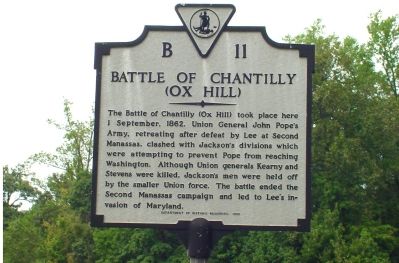
Photographed by J. J. Prats, September 16, 2006
1. Battle of Chantilly (Ox Hill) Marker
Erected 1990 by Department of Historic Resources. (Marker Number B-11.)
Topics and series. This historical marker is listed in this topic list: War, US Civil. In addition, it is included in the Virginia Department of Historic Resources (DHR) series list. A significant historical date for this entry is September 1, 1862.
Location. 38° 52.161′ N, 77° 22.974′ W. Marker is near Fairfax, Virginia, in Fairfax County. It is at the intersection of Fairfax County Parkway (County Route 7100) and Monument Drive, on the right when traveling north on Fairfax County Parkway. Touch for map. Marker is at or near this postal address: 4203 Summit Manor Ct, Fairfax VA 22033, United States of America. Touch for directions.

Regionally,
this page online
Other nearby markers. At least 8 other markers are within walking distance of this marker: Pender (approx. 0.6 miles away); The Death of General Kearny (approx. 0.7 miles away); Maryland (Antietam / Sharpsburg) Campaign (approx. 0.7 miles away); Reid-Ballard House (approx. 0.7 miles away); Battle of Ox Hill (approx. 0.7 miles away); Attack of General Birney’s Brigade (approx. 0.7 miles away); The Battle of "Chantilly" (Ox Hill) — Then & Now (approx. ¾ mile away); Major General Philip Kearny (approx. ¾ mile away). Touch for a list and map of all markers in Fairfax.
Another marker is no longer nearby. The Battle of Ox Hill
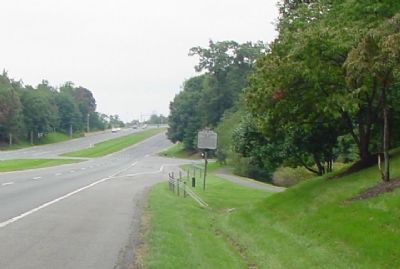
Photographed by J. J. Prats, September 16, 2006
2. Battle of Chantilly (Ox Hill) Marker
The road turning off to the right after the marker is North Lake Drive.
More about this marker. There is an older marker with this same number titled “Campaign of Second Manassas” (which see) a few miles away on Route 50 in Loudoun County.
Also see . . .
1. The Thunderstorm and the Battle of Ox Hill. (Submitted on September 17, 2006.)
2. Tempest at Ox Hill: The Battle of Chantilly. By David A. Welker. Amazon.com page allows you to look inside this 2003 book. (Submitted on September 17, 2006.)
3. Battle of Chantilly, or Ox Hill. Civil War Preservation Trust resource page for the battle. Includes an animated map. (Submitted on September 5, 2008, by Craig Swain of Leesburg, Virginia.)

Photographed by Craig Swain
3. From Manassas to Chantilly
Jackson left the battleground of 2nd Manassas taking Gum Springs Road to the Little River Turnpike (somewhat represented today in that area as US 50). After an uncharacteristically slow march, Jackson brought his men down the Turnpike toward Fairfax City. His objective was the intersection of the Little River and Warrenton Turnpikes (generally the same as modern US 29 in western Fairfax County). However, the Federals had shifted enough to the east to block Jackson.
This view, taken from the overpass of Fairfax Parkway (CR 7100) over US 50 just north of the marker location, offers a view of Jackson's approach. In the far distance to the left (south) of the highway is the northern end of the Bull Run Mountains.
This view, taken from the overpass of Fairfax Parkway (CR 7100) over US 50 just north of the marker location, offers a view of Jackson's approach. In the far distance to the left (south) of the highway is the northern end of the Bull Run Mountains.
Credits. This page was last revised on July 7, 2021. It was originally submitted on September 17, 2006, by J. J. Prats of Powell, Ohio. This page has been viewed 3,146 times since then and 48 times this year. Last updated on June 3, 2012. Photos: 1, 2. submitted on September 17, 2006, by J. J. Prats of Powell, Ohio. 3. submitted on May 26, 2008, by Craig Swain of Leesburg, Virginia. • Craig Swain was the editor who published this page.
