Eastport in Annapolis in Anne Arundel County, Maryland — The American Northeast (Mid-Atlantic)
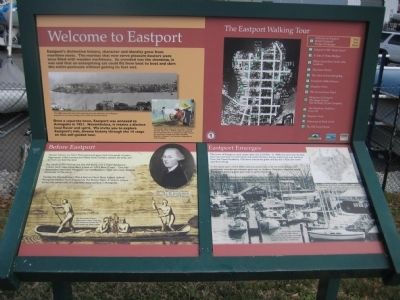
Welcome to Eastport
| — | Eastport Walking Tour | — |
Photographed by F. Robby, January 28, 2008
1. Welcome to Eastport Marker
Eastport's distinctive history, character and identity grew from maritime roots. The marinas that now serve pleasure boaters were once filled with wooden workboats. So crowded was the shoreline, it was said that an enterprising cat could flit from boat to boat and skirt the entire peninsula without getting its feet wet.
Once a separate town, Eastport was annexed to Annapolis in 1951. Nevertheless, it retains a distinct local flavor and spirit. We invite you to explore Eastport's rich, diverse history through the 14 stops on this self-guided tour.
[Caption:]
The popular yellow flags with the motto "We like it this way" flew first in 1998. To offset the potential loss to businesses from a temporary bridge closure, the community created the mock "Maritime Republic of Eastport" and declared independence from Annapolis.
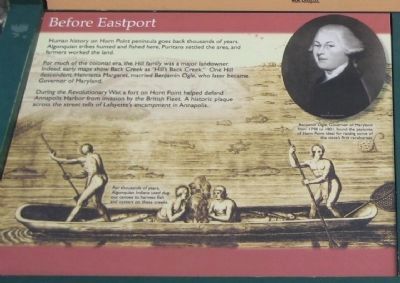
Before Eastport
Human history on Horn Point peninsula goes back thousands of years. Algonquin tribes hunted and fished here, Puritans settled the area, and farmers worked the land.
For much of the colonial era, the Hill family was a major landowner. Indeed, early maps show Back Creek as "Hill's
this page online
During the Revolutionary War, a fort on Horn Point helped defend Annapolis Harbor from invasion by the British Fleet. A historic plaque across the street tells of Lafayette's encampment in Annapolis.
[Captions:]
Benjamin Ogle, Governor of Maryland from 1798 to 1801, found the pastures of Horn Point ideal for raising some of the state's first racehorses.
For thousands of years, Algonquin Indians used dugout canoes to harvest fish and oysters on these creeks.
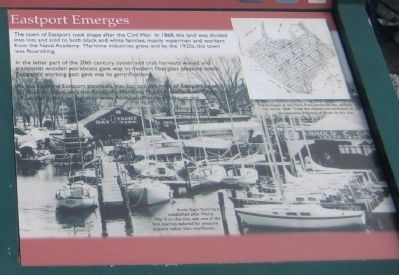
Eastport Emerges
The town of Eastport took shape after the Civil War. In 1868, the land was divided into lots and sold to both black and white families, mainly watermen and workers from the Naval Academy. Maritime industries grew, and by the 1920s, the town was flourishing.
In the latter part of the 20th century, oyster and crab harvests waned and the traditional wooden workboats gave way to modern fiberglass pleasure boats. Eastport's working past gave way to gentrification.
As you tour the Eastport peninsula, you can still see hints of Eastport's
Photographed by F. Robby, January 28, 2008
2. Before Eastport
Closeup of the Before Eastport section of the marker.
[Captions:]
The farmland of the Horn Point peninsula was divided into lots in 1868. Today the streets are numbered in the opposite direction of those on this plat.
Arnie Gay's Yacht Yard, established after World War II on this site, was one of the first marinas tailored for pleasure boaters rather than workboats.
Erected by Chesapeake Bay Gateways Network, Annapolis Maritime Museum, Four Rivers Garden Club. (Marker Number 1.)
Topics. This historical marker is listed in these topic lists: African Americans • Agriculture • Animals • Indigenous Peoples and Communities • Industry & Commerce • Settlements & Settlers • War, US Revolutionary • Waterways & Vessels. A significant historical year for this entry is 1951.
Location. This marker has been replaced by another marker nearby. It was located near 38° 58.282′ N, 76° 29.11′ W. Marker was in Annapolis, Maryland, in Anne Arundel County. It was in Eastport. It was on 6th Street 0.1 miles north of Severn
Photographed by F. Robby, January 28, 2008
3. Eastport Emerges
Closeup of the Eastport Emerges section of the marker.

Regionally, this marker was in Central Maryland. It was also in the American Mid-Atlantic, in the Chesapeake Bay Region, and on the Eastern Seaboard. Globally, it was in the North Atlantic Region, North America, the Western Hemisphere, the Western World, and the Anglosphere. Historically, it found itself in what was once one of the original Thirteen Colonies and also the Antebellum South.
Other nearby markers. At least 8 other markers are within walking distance of this location: A different marker also named Welcome to Eastport (here, next to this marker); Lafayette’s Encampment (within shouting distance of this marker); Eastport Veterans Park (about 400 feet away, measured in a direct line); Eastport's Old Main Street (about 600 feet away); Arnold C. Gay (about 600 feet away); a different marker also named A Tale of Three Bridges (about 700 feet away); "Burnside" (approx. 0.2 miles away); a different marker also named Three Great Boat Yards, One Location
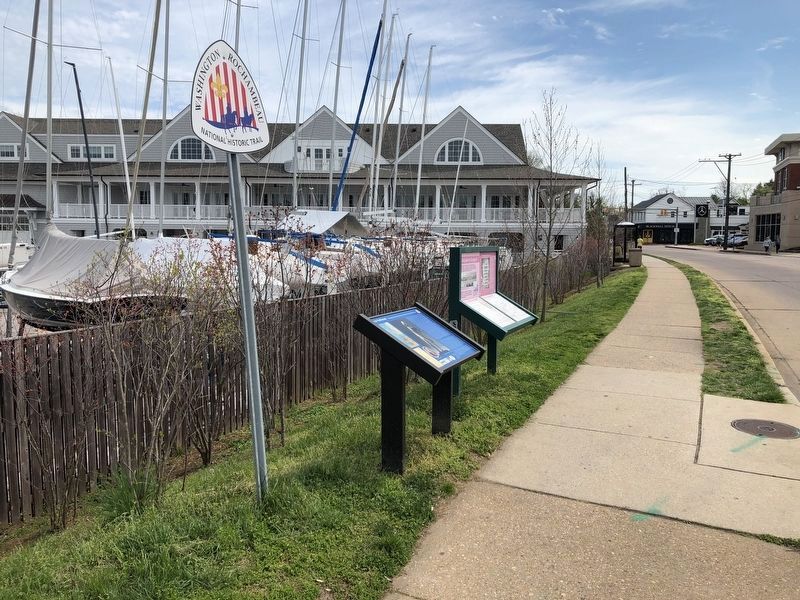
Other markers no longer nearby. On to Yorktown (was here, next to this marker but has been permanently removed); A Tale of Three Bridges (was about 600 feet away but has been replaced with another marker now near it); a different marker also named Eastport's Old "Main Street" (was about 600 feet away but has been replaced with another marker now near it); The Old Farmhouse (was about 800 feet away but has been replaced with another marker now near it); Three Great Boat Yards, One Location (was approx. ¼ mile away but has been replaced with another marker now near it).
Also see . . . Annapolis Maritime Museum. Museum website homepage (Submitted on March 2, 2008, by F. Robby of Baltimore, Maryland.)
Credits. This page was last revised on October 26, 2025. It was originally submitted on March 2, 2008, by F. Robby of Baltimore, Maryland. This page has been viewed 2,478 times since then and 131 times this year. Photos: 1, 2, 3. submitted on March 2, 2008, by F. Robby of Baltimore, Maryland. 4. submitted on April 5, 2020, by Devry Becker Jones of Washington, District of Columbia.
