The Springs
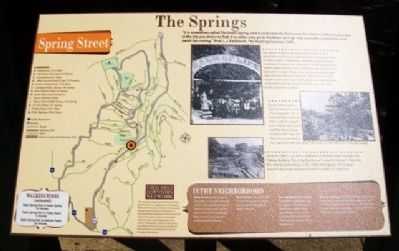
"It is sometimes called The Basin Springs, and is invariably the first resort for visitors. If there is any one in the city you desire to find, if no other way, go to the Basin Springs, seat yourself comfortable, and await his coming."
Prof. L.J. Kalklosch, The Healing Fountain, 1881.
[Inset photo captions read]
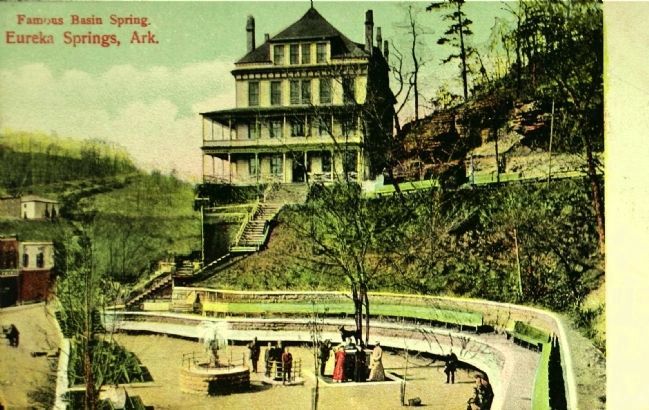
The earliest visitors to this place in the wilderness that would become Eureka Springs were here in desperate need of better health. Long known as a healing spring by Native Americans, the water was thought to cure all kinds of illness. Health-seekers flocked here in 1879, arriving on foot, horseback and in wagons. These were mostly poor people who had exhausted all other remedies. They lived in covered wagons, tents and rough shacks. Days were spent sociably walking from spring to spring with tin cups and water bottles to drink from each.
————————
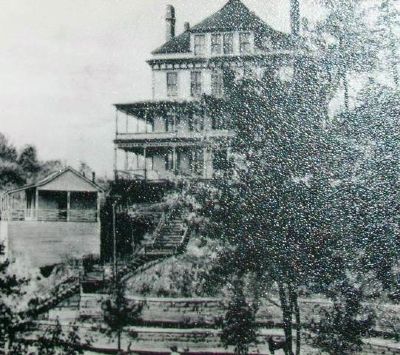
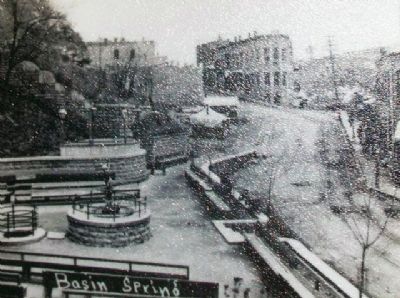
By the 1890s Eureka Springs was becoming a fine spa resort. Basin Park had fine hotels on either side. The Southern Hotel on the south and The Perry House on the north. After The Perry House burned it was replaced
this page online
————————
Since the 1880s, one of the landmarks of Spring Street has been the Flatiron Building. This is the fourth one to stand in this spot. Note the fine new brick buildings in this 1890s photograph. The original wooden structures were destroyed in a series of Great Fires.
In The Neighborhood
Rock House Cave: South of the park is a wooden stairway which is actually Rock House Avenue, a city street. Up the stairs, behind the building is Rock House Cave, viewed only from the stairway.
Bluff Shelter: The Bluff Shelter and the outlet for Basin Springs are on the hillside above the park.
The 1905 Basin Park Hotel: The hotel was noted by Ripley's Believe It or Not as a seven story hotel with a ground floor entrance on each level. Several of these entrances can be seen from the gazebo.
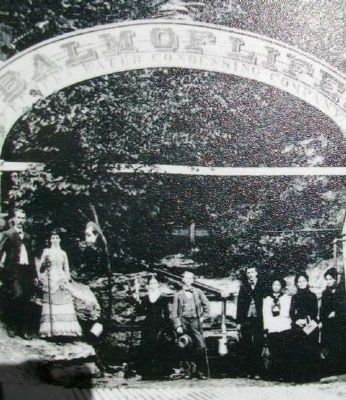
Balm of Life Sign: The arch sign is a replica of an early sign placed over the spring near the current site of the Bandshell. It was a gift to Eureka Springs from the local Rotary Club on the 125th anniversary of the city in 2004.
Landmarks
This material is based upon work assisted by a grant from the U.S. Department of the Interior, National Park Service, a Preserve America grant. Any opinions, findings, and conclusions or recommendations expressed in this material are those of the author and do not necessarily reflect the views of the Department of the Interior. Photographs courtesy of the Cornerstone Bank of Eureka Springs, Eureka Springs Historical Museum and the Eureka Springs Carnegie Public Library.
Erected by Eureka Springs Downtown Network.
Topics. This historical marker is listed in these topic lists: Industry & Commerce • Parks & Recreational Areas • Science & Medicine • Waterways & Vessels. A significant historical year for this entry is 1881.
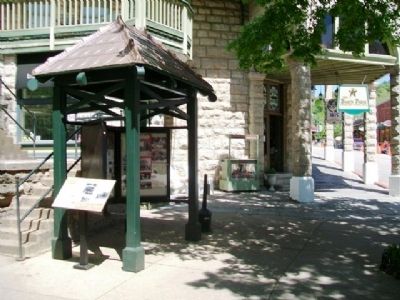
Location. 36° 24.132′ N, 93° 44.247′ W. Marker is in Eureka Springs, Arkansas, in Carroll County. It is on Spring Street, on the left when traveling north. Marker is in Basin Park. Touch for map. Marker is in this post office area: Eureka Springs AR 72632, United States of America. Touch for directions.
Regionally, this marker is on the Ozark Plateau, in the Cherokee Heritage Region,
Other nearby markers. At least 8 other markers are within walking distance of this marker: The Stone Walls (here, next to this marker); Spanish-American and World War Veterans Memorial (within shouting distance of this marker); The Perry House - Basin Park Hotel (within shouting distance of this marker); The Basin Park Sycamore (within shouting distance of this marker); The Southern Hotel (within shouting distance of this marker); The Three Flat-Irons (within shouting distance of this marker); The Basin Bath House (within shouting distance of this marker); Law Offices of F.O. Butt (within shouting distance of this marker). Touch for a list and map of all markers in Eureka Springs.
Credits. This page was last revised on August 16, 2020. It was originally submitted on February 14, 2013, by William Fischer, Jr. of Reynoldsburg, Ohio. This page has been viewed 1,479 times since then and 82 times this year. Photos: 1, 2, 3, 4, 5. submitted on February 14, 2013, by William Fischer, Jr. of Reynoldsburg, Ohio. 6. submitted on December 20, 2014.
