St. Simons Island in Glynn County, Georgia — The American South (South Atlantic)
A Clash Of Cultures
Photographed by Mike Stroud, September 20, 2008
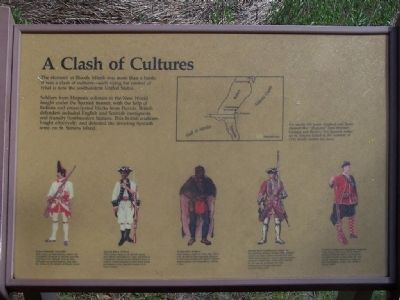
1. A Clash Of Cultures Marker
The skirmish at Bloody Marsh was more than a battle. It was a clash of cultures - each vying for control of what is now the southeastern United States.
Soldiers from Hispanic colonies in the New World fought under the Spanish banner, with the help of Indians and emancipated blacks from Florida. British defenders included English and Scottish immigrants and friendly Southeastern Indians. The British coalition fought effectively, and defeated the invading Spanish army of St. Simons Island.
Erected by National Park Service, U.S. Department of the Interior.
Topics. This historical marker is listed in these topic lists: African Americans • Colonial Era • Hispanic Americans • Indigenous Peoples and Communities. A significant historical date for this entry is July 7, 1742.
Location. 31° 9.398′ N, 81° 22.772′ W. Marker is on St. Simons Island, Georgia, in Glynn County. It is on Demere Road. This marker is located in the Blood Marsh Unit of the Fort Fredericka National Monument. The unit is located on Demere Rd., south of Stewart St. Touch for map. Marker is in this post office area: Saint Simons Island GA 31522,
this page online

Regionally, this marker is on the Coastal Plain, on the Georgia Coast and the Golden Isles, and on the Sea Islands. It is also in the American South, specifically in the Deep South, and on the Eastern Seaboard. Globally, it is in the North Atlantic Region, North America, the Western Hemisphere, the Western World, and the Anglosphere. Historically, it finds itself in what was once New Spain, the territory of the Mississippian Culture, one of the original Thirteen Colonies, one of the Confederate States of America, and the Antebellum South.
Other nearby markers. At least 8 other markers are within 2 miles of this marker, measured as the crow flies: Battle of Bloody Marsh (within shouting distance of this marker); Slave Cabin (approx. 0.6 miles away); Welcome (approx. 0.6 miles away); Demere Road (approx. 0.6 miles away); S.S. Oklahoma and Esso Baton Rouge (approx. 0.9 miles away); Retreat Plantation (approx. 1.4 miles away); St. Simons Park (approx. 1½ miles away); Fort Saint Simons (approx. 1½ miles away). Touch for a list and map of all markers in St. Simons Island.
More about this marker.
Photographed by Mike Stroud, September 20, 2008
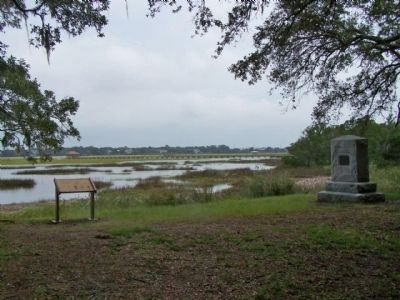
2. A Clash Of Cultures Marker, and Marble Monument
see nearby markers for Battle of Bloody Marsh
Photographed by Fort Frederica Nat. Mon.
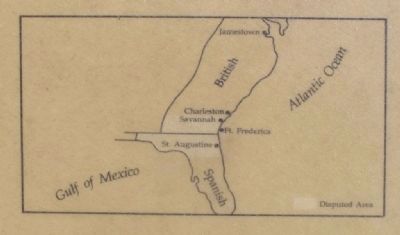
3. A Clash Of Cultures Marker, The disputed area
Photographed by Mike Stroud, /2008
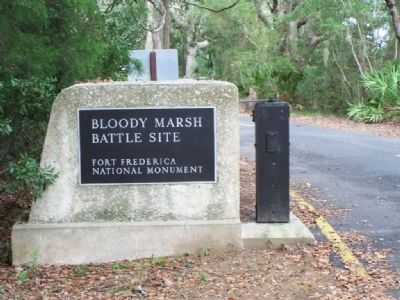
4. Battle of Bloody Marsh Battle Site - A Clash Of Cultures
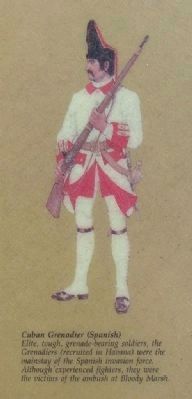
Photographed by Fort Frederica Nat, Mon.
5. A Clash Of Cultures Marker, Cuban Grenadier (Spanish)
Elite, tough, grenade-bearing soldiers, the
Grenadiers (recruited in Havana) were the
mainstay of the Spanish invasion force.
Although experienced fighters, they were
the victims of the ambush at Bloody Marsh.
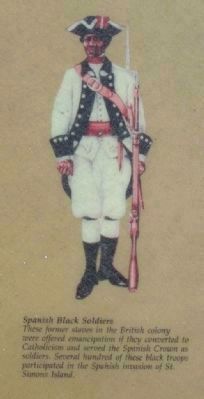
Photographed by Fort Frederica Nat. Mon.
6. A Clash Of Cultures Marker, Spanish Black Soldiers
These former slaves in the English Colony
were offered emancipation if they converted to
Catholicism and served the Spanish Crown as
soldiers. Several hundred of these black troops
participated in the Spanish invasion of St.
Simons Island.
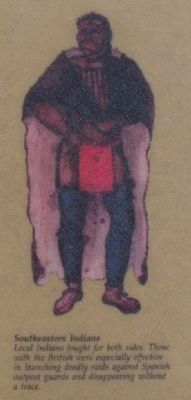
Photographed by Fort Frederica Nat. Mon.
7. A Clash Of Cultures Marker, Southeastern Indians
Local Indians fought for both sides. Those
with the British were especially effective
in launching raid against Spanish
outpost guards and disappearing without
a trace.
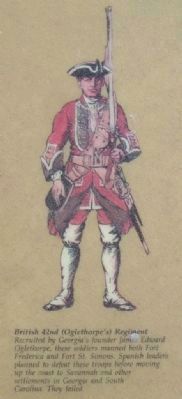
Photographed by Fort Frederica Nat. Mom.
8. A Clash Of Cultures Marker, British 42nd ( Oglethorpe's) Regiment
Recruited by Georgia's founder James Edward
Oglethorpe, these soldiers manned both Fort
Frederica and Fort St, Simons. Spanish leaders
planned to defeat the troops before moving
up the coast to Savannah and other
settlements in Georgia and South
Carolina. They failed.
Photographed by Fort Frederica Nat. Mon.
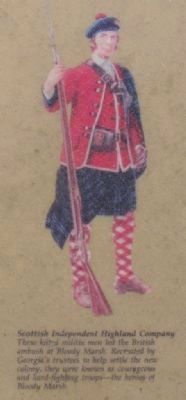
9. A Clash Of Cultures Marker, Scottish Independent Highland Company
These kilted militia men led the British
ambush at Bloody Marsh. Recruited by
Georgia's trustees to help settle the new
colony, they were known as courageous
and hard-fighting troops - the heroes of
Bloody Marsh.
Photographed by Byron Hooks, March 20, 2013
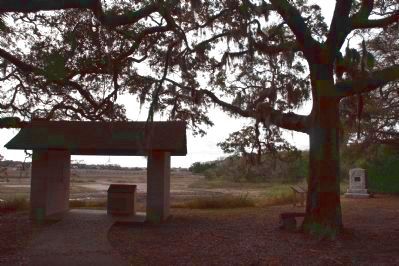
10. Markers at the Blood Marsh Unit of the Fort Fredericka National Monument
Photographed by Byron Hooks, March 20, 2013
11. NPS sign located on Demere Road, looking north
Credits. This page was last revised on September 26, 2024. It was originally submitted on October 24, 2008, by Mike Stroud of Bluffton, South Carolina. This page has been viewed 3,005 times since then and 44 times this year. Last updated on March 23, 2013, by Byron Hooks of Sandy Springs, Georgia. Photos: 1, 2, 3, 4, 5, 6, 7, 8, 9. submitted on October 24, 2008, by Mike Stroud of Bluffton, South Carolina. 10, 11. submitted on March 23, 2013, by Byron Hooks of Sandy Springs, Georgia.
