Downtown Harrisburg in Dauphin County, Pennsylvania — The American Northeast (Mid-Atlantic)
John Harris Sr. Grave Site
Photographed by William Pfingsten, March 21, 2008
1. John Harris Sr. Grave Site Marker
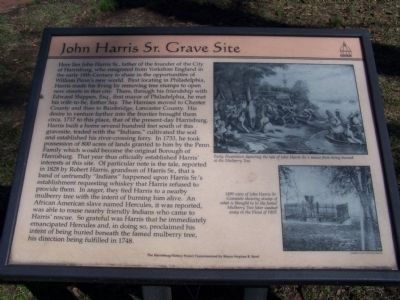
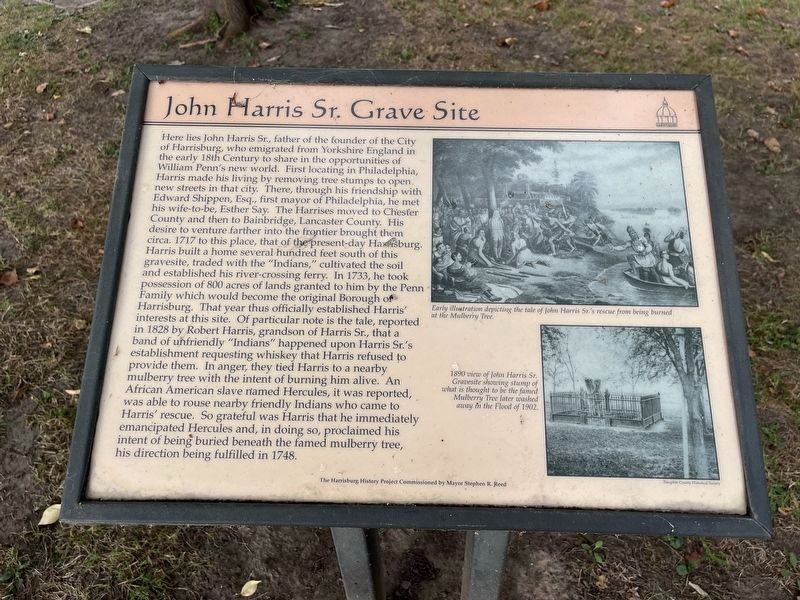
Here lies John Harris, Sr., father of the founder of the City of Harrisburg, who emigrated from Yorkshire England in the early 18th Century to share in the opportunities of William Penn's new world. First locating in Philadelphia, Harris made his living by removing tree stumps to open new streets in that city. There, through his friendship with Edward Shippen, Esq., first mayor of Philadelphia, he met his wife-to-be, Esther Say. The Harrises moved to Chester County and then to Bainbridge, Lancaster County. His desire to venture farther into the frontier brought them circa, 1717 to this place, that of the present-day Harrisburg. Harris built a home several hundred feet south of this gravesite, traded with the "Indians," cultivated the soil and established his river-crossing ferry. In 1733, he took possession of 800 acres of lands granted to him by the Penn Family which would become the original Borough of Harrisburg. That year thus officially established Harris' interests at this site. Of particular note is the tale, reported in 1828 by Robert Harris, grandson of Harris Sr., that a band of unfriendly "Indians" happened
this page online
[Captions:]
Early illustration depicting the tale of John Harris Sr.'s rescue from being burned at the Mulberry Tree.
1890 view of John Harris Sr. Gravesite showing stump of what is thought to be the famed Mulberry Tree later washed away in the Flood of 1902.
Erected by The Harrisburg History Project Commissioned by Mayor Stephen R. Reed.
Topics and series. This historical marker is listed in these topic lists: Cemeteries & Burial Sites • Colonial Era • Indigenous Peoples and Communities • Settlements & Settlers. In addition, it is included in the Pennsylvania, The Harrisburg History Project series list. A significant historical year for this entry is 1717.
Location. 40° 15.364′ N,
Photographed by Devry Becker Jones (CC0), August 3, 2024
2. John Harris Sr. Grave Site Marker
The marker appears to have weathered slightly but remains legible.

Regionally, this marker is in South-Central Pennsylvania, specifically in Pennsylvania Dutch Country, and in the Susquehanna Valley. It is also in the American Northeast and in the Mid-Atlantic. Globally, it is in North America, the Western Hemisphere, the Western World, and the Anglosphere. Historically, it finds itself in what was once the Haudenosaunee (Iroquois) Confederacy and also one of the original Thirteen Colonies.
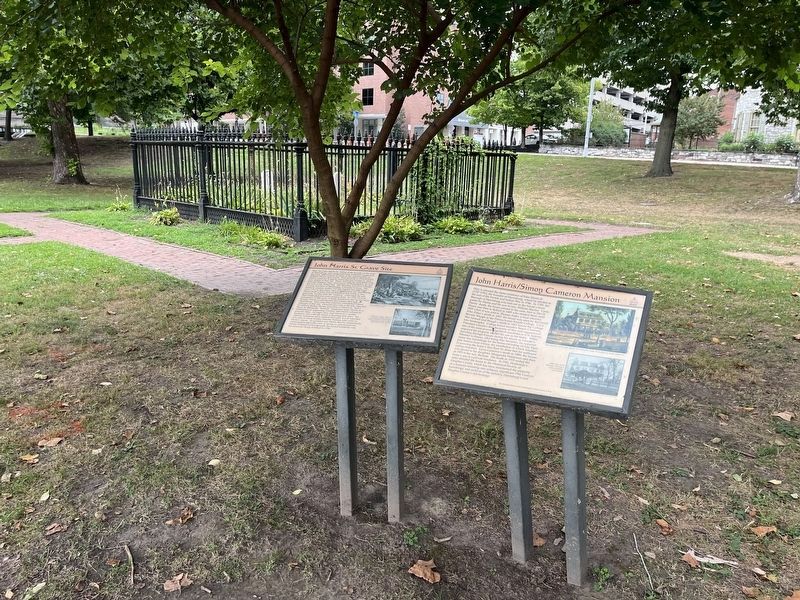
Other nearby markers. At least 8 other markers are within walking distance of this marker: John Harris / Simon Cameron Mansion (here, next to this marker); John Harris (a few steps from this marker); In Memory of John Harris (a few steps from this marker); Vietnam Veterans Memorial (within shouting distance of this marker); Harrisburg's Grand Review of Black Troops
Photographed by William Pfingsten, March 21, 2008
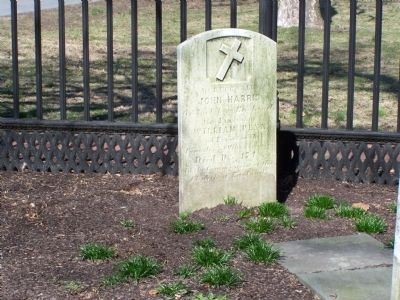
4. John Harris Sr. Grave Stone
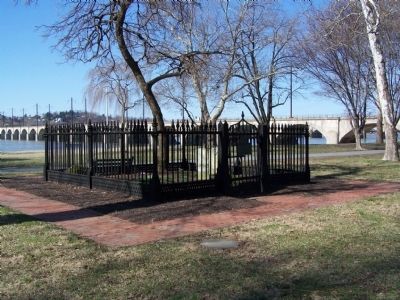
Photographed by William Pfingsten, March 21, 2008
5. Full view of grave site.
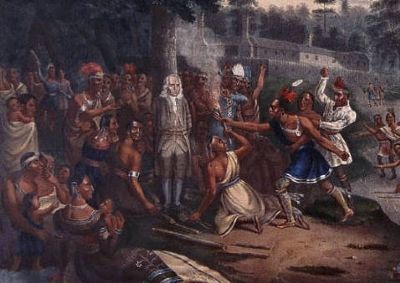
Photographed by John K. Robinson, July 29, 2014
6. Photo of 19th century depiction of the incident in color. Collection of Historical Society.
Credits. This page was last revised on August 5, 2024. It was originally submitted on March 25, 2008, by Bill Pfingsten of Bel Air, Maryland. This page has been viewed 5,267 times since then and 135 times this year. Photos: 1. submitted on March 25, 2008, by Bill Pfingsten of Bel Air, Maryland. 2, 3. submitted on August 5, 2024, by Devry Becker Jones of Washington, District of Columbia. 4, 5. submitted on March 25, 2008, by Bill Pfingsten of Bel Air, Maryland. 6. submitted on March 18, 2015, by John K. Robinson of Harrisburg, Pennsylvania.
