Near Mt. Vernon in Mobile County, Alabama — The American South (East South Central)
Mt. Vernon Arsenal and Barracks
⎯⎯⎯
Searcy Hospital
Photographed by Mark Hilton, December 4, 2013
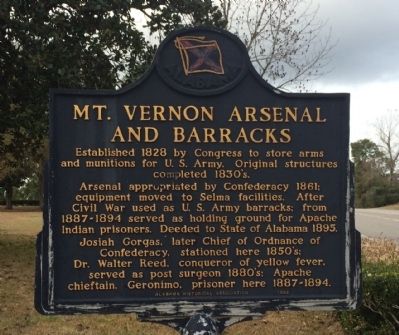
1. Mount Vernon Arsenal and Barracks Marker
Established 1828 by Congress to store arms and munitions for U. S. Army. Original structures completed 1830's.
Arsenal appropriated by Confederacy 1861; equipment moved to Selma facilities. After Civil War used as U. S. Army barracks; from 1887-1894 served as holding ground for Apache Indian prisoners. Deeded to State of Alabama 1895.
Josiah Gorgas, later Chief of Ordnance of Confederacy, stationed here 1850's; Dr. Walter Reed, conqueror of yellow fever, served as post surgeon 1880's; Apache chieftain, Geronimo, prisoner here 1887-1894.
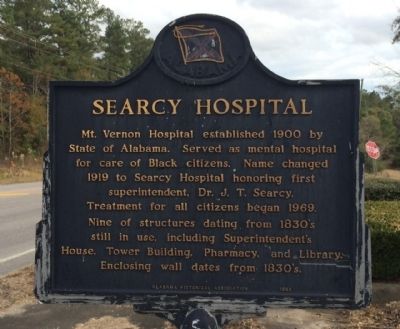
(reverse)
Mt. Vernon Hospital established 1900 by State of Alabama. Served as mental hospital for care of Black citizens. Name changed 1919 to Searcy Hospital honoring first superintendent, Dr. J. T. Searcy. Treatment for all citizens began 1969. Nine of structures dating from 1830's still in use, including Superintendent's House, Tower Building, and Library. Enclosing wall dates from 1830's.
Erected 1982 by Alabama Historical Association.
Topics and series. This historical marker is listed in these topic
this page online
Location. 31° 5.287′ N, 88° 1.451′ W. Marker is near Mt. Vernon, Alabama, in Mobile County. It is at the intersection of East Coy Smith Highway (County Road 96) and Superintendents Drive, on the left when traveling west on East Coy Smith Highway. Touch for map. Marker is in this post office area: Mount Vernon AL 36560, United States of America. Touch for directions.

Regionally, this marker is on Alabama’s Gulf Coast, in the Mobile Bay area, and specifically in the Mobile Metropolitan Area. It is also in the American South, specifically in the Deep South, and on the Gulf Coast. Globally, it is in North America, a Gulf of Mexico state, the Western Hemisphere, the Western World, and the Anglosphere. Historically, it finds itself in what was once New Spain, the Viceroyalty of New France, the territory of the Mississippian Culture, one of the Confederate States of America, and
Photographed by Mark Hilton, December 4, 2013
2. Searcy Hospital Marker
Other nearby markers. At least 8 other markers are within 3 miles of this marker, measured as the crow flies: Mount Vernon Arsenal (here, next to this marker); Mt. Vernon Federal Highway (approx. half a mile away); In Memory of Col. Ephraim Kirby (approx. half a mile away); Fort Stoddert (approx. half a mile away); Mount Vernon Historical Museum and Train Depot (approx. 0.6 miles away); Old Military Road and Old Federal Road (approx. 1.8 miles away); Ephraim Kirby's Grave (approx. 2½ miles away); a different marker also named Fort Stoddert (approx. 2½ miles away). Touch for a list and map of all markers in Mt. Vernon.
Also see . . .
1. On the historic Mount Vernon grounds, an already weathered piece of history nears ruin. (Submitted on December 5, 2013.)
2. Mount Vernon. Encyclopedia of Alabama entry (Submitted on October 18, 2020, by Larry Gertner of New York, New York.)
Photographed by Mark Hilton, December 4, 2013
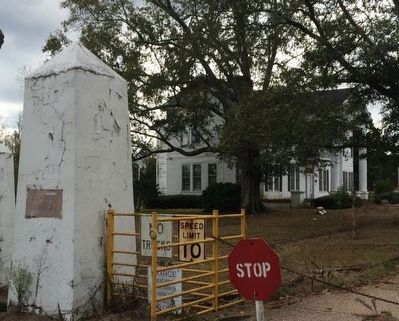
3. Searcy Hospital Entrance
Photographed by Mark Hilton, December 4, 2013
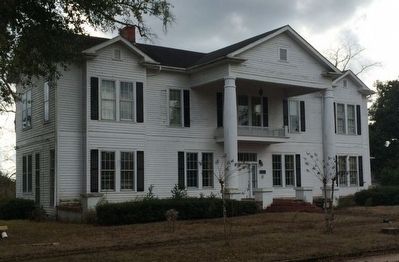
4. Searcy Hospital Building
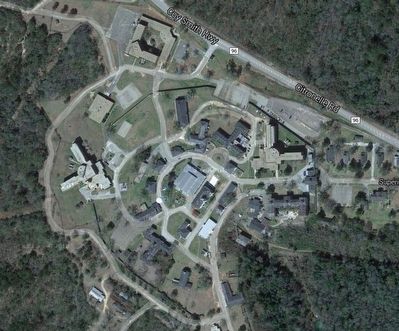
Photographed by Google Map, December 4, 2013
5. Arsenal, Barracks & Hospital Aerial View
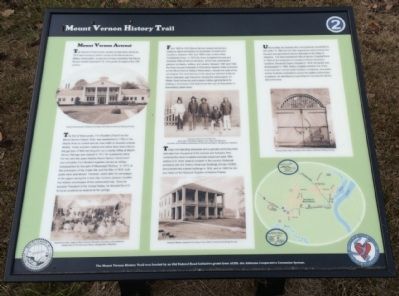
Photographed by Mark Hilton, December 4, 2013
6. Mount Vernon Arsenal Interpretive Sign
Credits. This page was last revised on December 9, 2024. It was originally submitted on December 5, 2013, by Mark Hilton of Montgomery, Alabama. This page has been viewed 3,746 times since then and 122 times this year. Photos: 1, 2, 3, 4, 5, 6. submitted on December 5, 2013, by Mark Hilton of Montgomery, Alabama. • Bernard Fisher was the editor who published this page.
