Anadarko in Caddo County, Oklahoma — The American South (West South Central)
Pocahontas
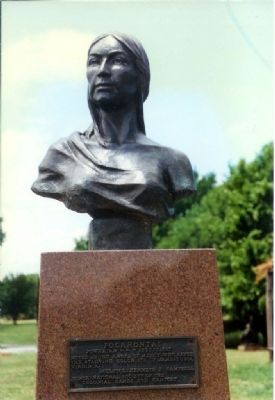
Photographed by Mike Stroud, June 1996
1. Pocahontas Marker
Sculptor: Kenneth F. Campbell
Donor: National Society of the Colonial Dames XVII Century
Erected by National Hall Of Fame For Famous American Indians.
Topics. This historical marker is listed in these topic lists: Colonial Era • Indigenous Peoples and Communities • Settlements & Settlers • Women. A significant historical year for this entry is 1595.
Location. 35° 4.368′ N, 98° 13.716′ W. Marker is in Anadarko, Oklahoma, in Caddo County. It is on Highway 62. Touch for map. Marker is at or near this postal address: 851 E Central Blvd, Anadarko OK 73005, United States of America. Touch for directions.

Regionally, this marker is in the Kiowa Tribe and in Southwest Oklahoma—Great Plains Country. It is also in the American South, specifically on the prairies, and on the Southern Plains. Globally, it is in North America, the Western Hemisphere, the Western World, and the Anglosphere. Historically, it finds itself in what was once the Comanchería, the territory of the Mississippian Culture,
this page online
Other nearby markers. At least 8 other markers are within walking distance of this marker: Black Beaver (Se-Ket-Tu-Ma-Qua) (a few steps from this marker); Allen Wright (Kuliahote) (a few steps from this marker); Sequoyah (a few steps from this marker); Osceola (Asi Yahola) (a few steps from this marker); Chief Joseph (within shouting distance of this marker); Will Rogers (within shouting distance of this marker); Roberta Campbell Lawson (within shouting distance of this marker); Jim Thorp (within shouting distance of this marker). Touch for a list and map of all markers in Anadarko.
More about this marker. Found at National Hall Of Fame For Famous American Indians
Regarding Pocahontas. The National Hall of Fame of Famous American Indians was established to recognize famous American Indians. It was a chance to provide a portrait in a bronze bust, a three dimensional likeness, for visitors to touch and see famous people they have read about in history books. Formed in 1952 by historians and people interested in history, there are now 41 busts in the Hall of Fame, an outdoor garden with a sidewalk
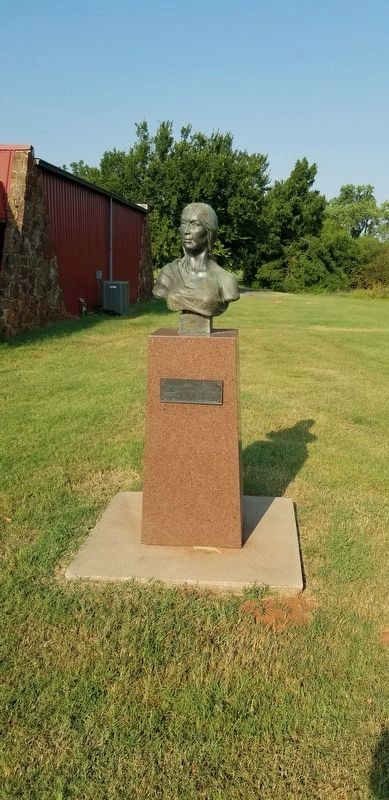
Photographed by James Hulse, September 9, 2021
2. The Pocahontas Marker at the entrance to the park
Many times Ta-hau-san, Satanta, Quanah Parker, Jose Maria, Black Beaver, Kickingbird, Ahpeahtone, and maybe Geronimo, as well as others, rode their horses over the grounds of the Hall of Fame many years ago. Several families come to wash their family member's bust and say a few prayers.
Also see . . . Wikipedia entry for Pocahontas. During a time when the colonists were starving, "ever once in four or five days, Pocahontas with her attendants brought him [Smith] so much provision that saved many of their lives that else for all this had starved with hunger." (Submitted on May 5, 2008, by Mike Stroud of Bluffton, South Carolina.)
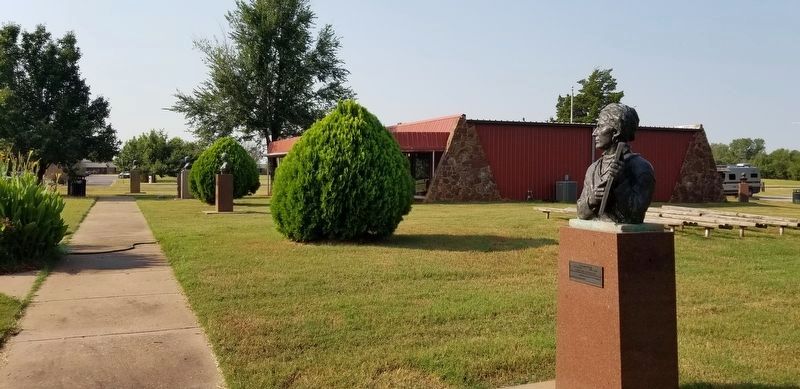
Photographed by James Hulse, September 9, 2021
3. The Pocahontas Marker is the second marker from the right near the entrance
Photographed by Allen C. Browne, February 16, 2015
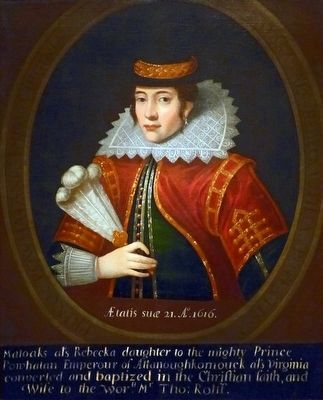
4. Pocahontas, age 21, 1616
This portrait of Pocahontas (Matoaks) after a 1616 engraving by Simon van de Passe hangs in the National Portrait Gallery in Washington DC.
Ætatis suæ 21. Ao. 1616.
Matoaks als Rebecka daughter to the mighty Prince Powhatan Emperour of Attanoughkomouck als Virginia converted and baptized in the Chriƒtian faith, and Wife to the worʰ. Mr Tho: Rolff.
“Pocahontas, the Indian princess who allegedly saved the life of English colonist John Smith, survives and flourishes as an example of an early American heroine. While Smith may have embellished the story of his rescue, the importance of Pocahontas to relations between colonists and Native Americans is undisputed. Following her conversion to Christianity and marriage to Englishman John Rolfe, Pocahontas journeyed to England with her family to demonstrate the ability of new settlers and native tribes to coexist in the Virginia colony. While in England, Pocahontas sat for her portrait, which was later engraved. That print served as the basis for this later portrait. The painter included an inscription beneath the likeness, copied from the engraving, but through an error in transcription it misidentifies her husband as Thomas, the name given to their son.” — National Portrait Gallery
Ætatis suæ 21. Ao. 1616.
Matoaks als Rebecka daughter to the mighty Prince Powhatan Emperour of Attanoughkomouck als Virginia converted and baptized in the Chriƒtian faith, and Wife to the worʰ. Mr Tho: Rolff.
“Pocahontas, the Indian princess who allegedly saved the life of English colonist John Smith, survives and flourishes as an example of an early American heroine. While Smith may have embellished the story of his rescue, the importance of Pocahontas to relations between colonists and Native Americans is undisputed. Following her conversion to Christianity and marriage to Englishman John Rolfe, Pocahontas journeyed to England with her family to demonstrate the ability of new settlers and native tribes to coexist in the Virginia colony. While in England, Pocahontas sat for her portrait, which was later engraved. That print served as the basis for this later portrait. The painter included an inscription beneath the likeness, copied from the engraving, but through an error in transcription it misidentifies her husband as Thomas, the name given to their son.” — National Portrait Gallery
Credits. This page was last revised on September 17, 2021. It was originally submitted on May 5, 2008, by Mike Stroud of Bluffton, South Carolina. This page has been viewed 2,739 times since then and 61 times this year. Photos: 1. submitted on May 5, 2008, by Mike Stroud of Bluffton, South Carolina. 2, 3. submitted on September 17, 2021, by James Hulse of Medina, Texas. 4. submitted on October 26, 2015, by Allen C. Browne of Silver Spring, Maryland. • Kevin W. was the editor who published this page.
