
Hermitage in Davidson County, Tennessee — The American South (East South Central)
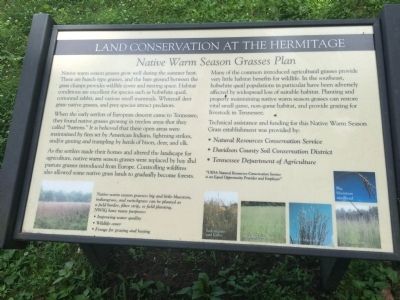
Land Conservation at The Hermitage
Native Warm Season Grasses Plan
Photographed by J. Makali Bruton, June 14, 2015
1. Land Conservation at The Hermitage Marker
When the early settlers of European descent came to Tennessee, they found native grasses growing in treeless areas that they called “barrens.” It is believed that these open areas were maintained by fires set by American Indians, lightning strikes, and/or grazing and trampling by herds of bison, deer, and elk.
As the settlers made their homes and altered the landscape for agriculture, native warm season grasses were replaced by hay and pasture grasses introduced from Europe. Controlling wildfires also allowed some native grass lands to gradually become forests.
Many of the common introduced agricultural grasses provide very little habitat benefits for wildlife. In the southeast, bobwhite quail populations in particular have been adversely affected by
this page online
Technical assistance and funding for this Native Warm Season Grass establishment was provided by:
• Natural Resources Conservation Service
• Davidson County Soil Conservation District
• Tennessee Department of Agriculture
Native warm season grasses: big and little bluestem, indiangrass, and switchgrass can be planted as a field border, filter strip, or field planting. NWSG have many purposes:
• Improving water quality
• Wildlife cover
• Forage for grazing and haying
Captions:
Indiangrass and forbs
Switchgrass
Little bluestem
Big bluestem
Big bluestem seedhead
Topics. This historical marker is listed in these topic lists: Agriculture • Anthropology & Archaeology • Indigenous Peoples and Communities • Settlements & Settlers.
Location. 36° 13.152′ N, 86° 36.683′ W. Marker is in Hermitage, Tennessee, in Davidson County. It can be reached from Rachels Lane. The marker is
Photographed by J. Makali Bruton, June 14, 2015
2. Land Conservation at The Hermitage Marker
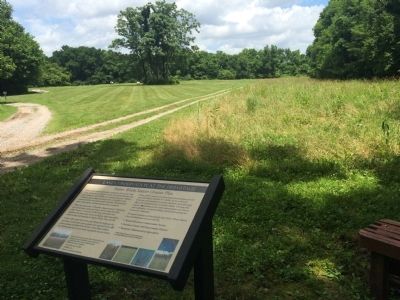
The Field Quarter can be seen in the background looking north.

Regionally, this marker is in Middle Tennessee and in Greater Nashville. It is also in the American South and specifically in the Upper South. Globally, it is in North America, the Western Hemisphere, the Western World, and the Anglosphere. Historically, it finds itself in what was once the territory of the Mississippian Culture, one of the Confederate States of America, and the Antebellum South.
Other nearby markers. At least 8 other markers are within walking distance of this marker: The Field Quarter Spring (within shouting distance of this marker); Determined Resistance (within shouting distance of this marker); Stories Told by Things the Enslaved Left Behind (about 400 feet away, measured in a direct line); The Field Quarter (about 400 feet away); "Have the Negro Houses Placed Where the Old Ones Stands" (about 400 feet away); A Lively Place (about 400 feet away); The Hermitage Overseer (about 400 feet away); Ginning and Pressing "King Cotton" (about 600 feet away). Touch for a list and map of all markers in Hermitage.
Credits. This page was last revised on February 7, 2023. It was originally submitted on July 14, 2015, by J. Makali Bruton of Washington, District of Columbia. This page has been viewed 425 times since then and 11 times this year. Photos: 1, 2. submitted on July 14, 2015, by J. Makali Bruton of Washington, District of Columbia. • Bill Pfingsten was the editor who published this page.
