Montgomery in Montgomery County, Alabama — The American South (East South Central)
Alabama's First Capitals
⎯⎯⎯
The Alabama State Capitol
Photographed by Brandon Fletcher, July 8, 2011
1. Alabama's First Capitals / The Alabama State Capitol Marker
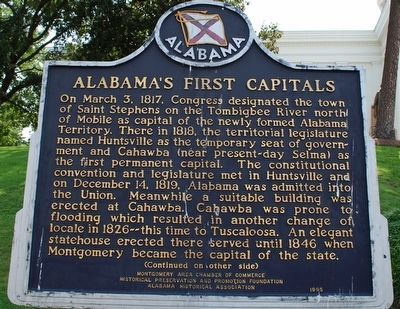
Alabama's First Capitals
On March 3, 1817, Congress designated the town of St. Stephens on the Tombigbee River north of Mobile as capital of the newly formed Alabama Territory. There in 1818, the territorial legislature named Huntsville as the temporary seat of government and Cahawba (near present-day Selma) as the first permanent capital. The constitutional convention and legislature met in Huntsville and on December 14, 1819, Alabama was admitted into the Union. Meanwhile a suitable building was erected at Cahawba. Cahawba was prone to flooding which resulted in another change of locale in 1826-this time to Tuscaloosa. An elegant statehouse erected there served until 1846 when Montgomery became the capital of the state.
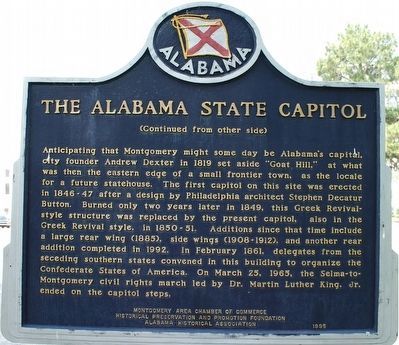
The Alabama State Capitol
Anticipating that Montgomery might some day be Alabama's capital, city founder Andrew Dexter in 1819 set aside "Goat Hill," at what was then the eastern edge of a small frontier town, as the locale for a future statehouse. The first capitol on this site was erected in 1846-47 after a design by Philadelphia architect Stephen Decatur Button. Burned only two years later
this page online
Erected 1995 by Alabama Historical Association, Montgomery Area Chamber of Commerce, Historical Preservation and Promotion Foundation.
Topics and series. This historical marker is listed in these topic lists: Civil Rights • Settlements & Settlers • War, US Civil. In addition, it is included in the Alabama Historical Association, the Liberty Bell Replica, and the National Historic Landmarks series lists. A significant historical month for this entry is February 1861.
Location. 32° 22.677′ N, 86° 18.048′ W. Marker is in Montgomery, Alabama, in Montgomery County. It is at the intersection of South Bainbridge Street and Dexter Avenue,
Photographed by Brandon Fletcher, July 8, 2011
2. Alabama's First Capitals / The Alabama State Capitol Marker

Regionally, this marker is in the Tri-Counties River Region. It is also in the American South, specifically in the Deep South, and in the Black Belt. Globally, it is in North America, a Gulf of Mexico state, the Western Hemisphere, the Western World, and the Anglosphere. Historically, it finds itself in what was once the territory of the Mississippian Culture, one of the Confederate States of America, and the Antebellum South.
Other nearby markers. At least 8 other markers are within walking distance of this marker: Jefferson Davis (a few steps from this marker); Alabama State Capitol (a few steps from this marker); Spot Where Jefferson Davis Stood (within shouting distance of this marker); Selma-to-Montgomery March (within shouting distance of this marker); "Battle Flag of the Confederacy" (within shouting distance of this marker); "Third National Confederate Flag" (within shouting distance of this marker); John Allan Wyeth (within shouting
Photographed by Lee Hattabaugh, October 1, 2010
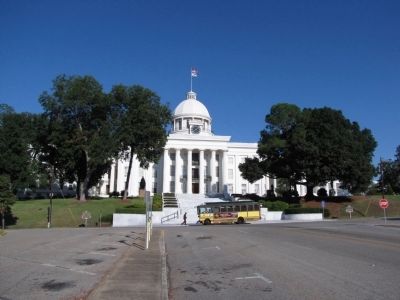
3. Marker is to the left of the Capitol steps in this view.
Photographed by Tim Carr, August 1, 2009
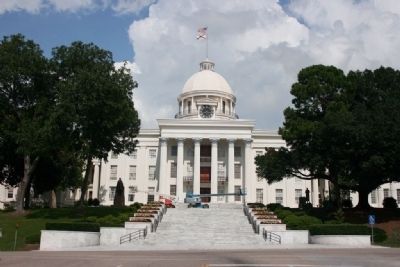
4. Alabama's State Capitol in Montgomery
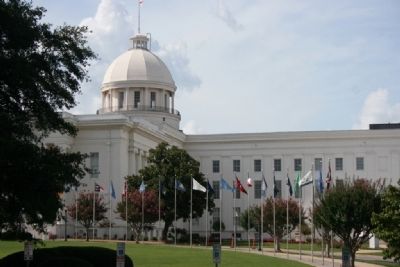
Photographed by Tim Carr, August 1, 2009
5. South and East Wing view of the State Capitol.
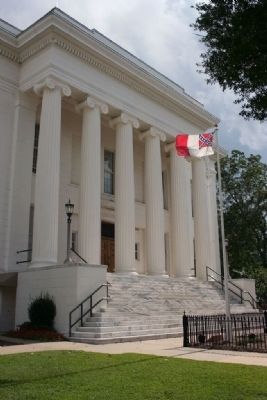
Photographed by Tim Carr, August 1, 2009
6. North Wing View of the State Capitol.
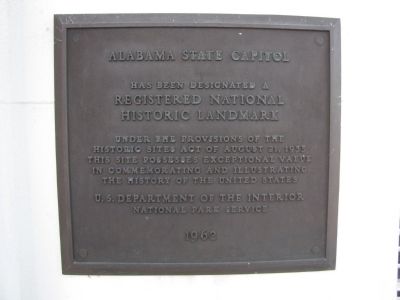
Photographed by Lee Hattabaugh, October 1, 2010
7. National Historic Landmark
This plaque is to the right of the west entrance doors.
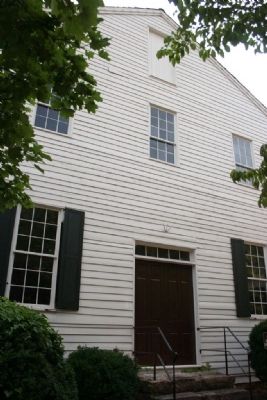
Photographed by Tim Carr, June 27, 2009
8. Replica of Contitution Hall
Located on the Site of Alabama's First Constitutional Convention July 5, 1819. Huntsville, Alabama.
Photographed by Tim Carr, August 15, 2009
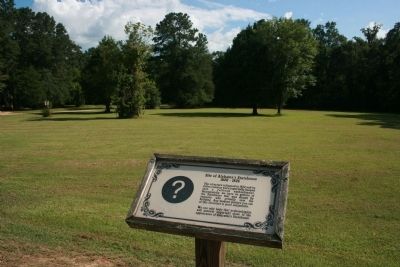
9. Site of Alabama's First Statehouse 1820-1825
This structure collapsed in 1823 and its fallen remains were reportedly heaped into a railroad embankment. Consequently,we have no picture of the Statehouse that was drawn by someone who actually saw the building. Any modern picture you see of this structure is pure conjecture.
We can only hope that archaeologists will uncover important clues to the appearance of Cahawba's Statehouse.
We can only hope that archaeologists will uncover important clues to the appearance of Cahawba's Statehouse.
Photographed by Tim Carr, July 4, 2006
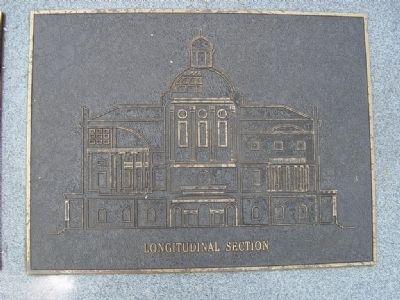
10. Relief View of the Alabama's Second Statehouse.
Photographed by Tim Carr, July 4, 2006
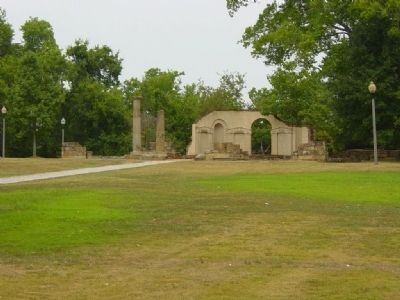
11. Site and Ruins of Alabama's Second Statehouse 1826-1846 in Tuscaloosa
After the seat of government was moved to Montgomery in 1847, the Tuscaloosa Capitol and its furnishings were deeded to the University of Alabama to be used for educational purposes.
In 1857, the University Board of Trustees leased the building for ninety-nine years to the newly formed Baptist-affiliated Alabama Central Female College. At this time, a large brick four story dormitory was constructed at the west of the building.
On August 22, 1923, the historic building was totally destroyed by fire. In the 1930, the site was cleared for use as a park.
In 1857, the University Board of Trustees leased the building for ninety-nine years to the newly formed Baptist-affiliated Alabama Central Female College. At this time, a large brick four story dormitory was constructed at the west of the building.
On August 22, 1923, the historic building was totally destroyed by fire. In the 1930, the site was cleared for use as a park.
Photographed by Beverly Pfingsten, April 5, 2014
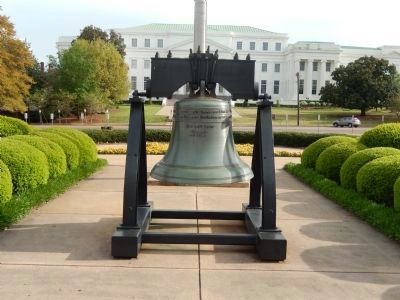
12. Liberty Bell Replica
In 1950 the Secretary of the Treasury gave each state and territory a replica of the Liberty Bell in appreciation of their participation in the Savings Bond drive. The original plaque has been removed. This bell is located on the Washington Street side of the State Capitol.
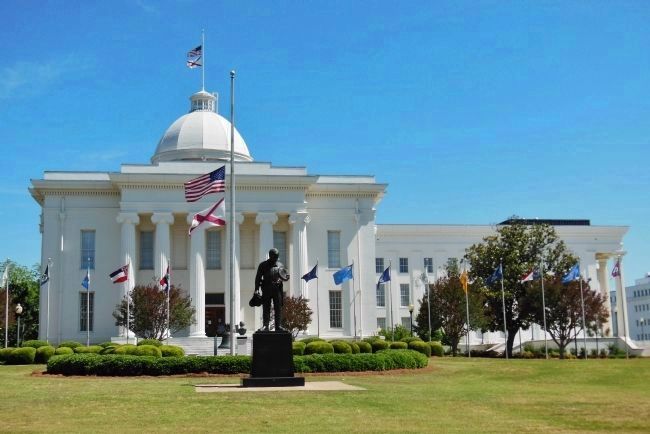
Photographed by Cosmos Mariner, May 25, 2013
13. Alabama State Capitol south
Credits. This page was last revised on July 16, 2025. It was originally submitted on December 5, 2009, by Timothy Carr of Birmingham, Alabama. This page has been viewed 7,224 times since then and 242 times this year. Last updated on July 24, 2015, by J. Makali Bruton of Washington, District of Columbia. Photos: 1, 2. submitted on August 15, 2015, by Brandon Fletcher of Chattanooga, Tennessee. 3. submitted on October 6, 2010, by Lee Hattabaugh of Capshaw, Alabama. 4, 5, 6. submitted on December 5, 2009, by Timothy Carr of Birmingham, Alabama. 7. submitted on October 4, 2010, by Lee Hattabaugh of Capshaw, Alabama. 8, 9, 10, 11. submitted on December 5, 2009, by Timothy Carr of Birmingham, Alabama. 12. submitted on April 16, 2014, by Bill Pfingsten of Bel Air, Maryland. 13. submitted on October 9, 2013, by Cosmos Mariner of Cape Canaveral, Florida. • Bill Pfingsten was the editor who published this page.
