Niagara Falls in Niagara County, New York — The American Northeast (Mid-Atlantic)
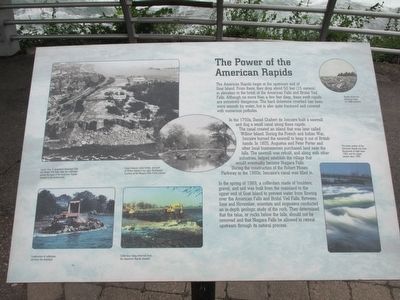
The Power of the American Rapids
Photographed by Anton Schwarzmueller, August 26, 2015
1. The Power of the American Rapids Marker
In the 1750's, Daniel Chabert de Joncaire built a sawmill and dug a small canal along these rapids. The canal created an island that was later called Willow Island. During the French and Indian War, Joncaire burned the sawmill to keep it out of British hands. In 1805, Augustus and Peter Porter and other local businessmen purchased land near the falls. The sawmill was rebuilt, and along with other industries, helped establish the village that would eventually become Niagara Falls. During the construction of the Robert Moses Parkway in the 1960s, Joncaire's canal was filled in.
In the spring of 1969, a cofferdam made of boulders, gravel, and soil was built from the mainland to the upper end of Goat Island to prevent water from flowing over the
this page online
Canal channel, rustic bridge, and part of Willow Island to the right. Photograph courtesy of the Niagara Falls Public Library.
Construction of cofferdam out from the mainland.
Cofferdam being removed from the American Rapids channel.
Rapids above the American Falls, ca. 1868 postcard.
The lower section of the American Rapids has been illuminated at night since 1989, and the upper section since 1998.
Topics. This historical marker is listed in these topic lists: Environment • Industry & Commerce • War, French and Indian • Waterways & Vessels. A significant historical year for this entry is 1750.
Location. 43° 5.02′ N, 79° 3.844′ W. Marker is in Niagara Falls, New York, in Niagara County. It can be reached from Niagara Scenic Parkway (New York State Route 957A) 0.1 miles west of 1st Street. Marker is in Niagara Falls State Park.
Photographed by Anton Schwarzmueller, August 26, 2015
2. Approaching from Upstream
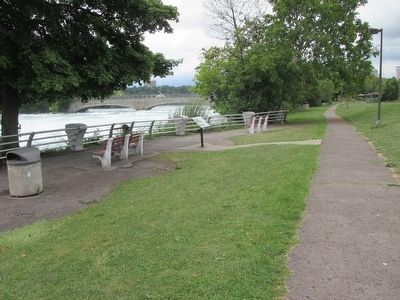
Goat Island pedestrian bridge in background, leading to Green Island first.

Regionally, this marker is in Upstate New York, specifically in Western New York, and in the Buffalo Metropolitan Area. It is also in the American Northeast and in the Mid-Atlantic. Globally, it is in North America, on the Great Lakes, in the Western Hemisphere, in the Western World, and in the Anglosphere. Historically, it finds itself in what was once the Viceroyalty of New France, the Haudenosaunee (Iroquois) Confederacy, New Netherland, and one of the original Thirteen Colonies.
Other nearby markers. At least 8 other markers are within walking distance of this marker: Cataract House (about 300 feet away, measured in a direct line); The Red Coach Inn / Annex Building
Photographed by Anton Schwarzmueller, August 26, 2015
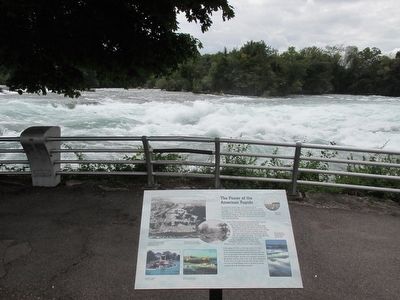
3. Marker & American Rapids
Photographed by Anton Schwarzmueller, August 26, 2015
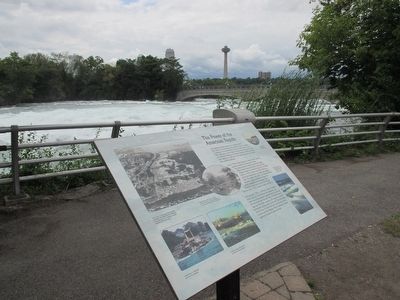
4. American Rapids & Marker
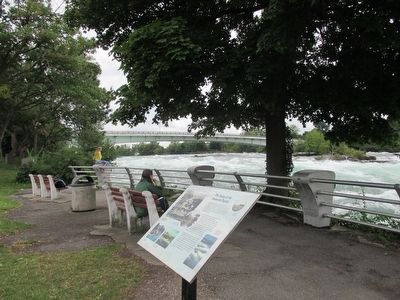
Photographed by Anton Schwarzmueller, August 26, 2015
5. American Rapids & Marker & Violator
In one minute, a sharp-eyed passing park employee will stop his car and, on foot, approach the young blonde lady perched and meditating on the railing standard. She will be advised of her infraction: No climbing or breaching the railing.
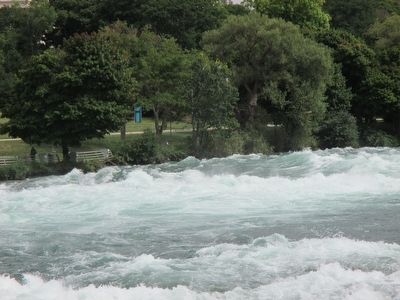
Photographed by Anton Schwarzmueller, August 26, 2015
6. American Rapids
View towards upriver from the pedestrian bridge. The marker is in the area behind the railings at left. This view is actually obscured by the metal overdeck and reinforcement structure on the bridge; I aimed the lens between the various obstructions.
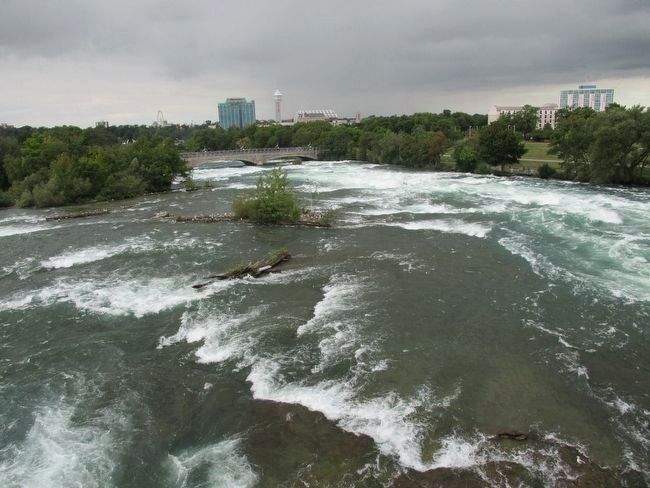
Photographed by Anton Schwarzmueller, August 26, 2015
7. American Rapids
View from the vehicular bridge (1st Street) to Goat Island. Most pedestrians use the stone bridge in the background, but there are safe walkways here on this, the vehicular bridge. This is looking downstream. The buildings in the center background are in Canada. The marker is in the clearing to the right; the white building near the marker is the Comfort Inn. The glass building near the marker is the former Occidental Chemical office building, now housing food and souvenier vendors at ground level.
Credits. This page was last revised on September 12, 2016. It was originally submitted on August 30, 2015, by Anton Schwarzmueller of Wilson, New York. This page has been viewed 646 times since then and 31 times this year. Photos: 1, 2, 3, 4, 5, 6, 7. submitted on August 30, 2015, by Anton Schwarzmueller of Wilson, New York.
