Downtown in Baltimore, Maryland — The American Northeast (Mid-Atlantic)
Discover Baltimore: The Monumental City
Heritage Walk
Photographed by Allen C. Browne, September 27, 2015
1. Discover Baltimore: The Monumental City Marker
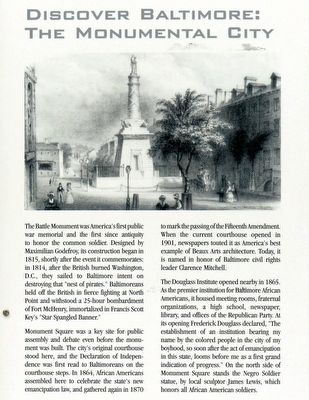
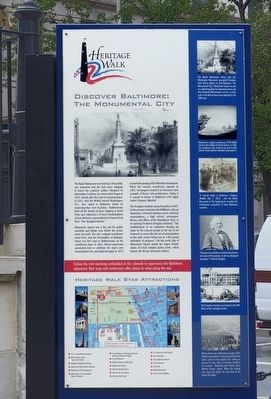
Monument Square was a key site for public assembly and debate even before the monument was built. The city's original courthouse stood here, and the Declaration of Independence was first read to Baltimoreans on the courthouse steps. In 1864, African Americans assembled here to celebrate the state's new emancipation law, and gathered again in 1870 to mark the passing of the Fifteenth Amendment. When the current courthouse opened in 1901, newspapers touted it as America's best example of Beaux Arts architecture. Today, it is named in honor of Baltimore civil rights leader Clarence
this page online
The Douglass Institute opened nearby in 1865. As the premier institution for Baltimore African Americans, it housed meeting rooms, fraternal organizations, a high school, newspaper, library, and offices of the Republican Party. At its opening Frederick Douglass declared, “The establishment of an institution bearing my name by the colored people in the city of my boyhood, so soon after the act of emancipation in this state, looms before me as a first grand indication of progress.” On the north side of Monument Square stands the Negro Soldier statue, by local sculptor James Lewis, which honors all African American soldiers.
Topics. This historical marker is listed in these topic lists: African Americans • War of 1812 • War, US Civil.
Location. 39° 17.444′ N, 76° 36.746′ W. Marker is in Baltimore, Maryland. It is in Downtown. It can be reached from North Calvert Street (Maryland Route 2) north of East Fayette Street, in the median. Located in Battle Monument Park. Touch for map. Marker is in this post office area: Baltimore MD 21202, United States of
Photographed by Allen C. Browne, September 27, 2015
2. Discover Baltimore: The Monumental City Marker

Regionally, this marker is in Central Maryland. It is also in the American Mid-Atlantic, in the Chesapeake Bay Region, and on the Eastern Seaboard. Globally, it is in the North Atlantic Region, North America, the Western Hemisphere, the Western World, and the Anglosphere. Historically, it finds itself in what was once one of the original Thirteen Colonies and also the Antebellum South.
Other nearby markers. At least 8 other markers are within walking distance of this marker: The Battle Monument (a few steps from this marker); a different marker also named The Battle Monument (a few steps from this marker); Baltimore City Courthouse (a few steps from this marker); a different marker also named The Battle Monument (a few steps from this marker); Old Post Office (a few steps from this marker); The Equitable Building (within shouting distance of this marker); The Lenore (within shouting distance of this marker); The Munsey Building (within shouting distance of this marker). Touch for a list and map of all markers in Baltimore.
Another marker is no longer nearby. The Equitable Building (was
Photographed by Allen C. Browne, September 27, 2015
3. Discover Baltimore: The Monumental City Marker
Photographed by Allen C. Browne, September 27, 2015
4. The Battle Monument
Photographed by Allen C. Browne, September 27, 2015
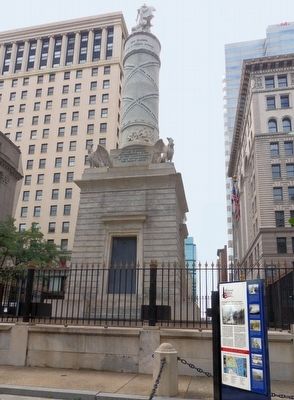
5. The Battle Monument
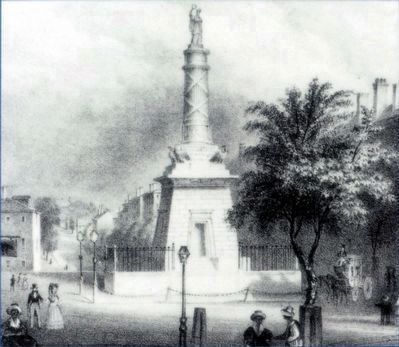
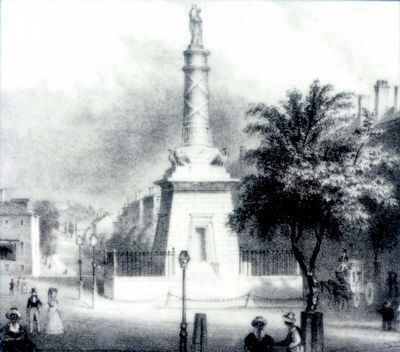
The Battle Monument, along with the Washington Monument, prompted President John Quincy Adams to dub Baltimore “the Monumental City.” Monument Square served as a gathering place for important events and also attracted Baltimoreans out for a stroll, such as the African Americans depicted in this 1838 view.Close-up of image on marker
Photographed by Harper's Weekly, September 27, 2015
6. Baltimore's Original Courthouse
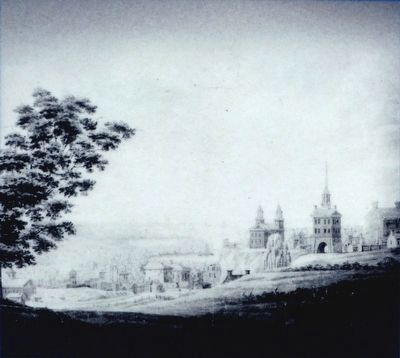
Baltimore's Original Courthouse (1770-1809) stood in the middle of Calvert Street. In 1784, the courthouse was raised on an arch so that Calvert Street could be extended underneath it.Close-up of image on marker
Photographed by Allen C. Browne, 1861
7. A Female Rebel
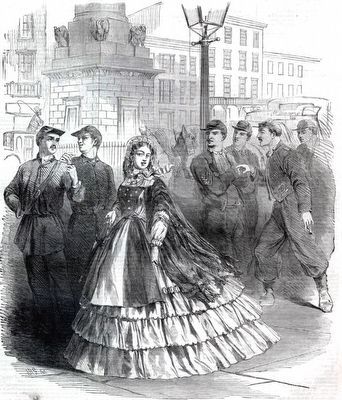
“A Female Rebel in Baltimore” (Harper's Weekly, May 7, 1861), with the Battle Monument in the background, revealed the confederate sympathies of some Baltimore residents.Harper's Weekly image used on marker
Photographed by Allen C. Browne, September 27, 2015
8. Frederick Douglass
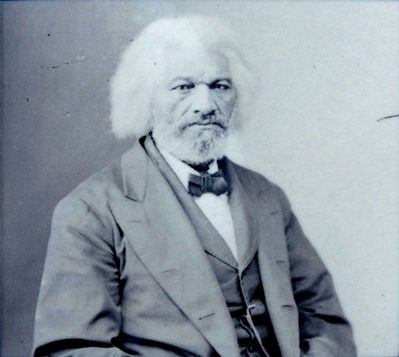
“Going to live in Baltimore laid the foundation, and opened the gateway, to all my subsequent prosperity.” — Frederick DouglassClose-up of image on marker
Photographed by Allen C. Browne, September 27, 2015
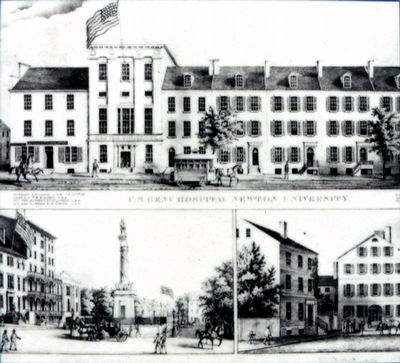
9. The Douglas Institute
The Douglas Institute was located in the 200 block of East Lexington Street. Close-up of image on marker
Photographed by Allen C. Browne, September 27, 2015
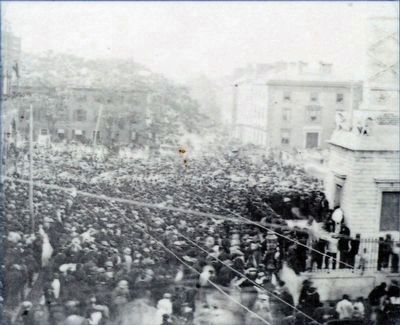
10. Celebrating the Fifteenth Amendment
African Americans celebrating passage of the Fifteenth Amendment, which guaranteed that states could not bar people from voting on account of “race, color, or previous condition of servitude.” Baltimore poet Frances Ellen Watkins Harper stated, “When the colored man drops the bullet, he must have in his hands the ballot.” Close-up of image on marker
Photographed by Allen C. Browne, September 27, 2015
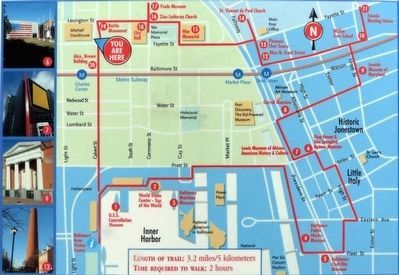
11. You are Here
Photographed by Allen C. Browne, September 27, 2015
12. Heritage Walk markers
Credits. This page was last revised on April 17, 2020. It was originally submitted on October 7, 2015, by Allen C. Browne of Silver Spring, Maryland. This page has been viewed 954 times since then and 39 times this year. Photos: 1, 2, 3, 4, 5, 6, 7, 8, 9, 10, 11, 12. submitted on October 7, 2015, by Allen C. Browne of Silver Spring, Maryland. • Bernard Fisher was the editor who published this page.
