
Santiago de Querétaro in Querétaro, Mexico — The Central Highlands (North America)
Church and Former Convent of San Francisco
⎯⎯⎯
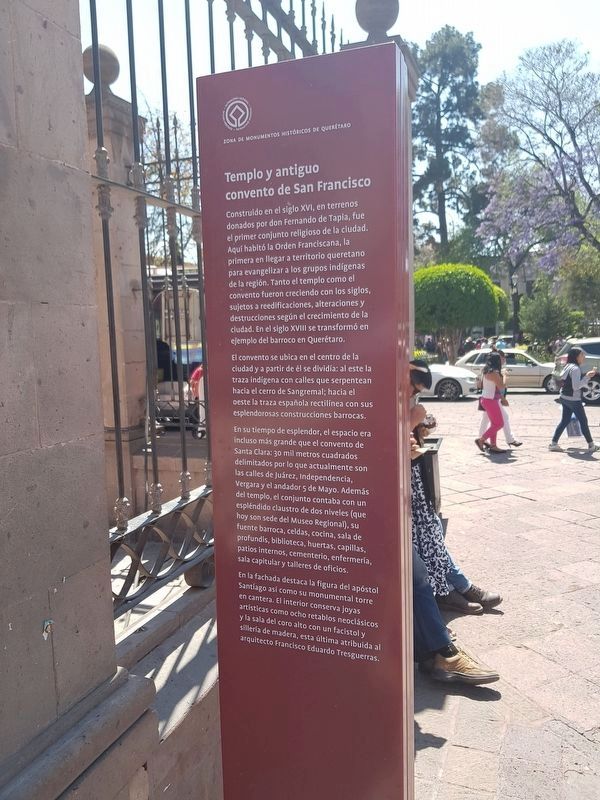
Templo y antiguo convento de San Francisco
Photographed by J. Makali Bruton, April 1, 2018
1. Temple and former Convent of San Francisco Marker

El convento se ubica en el centro de la ciudad y a partir de él se dividía: al este la traza indígena con calles que serpentean hacia el cerro de Sangremal; hacia el oeste la traza española rectilínea con sus esplendorosas construcciones barrocas.
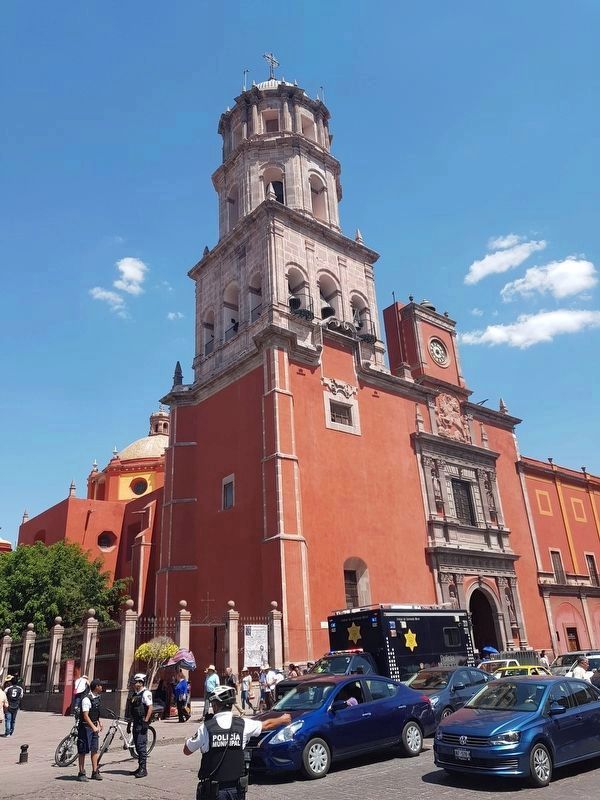
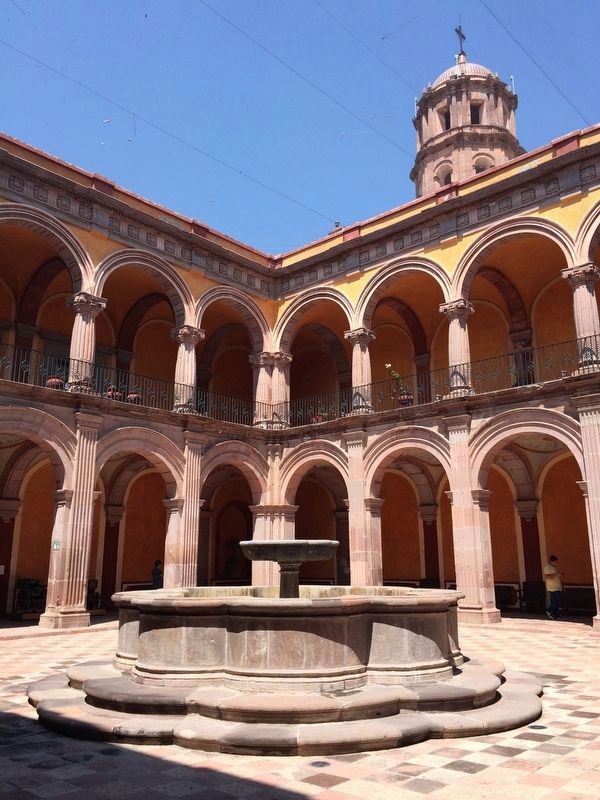
En su tiempo de esplendor, el espacio era incluso más grande que el convento de Santa Clara: 30 mil metros cuadrados delimitados por lo que actualmente son las calles de Juárez, Independencia, Vergara y el andador 5 de Mayo. Además del templo, el conjunto contaba con un espléndido claustro de dos niveles (que hoy son sede del Museo Regional), su fuente barroca,
this page online
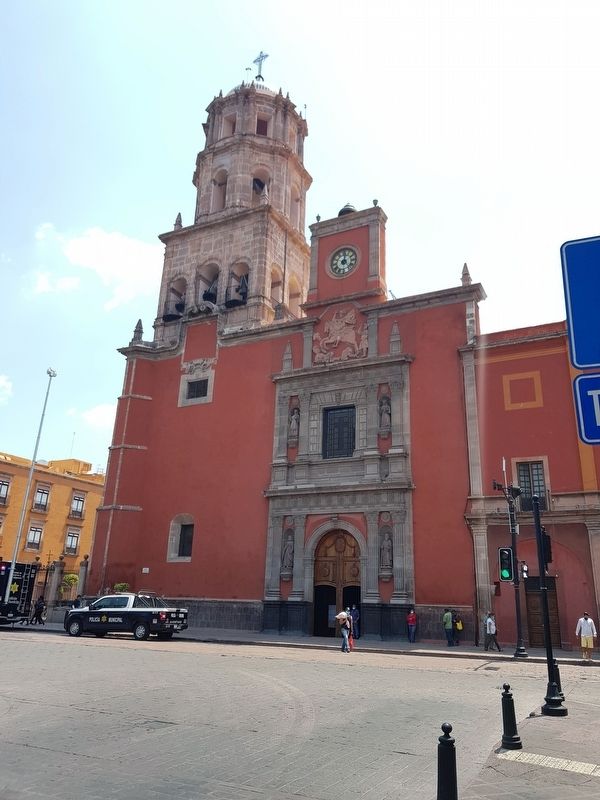
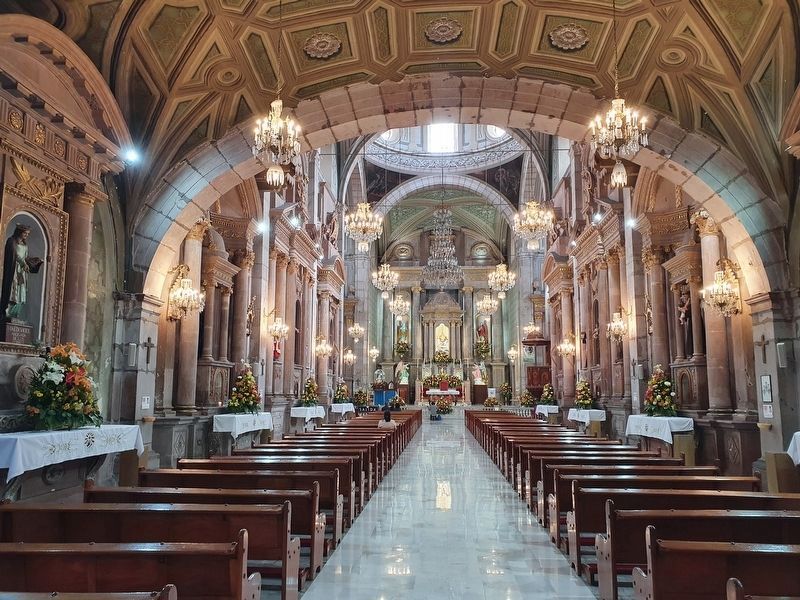
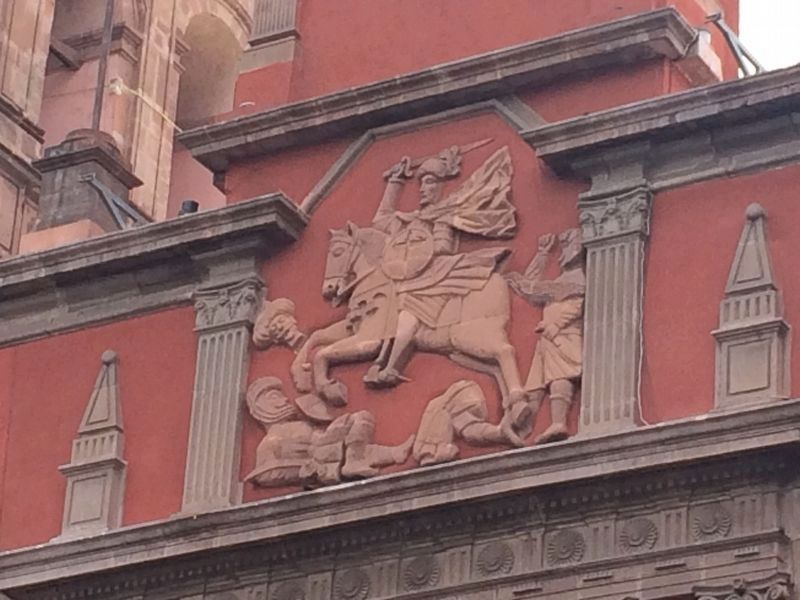
En la fachada destaca la figura del apóstol Santíago así como su monumental torre en cantera. El interior conserva joyas artísticas como ocho retablos neoclásicos y la sala del coro alto con un facistol y retablos neoclásicos y sillería de madera, esta última atribuida al arquitecto Francisco Eduardo Tresguerras
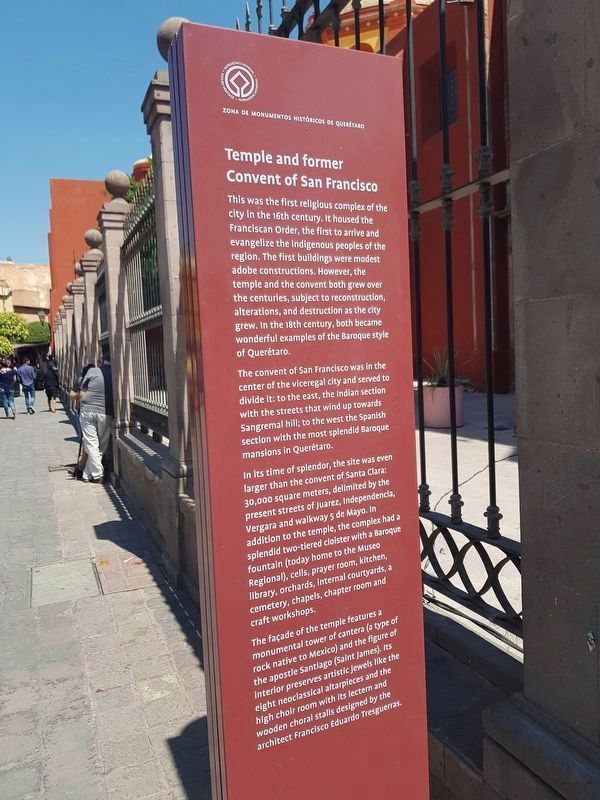
The convent of San Francisco was in the center of the viceregal city and served to divide it: to the east, the Indian section with the streets that wind up towards Sangremal hill; to the west the Spanish section with the most splendid Baroque mansions in Querétaro.
In its time of splendor, the site was even larger than the convent of Santa Clara: 30,000 square meters, delimited by the present streets of Juarez, Independencia, Vergara and walkway 5 de Mayo. In addition to the temple, the complex had a splendid two-tiered cloister with a Baroque fountain (today home to the Museo Regional), cells, prayer room, kitchen, library, orchards, internal courtyards, a cemetery, chapels, chapter room and craft workshops.
The façade of the temple features a monumental tower of cantera (a type of rock native to Mexico) and the figure of the apostle Santiago (Saint James). Its interior preserves artistic jewels like the eight neoclassical altarpieces and the high choir room with its lectern and wooden choral stalls designed by the architect Francisco Eduardo Tresguerras.
Erected 2018
Photographed by J. Makali Bruton, April 1, 2018
2. Temple and former Convent of San Francisco Marker English text
The marker is a two-sided bilingual marker, with the English text facing towards the street and Parque Zinea.
Topics. This historical marker is listed in these topic lists: Colonial Era • Man-Made Features • Religion & Religious Structures.
Location. 20° 35.586′ N, 100° 23.496′ W. Marker is in Santiago de Querétaro, Querétaro. It can be reached from Calle 5 de Mayo. Touch for map. Marker is in this post office area: Santiago de Querétaro QUE 76000, Mexico. Touch for directions.

Regionally, this marker is in Central Mexico and in the Bajío. Globally, it is in North America, specifically in Mesoamerica, on the Ring of Fire, and in the Western Hemisphere. Historically, it finds itself in what was once New Spain, a Spanish colony, and the Aztec Empire.
Other nearby markers. At least 8 other markers are within walking distance of this marker: Monument to Josefa Ortiz de Domínguez (about 90 meters away, measured in a direct line); The Royal Inland Road (about 90 meters away); Residence of Epigmenio and Emeterio González (about 90 meters away); The Great Convent of San Francisco (about 120 meters away); Foundations of the Convent of San Francisco
Photographed by J. Makali Bruton, October 27, 2015
3. The previous Ex-convent and Temple of San Francisco Marker
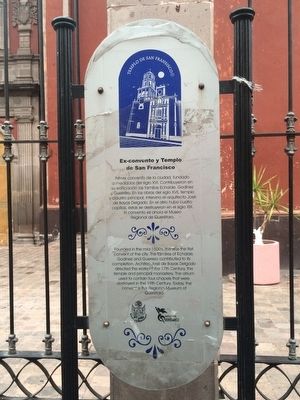
This previous marker by Unidos por Querétaro was replaced in 2018. Its text read:
Primer convento de la ciudad, fundado
a mediados del siglo XVI. Contribuyeron en
su edificación las familias Echaide, Godínez
y Guerrero. En las obras del siglo XVII, templo
y claustro principal, intervino el arquitecto José
de Bayas Delgado. En el atrio hubo cuatro
capillas, éstas se destruyeron en el siglo XIX.
El convento es ahora el Museo
Regional de Querétaro.
English:
Founded in the mid-1500s, this was the first
convent in the city. The families of Echaide,
Godínez and Guerrero contributed to its
completion. Architect José de Bayas Delgado
directed the works of the 17th Century, the
temple and principal monastery. The atrium
used to contain four chapels that were
destroyed in the 19th Century. Today, the
convent is the Regional Museum of
Querétaro.
a mediados del siglo XVI. Contribuyeron en
su edificación las familias Echaide, Godínez
y Guerrero. En las obras del siglo XVII, templo
y claustro principal, intervino el arquitecto José
de Bayas Delgado. En el atrio hubo cuatro
capillas, éstas se destruyeron en el siglo XIX.
El convento es ahora el Museo
Regional de Querétaro.
convent in the city. The families of Echaide,
Godínez and Guerrero contributed to its
completion. Architect José de Bayas Delgado
directed the works of the 17th Century, the
temple and principal monastery. The atrium
used to contain four chapels that were
destroyed in the 19th Century. Today, the
convent is the Regional Museum of
Querétaro.
Another marker is no longer nearby. Monument Dedicated to "La Corregidora" (was about 90 meters away but has been permanently removed).
More about this marker. The marker was replaced in 2018 with updated text but in the same location as a marker with the same name. The marker also mentions that the area is part of the Zone of Historical Monuments of Querétaro (Zona de Monumentos Históricos de Querétaro) as part of its designation as a UNESCO World Heritage Site.
Photographed by J. Makali Bruton, October 27, 2015
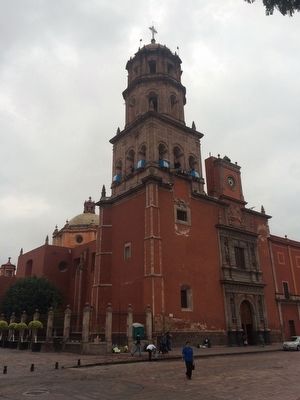
4. Ex-convent and Temple of San Francisco
Photographed by J. Makali Bruton, April 1, 2018
5. Temple and former Convent of San Francisco and Marker
The 2018 marker can be seen here towards the left, some few meters to the west of the previous marker's location.
Photographed by J. Makali Bruton, October 27, 2015
6. The previous Ex-convent and Temple of San Francisco Marker
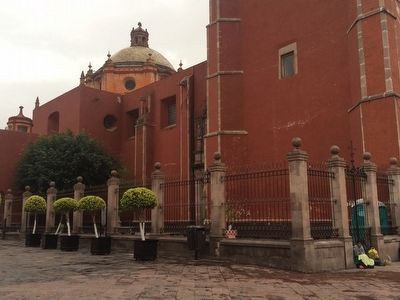
The previous marker was mounted next to the fourth stone column along the side of the temple.
Photographed by J. Makali Bruton, October 27, 2015
7. Fountain of the atrium of the Temple of San Francisco
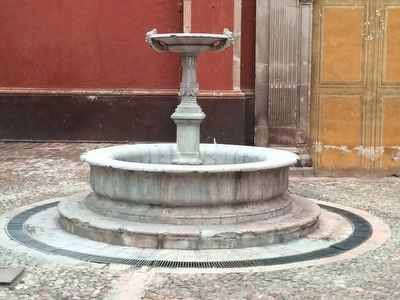
This fountain is just north of the temple, within its gated atrium area. A nearby sign (removed in 2018) read:
Fuente del atrio del Templo de San Francisco, Antigua y hermosa construcción, muy franciscana por lo sencillo de su fabricación, en cantera gris, tonel pretil hacia fuera; las piedras están unidas en la parte superior con grapas de fierro. Al centro luce una curiosa columna que sostiene extendida taza con vertor, a cuyos costados oriente y poniente tiene figuras estilizadas que semejan peces, por cuyas bocas cae el agua hacia la fuente.
English:
An old and beautiful construction, very Franciscan by the simplicity of its manufacture, in gray stone, guardrail butt facing outward; the stones are joined in the upper part with iron cramps. In the center, it displays a curious column holding an outstretched cup with pourer, whose east and west sides have stylized figures resembling fish, through whose mouths the water falls into the fountain.
An old and beautiful construction, very Franciscan by the simplicity of its manufacture, in gray stone, guardrail butt facing outward; the stones are joined in the upper part with iron cramps. In the center, it displays a curious column holding an outstretched cup with pourer, whose east and west sides have stylized figures resembling fish, through whose mouths the water falls into the fountain.
Photographed by J. Makali Bruton, March 26, 2017
8. The interior courtyard and fountain of the Ex-convent and Temple of San Francisco
The building now houses the Querétaro Regional Museum.
Photographed by J. Makali Bruton, May 9, 2020
9. Temple and former Convent of San Francisco
Photographed by J. Makali Bruton, October 9, 2021
10. An interior view of the Temple of San Francisco
Photographed by J. Makali Bruton, October 27, 2015
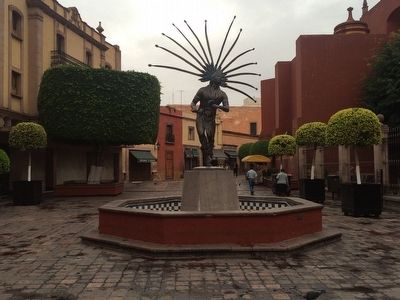
11. Concheros statue and fountain
This statue of a Concheros dancer by Juan Velasco Perdomo (Fundición Neleco, S.A. de C.V) from 2002 can be seen in the Andandor Cinco de Mayo north of the Temple. To the right of the potted tree can be seen the previous marker (removed in early 2018) about the atrium's fountain.
Photographed by J. Makali Bruton, July 18, 2017
12. Detail of the facade of the Temple of San Francisco
On the facade of the church is this image of St. James (Santiago) probably depicted fighting against Moors in Spain.
Credits. This page was last revised on October 23, 2025. It was originally submitted on November 6, 2015, by J. Makali Bruton of Washington, District of Columbia. This page has been viewed 996 times since then and 92 times this year. Photos: 1, 2. submitted on May 13, 2018, by J. Makali Bruton of Washington, District of Columbia. 3, 4. submitted on November 6, 2015, by J. Makali Bruton of Washington, District of Columbia. 5. submitted on May 13, 2018, by J. Makali Bruton of Washington, District of Columbia. 6, 7. submitted on November 6, 2015, by J. Makali Bruton of Washington, District of Columbia. 8. submitted on May 26, 2017, by J. Makali Bruton of Washington, District of Columbia. 9. submitted on May 25, 2020, by J. Makali Bruton of Washington, District of Columbia. 10. submitted on December 21, 2021, by J. Makali Bruton of Washington, District of Columbia. 11. submitted on November 6, 2015, by J. Makali Bruton of Washington, District of Columbia. 12. submitted on July 23, 2017, by J. Makali Bruton of Washington, District of Columbia.
