Navy Yard in Southeast Washington in Washington, District of Columbia — The American Northeast (Mid-Atlantic)
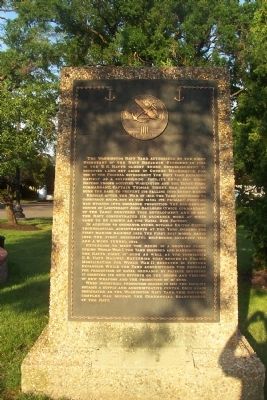
The Washington Navy Yard
Photographed by Richard E. Miller, 2008
1. The Washington Navy Yard, Marker
Rebuilt after the War of 1812, the Yard continued to construct ships, but by the 1850s its primary function had evolved into ordnance production. The engineering genius of Lieutenant John Dahlgren (twice commandant of the Yard) nurtured this development, and in 1886 the Navy concentrated its ordnance work at what came to be known as the Naval Gun Factory.
In addition to ordnance, other notable United States technological achievements at the Yard include: the first marine railway (1822), the first ship model basin (1898), the first successful shipboard catapult (1912), and a wind tunnel (1914).
Expanding to meet the needs of a growing fleet during World War I, the Yard designed and manufactured the Navy's first 16" guns as well as the innovative U.S. Navy Railway Batteries that served in France. Mobilization for World War II resulted in further expansion. While the Yard administered the program for production of naval ordnance by private industry, it directed its own efforts on the design and testing of new weapons and the production of 16" guns.
When industrial production ceased in 1961, the facility became a supply and administrative center. Once again designated as the Washington Navy Yard, this historic complex has become the ceremonial quarterdeck of the Navy.
Erected by U.S. Navy.
Topics and series. This historical marker is listed in these topic lists: Industry & Commerce
this page online
Location. 38° 52.549′ N, 76° 59.69′ W. Marker is in Southeast Washington in Washington, District of Columbia. It is in Navy Yard. It is at the intersection of Dahlgren Avenue Southeast and Warrington Avenue Southeast, on the right when traveling north on Dahlgren Avenue Southeast. Marker is inside the Washington Navy Yard, at the northwest corner of Leutze Park and across Warrington Avenue from the historic Latrobe Gate which is now an entrance for high ranking Yard residents, only. Touch for map. Marker is in this post office area: Washington Navy Yard DC 20374, United States of America. Touch for directions.

Regionally, this marker is in the Washington Metropolitan Area. It is also in the American Northeast, in the Upper South, in the Mid-Atlantic, in the Tidewater, and in the Chesapeake Bay Region. Globally, it is in North America, the Western Hemisphere, the Western World, and the Anglosphere.
Other nearby markers. At least 8 other markers are within walking
Photographed by Craig Swain, July 21, 2008
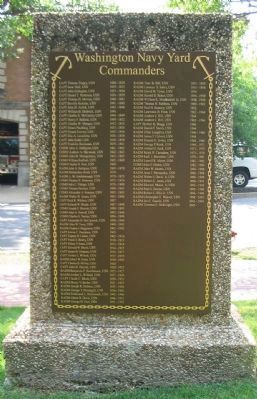
2. Back of Monument
Listing of the Navy Yard Commanders.
More about this marker. Parking is restricted in the area of Luetze Park during business hours. Visitors are required to enter the Yard via the west or north entrances off M or 11th Streets Southeast. Drivers without military identification must obtain a visitor's pass and proceed to an authorized parking area as directed.
Also see . . .
1. Washington Navy Yard. (Submitted on July 4, 2008, by Richard E. Miller of Oxon Hill, Maryland.)
2. RAdm Eugene Henry Cozzens Leutze, USN.
Photographed by Craig Swain, July 21, 2008
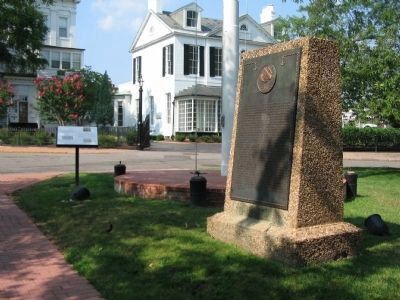
3. The Washington Navy Yard Monument
Note the iron "eprouvettes" and muzzles of iron cannons at the base of the flag pole. See photos below for more on the eprouvettes. The iron cannon were old types discarded by the Navy, but used here as bases for flagpole cleats.
3. "History of the Washington Navy Yard Watch Box". (Submitted on November 9, 2015, by Richard E. Miller of Oxon Hill, Maryland.)
Photographed by Richard E. Miller, 2008
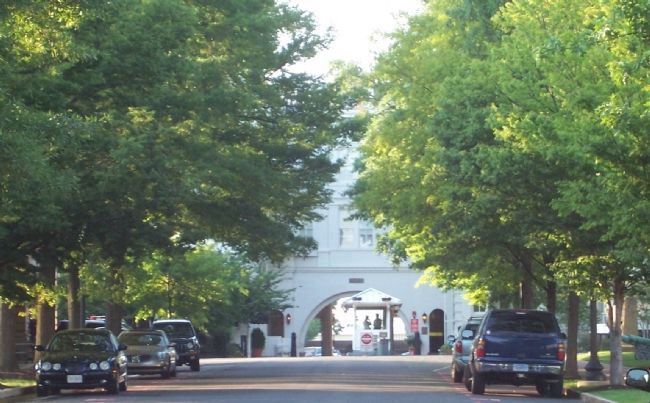
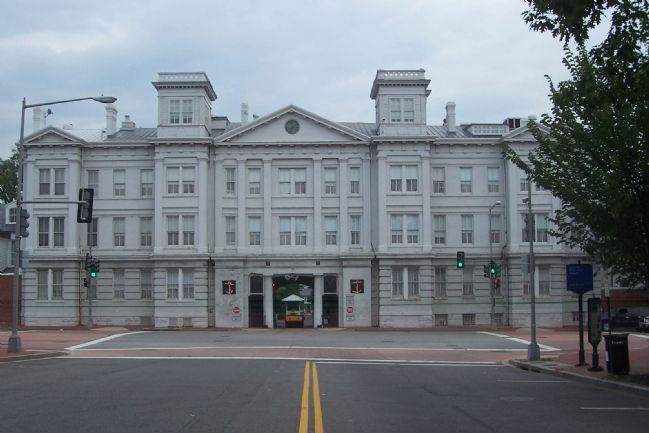
4. Latrobe Gate - designed by Benjamin Henry Latrobe, 1804
View north on Dahlgren Avenue toward the oldest continuously manned sentry post in the U.S. Marine Corps. The marker can be seen among the trees to the right.
Photographed by Richard E. Miller, 2008
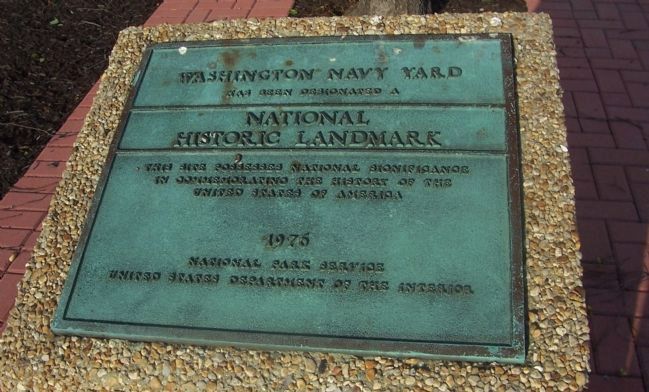
5. The Washington Navy Yard
Designated a National Historic Landmark, 1976
Photographed by Richard E. Miller, 2008
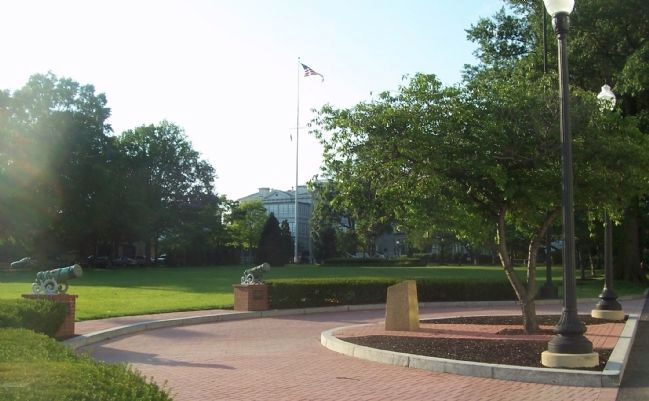
6. Leutze Park, the Washington Navy Yard's ceremonial quarterdeck
View toward Latrobe Gate, across the park (named for RAdm. Eugene H. Leutze, Commandant of the Yard, 1905-1910) from the National Historic Landmark plaque. The Washington Navy Yard Marker is among the trees near the flagpole.
Photographed by Richard E. Miller, August 5, 2008
7. The Latrobe Gate, Washington Navy Yard
as seen from outside the Yard at 8th and M Streets, SE.
Photographed by Craig Swain, July 21, 2008
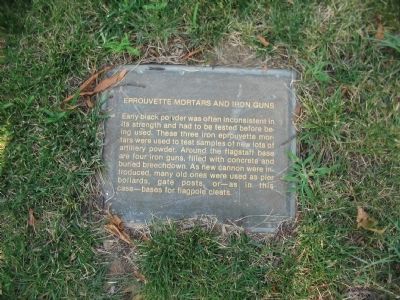
8. Eprouvette Mortars and Iron Guns
Early black powder was often inconsistent in its strength and had to be tested before being used. These three iron eprouvette mortars were used to test samples of new lots of artillery powder. Around the flagstaff base are four iron guns, filled with concrete and buried breechdown. As new cannon were introduced, many old ones were used as pier bollards, gate posts, or - as in this case - bases for flagpole cleats.
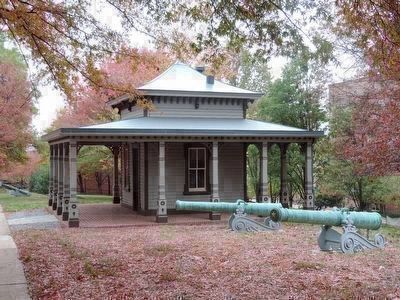
Photographed by Richard E. Miller, November 2, 2015
9. The Washington Navy Yard "Watch Box"
Manned by Marines, this small building was part of the sentry post that helped secure the 8th Street entrance to the Washington Navy Yard until around 1905 when it was removed to the Navy's Proving Grounds at Indian Head, Maryland for another century.
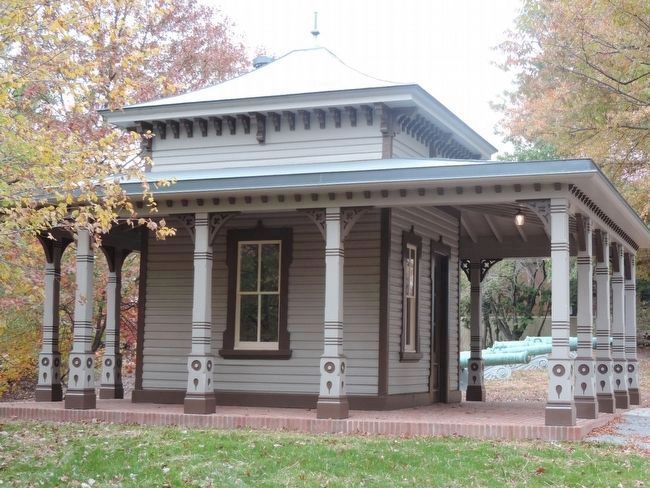
Photographed by Richard E. Miller, November 2, 2015
10. The Washington Navy Yard "Watch Box"
Abraham Lincoln passed here.
Photographed by Craig Swain, July 21, 2008
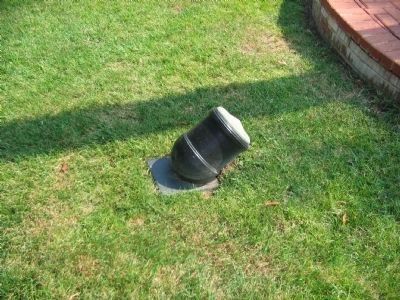
11. An Eprouvette
The eprouvette was a variation of the mortar. As seen here, construction was a simple "cup" on a fixed bed. Elevation was exactly 45 degrees. Based on that fixed elevation, the strength of the powder could be calculated based on the distance a 24 pound shot was propelled by a single ounce of powder. The range was expected to exceed 225 yards. Good powder propelled the shot to over 300 yards.
The eprouvette fell into disfavor as it was discovered black powder strength increases exponentially as quantity is increased. Furthermore, the qualities of slow burning powder, which worked much better in long bore cannon, could not be tested in the small mortar.
The eprouvette fell into disfavor as it was discovered black powder strength increases exponentially as quantity is increased. Furthermore, the qualities of slow burning powder, which worked much better in long bore cannon, could not be tested in the small mortar.
Photographed by Richard E. Miller, June 08
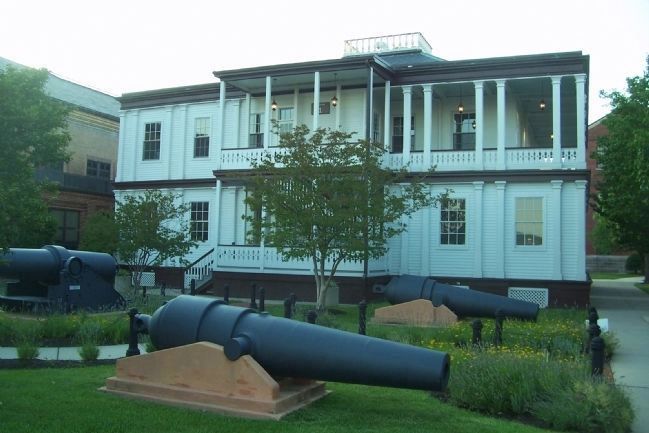
12. The Middledorf Building and Historic Commandant's Office
The U.S. Navy's oldest active office building, constructed 1837-38, renovated 1993. Note some of the Yard's extensive collection of historic iron ordnance on display in the foreground. On the right is a "Stockton Gun" which once armed the USS Princeton. In the center is a Brooke 7-inch Rifled Cannon from the CSS Tennessee, made famous for actions at the Battle of Mobile Bay. On the right is a 10-inch Brooke Smoothbore from the CSS Columbia, captured at Charleston, S.C.
Photographed by Richard E. Miller, August 12, 2008
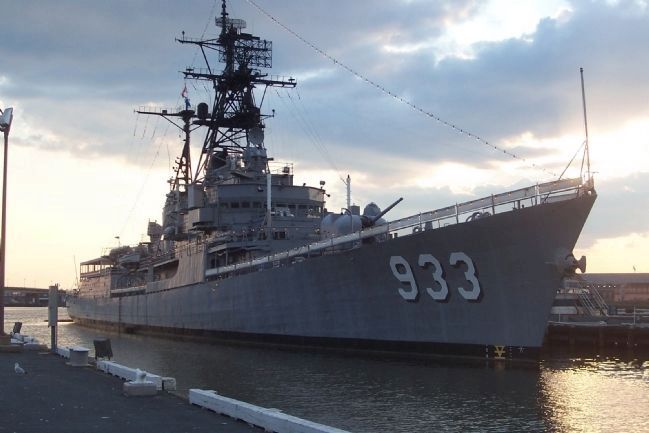
13. Display Ship, USS Barry (DD-933)
permanently moored on the Yard's Anacostia riverfront.
Credits. This page was last revised on January 30, 2023. It was originally submitted on July 4, 2008, by Richard E. Miller of Oxon Hill, Maryland. This page has been viewed 3,683 times since then and 58 times this year. Last updated on November 9, 2015, by Richard E. Miller of Oxon Hill, Maryland. Photos: 1. submitted on July 4, 2008, by Richard E. Miller of Oxon Hill, Maryland. 2, 3. submitted on August 6, 2008, by Craig Swain of Leesburg, Virginia. 4, 5, 6. submitted on July 4, 2008, by Richard E. Miller of Oxon Hill, Maryland. 7. submitted on August 6, 2008, by Richard E. Miller of Oxon Hill, Maryland. 8. submitted on August 6, 2008, by Craig Swain of Leesburg, Virginia. 9, 10. submitted on November 10, 2015, by Richard E. Miller of Oxon Hill, Maryland. 11. submitted on August 6, 2008, by Craig Swain of Leesburg, Virginia. 12. submitted on August 10, 2008, by Richard E. Miller of Oxon Hill, Maryland. 13. submitted on August 13, 2008, by Richard E. Miller of Oxon Hill, Maryland. • Bill Pfingsten was the editor who published this page.
