Fredericksburg, Virginia — The American South (Mid-Atlantic)
No Outlet
Captain John Smith Chesapeake National Historic Trail
| — | National Park Service, U.S. Department of the Interior | — |
Photographed by Kevin W., April 27, 2025
1. No Outlet Marker
(panel 1)
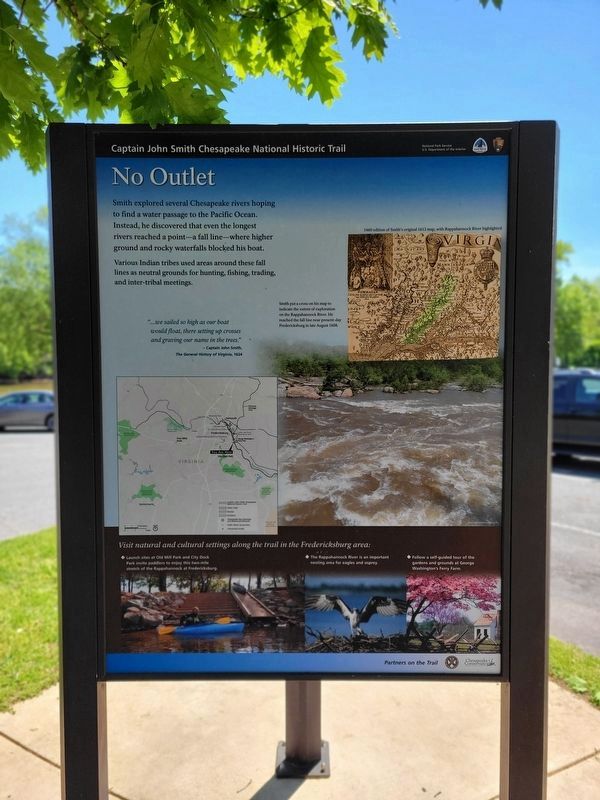
No Outlet
Smith explored several Chesapeake rivers hoping to find a water passage to the Pacific Ocean. Instead, he discovered that even the longest rivers reached a point—a fall line—where higher ground and rocky waterfalls blocked his boat.
Various Indian tribes used areas around these fall lines as neutral grounds for hunting, fishing, trading, and inter-tribal meetings.
“…we sailed so high as our boat would float, there setting up crosses and graving our name in the trees.”
-Captain John Smith, The General History of Virginia, 1624
(captions)
Smith puts a cross on his map to indicate the extent of exploration on the Rappahannock River. He reached the fall line near present-day Fredericksburg in late August 1608.
1660 edition of Smith’s original 1612 map, with Rappahannock River highlighted.
Visit natural and cultural settings along the trail in the Fredericksburg area:
• Launch sites at Old Mill Park and City Dock Park invite paddlers to enjoy this two-mile stretch of the Rappahannock at Fredericksburg.
• The Rappahannock River is an important nesting area for
this page online
• Follow a self-guided tour of the gardens and grounds at George Washington’s Ferry Farm.
(panel 2)
John Smith Explores the Chesapeake
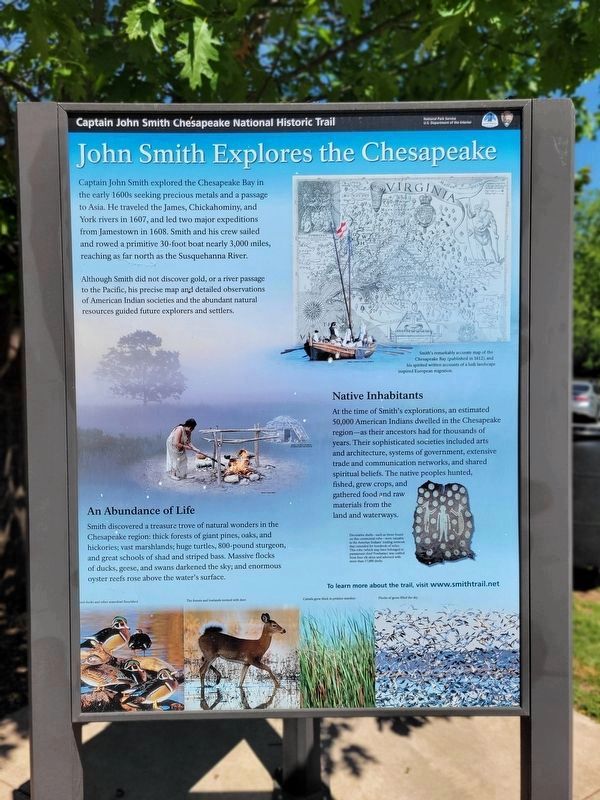
Captain John Smith explored the Chesapeake Bay in the early 1600s seeking precious metals and a passage to Asia. He traveled the James, Chickahominy, and York rivers in 1607, and led two major expeditions from Jamestown in 1608. Smith and his crew sailed and rowed a primitive 30-foot boat nearly 3,000 miles, reaching as far north as the Susquehanna River.
Although Smith did not discover gold, or a river to the Pacific, his precise map and detailed observations of American Indian societies and the abundant natural resources guided future explorers and settlers.
Native Inhabitants
At the time of Smith's explorations, an estimated 50,000 American Indians dwelled in the Chesapeake region—as their ancestors had for thousands of years. Their sophisticated societies included arts and architecture, systems of government, extensive trade and communication networks, and shared spiritual beliefs. The native people hunted, fished, grew crops, and gathered food and raw materials
Photographed by Kevin W., April 27, 2025
2. John Smith Explores the Chesapeake Marker
An Abundance of Life
Smith discovered a treasure trove of natural wonders in the Chesapeake region: thick forests of giant pines, oaks, and hickories; vast marshlands, huge turtles, 800-pound sturgeon, and great schools of shad and striped bass. Massive flocks of ducks, geese, and swans darkened the sky; and enormous oyster reefs rose above the water's surface.
To learn more about the trail visit www.smithtrail.net
(captions)
Smith’s remarkably accurate map of the Chesapeake Bay (published in 1612), and his spirited written accounts of a lush landscape inspired European migration.
Decorative shells-such as those found on this ceremonial robe-were valuable in the American Indian’s trading network that extended for hundreds of miles. This robe (which may have belonged to paramount chief Powhatan) was crafted from four elk skins and adorned with more than 17,000 shells.
Wood ducks and other waterfowl flourished
The forests and lowlands teemed with deer
Cattails grew thick in pristine marshes
Flocks of geese filled the sky
(panel 3)
Join the Adventure
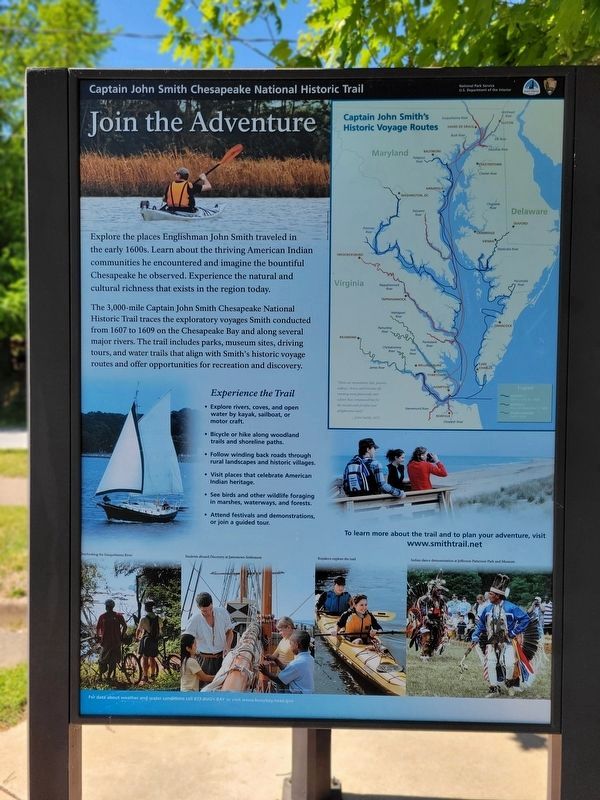
Explore the places Englishman
Photographed by Kevin W., April 27, 2025
3. Join the Adventure Panel
The 3,000-mile Captain John Smith Chesapeake National Historic Trail traces the exploratory voyages Smith conducted from 1607 to 1609 on the Chesapeake Bay and along several major rivers. The trail includes parks, museum sites, driving tours, and water trails that align with Smith's historic voyage routes and offer opportunities for recreation and discovery.
Experience the Trail
• Explore rivers, coves, and open water by kayak, sailboat, or motor craft.
• Bicycle or hike along woodland trails and shoreline paths.
• Follow winding back roads through rural landscapes and historic villages.
• Visit places that celebrate American Indian heritage.
• See birds and other wildlife foraging in marshes, waterways, and forests.
• Attend festivals and demonstrations, or join a guided tour.
To learn more about the trail and to plan your adventure, visit
www.smithtrail.net
(captions)
Captain John
Photographed by Don Morfe, August 18, 2016
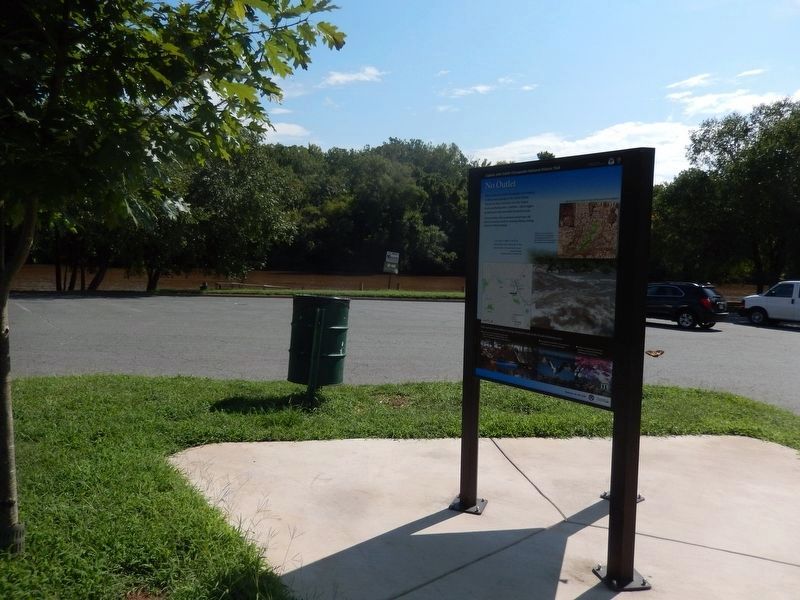
4. No Outlet Marker-Parking lot in the background
“Here are mountains, hils, plaines, valleys, rivers, and brookes all running most pleasantly into a faire Bay compassed but for the mouth with fruitful and delightsome land.”
– John Smith, 1612
Overlooking the Susquehanna River
Students aboard Discovery at Jamestown Settlement
Kayakers explore the trail
Indian dance demonstration at Jefferson Patterson Park and Museum
Erected by National Park Service, U.S. Department of the Interior.
Topics and series. This historical marker is listed in these topic lists: Colonial Era • Exploration • Indigenous Peoples and Communities • Settlements & Settlers • Waterways & Vessels. In addition, it is included in the Captain John Smith Chesapeake National Historic Trail series list. A significant historical month for this entry is August 1608.
Location. 38° 17.81′ N, 77° 27.232′ W. Marker is in Fredericksburg, Virginia. It can be reached from Sophia Street 0.2 miles south of Frederick Street, on the left when traveling south. The marker is located in City Dock Park. Touch for map. Marker is at or near this postal address: 101 Sophia Street, Fredericksburg VA 22401, United States of America. Touch for directions.

Regionally, this marker is in the Washington Metropolitan Area and in Northern Virginia. It is also in the American South and specifically in the Upper South. Globally, it is in North America, the Western Hemisphere, the Western World, and the Anglosphere. Historically, it finds itself in what was once the territory of the Mississippian Culture, one of the original Thirteen Colonies, one of the Confederate States of America, and the Antebellum South.
Other nearby markers. At least 8 other markers are within walking distance of this marker: The Slave Ship Othello (here, next to this marker); The Middle Passage (here, next to this marker); Eyewitness To Battle (within shouting distance of this marker); Washington's Boyhood Home (within shouting distance of this marker); Irish Brigade (within shouting distance of this marker); Rocky Lane (within shouting distance of this marker); George Washington’s Boyhood Home at Ferry Farm (about 300 feet away, measured in a direct line); Fredericksburg's Wharves and Harbor (about 300 feet away). Touch for a list and map of all markers in Fredericksburg.
Other markers no longer nearby. Fredericksburg City Dock (was within shouting distance of this marker but has been permanently removed); a different marker also named Fredericksburg City Dock (was within shouting distance of this marker but has been permanently removed); a different marker also named Fredericksburg City Dock (was within shouting distance of this marker but has been permanently removed).
Also see . . . Captain John Smith Chesapeake National Historic Trail. National Park Service (Submitted on September 1, 2016.)
Credits. This page was last revised on May 21, 2025. It was originally submitted on August 31, 2016, by Don Morfe of Baltimore, Maryland. This page has been viewed 744 times since then and 17 times this year. Photos: 1, 2, 3. submitted on May 21, 2025, by Kevin W. of Stafford, Virginia. 4. submitted on August 31, 2016, by Don Morfe of Baltimore, Maryland. • Bernard Fisher was the editor who published this page.
