Quiriguá in Los Amates, Izabal, Guatemala — Central America
Quirigua within the Context of the Mayan Cities
Quiriguá dentro del Contexto de las Ciudades Mayas
Photographed by J. Makali Bruton, August 16, 2016
1. Quirigua within the Context of the Mayan Cities Marker

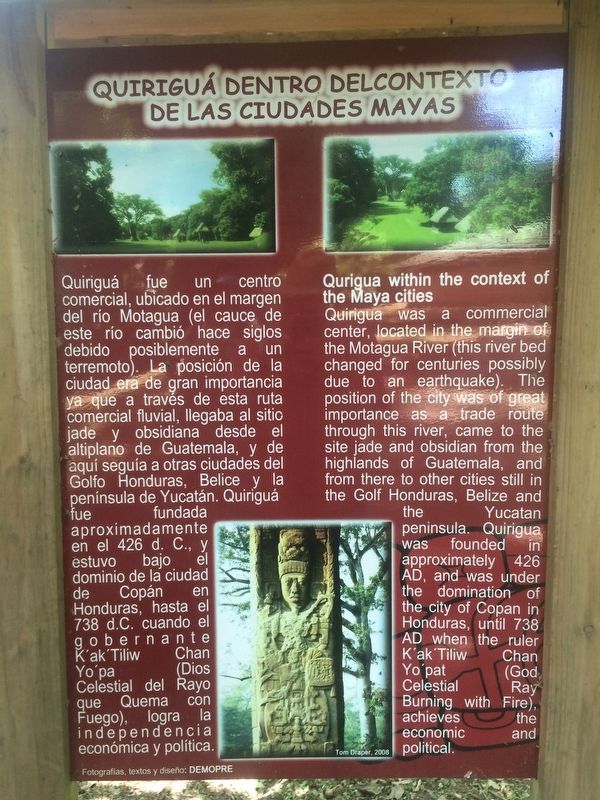
Quriguá fue un centro comercial, ubicado en el margen del río Motagua (el cauce de este río cambió hace siglos debido posiblemente a un terremoto). La posición de la ciudad era de gran importancia ya que a través de esta ruta comercial fluvial, llegaba al sitio jade y obsidiana desde el altiplano de Guatemala, y de aquí seguía a otras ciudades del Golfo Honduras, Belice y la península de Yucatán. Quiriguá fue fundada aproximadamente en el 426 d.C., y estuvo bajo el dominio de la ciudad de Copán en Honduras, hasta el 738 d.C. cuando el gobernante K'al'Tiliw Chan Yo'pa (Dios Celestial del Rayo que Quema con Fuego), logra la independencia económica y política.
Quirigua within the context of the Maya cities
Quirigua was a commercial center, located in the margin of the Motagua River (this river bed changed for centuries possibly due to an earthquake). The position of the city was of great importance as a trade route through this river, came to the site jade and obsidian from the highlands of Guatemala, and from there to other cities still in the Golf Honduras, Belize and the Yucatan peninsula. Quirigua was founded
this page online
Topics. This historical marker is listed in these topic lists: Anthropology & Archaeology • Indigenous Peoples and Communities • Man-Made Features.
Location. 15° 16.392′ N, 89° 2.473′ W. Marker is in Quiriguá, Izabal, in Los Amates. It can be reached from Ruinas de Quirigua. The marker is just to the west along the path into the Qurigua Archaeological Park. It is the first marker after the entrance to the park. Touch for map. Marker is in this post office area: Quiriguá, Izabal 18005, Guatemala. Touch for directions.

Regionally, it is on the Caribbean Sea, in North America, in Central America, in Mesoamerica, on the Ring of Fire, on the Pacific Rim, and in the Western Hemisphere. Historically, it finds itself in what was once New Spain and also a Spanish colony.
Other nearby markers. At least 6 other markers are within walking distance of this marker:
Photographed by J. Makali Bruton, August 16, 2016
2. Quirigua within the Context of the Mayan Cities Marker
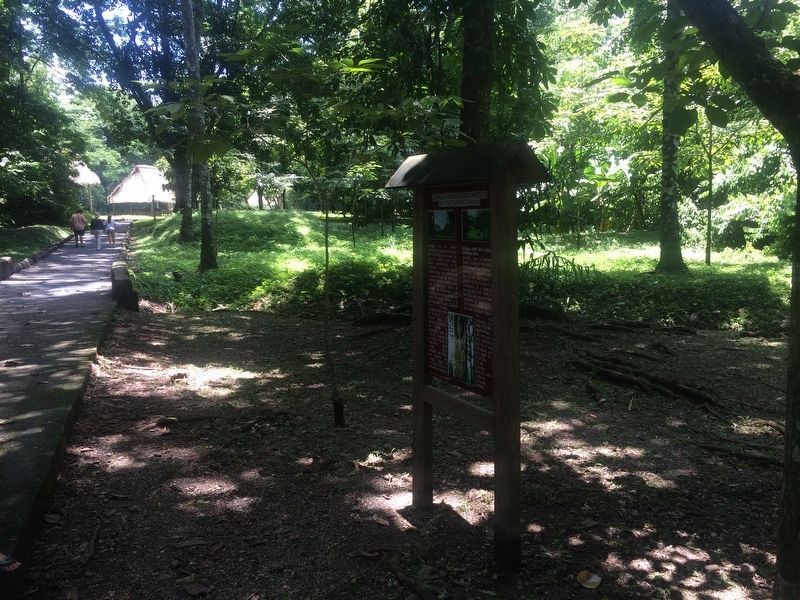
The Great Plaza at Quirigua marker can be seen in the distance in this view to the south.
Photographed by J. Makali Bruton, August 16, 2016
3. Quirigua within the Context of the Mayan Cities Marker
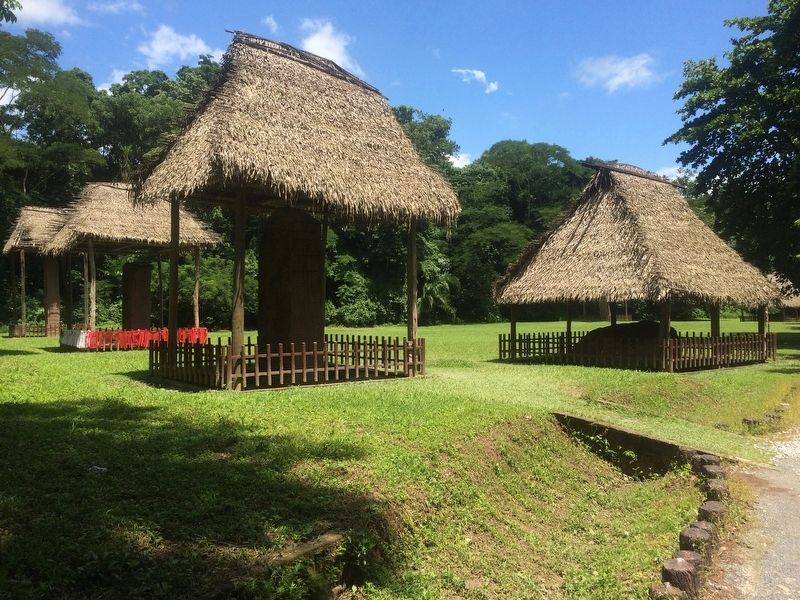
Stelae at the northern part of Quirigua Archaeological Park.
Credits. This page was last revised on January 31, 2025. It was originally submitted on September 20, 2016, by J. Makali Bruton of Washington, District of Columbia. This page has been viewed 408 times since then and 12 times this year. Photos: 1, 2, 3. submitted on September 20, 2016, by J. Makali Bruton of Washington, District of Columbia.
