Quiriguá in Los Amates, Izabal, Guatemala — Central America
The Stelae of Quiriguá

Photographed by J. Makali Bruton, August 16, 2016
1. The Stelae of Quiriguá Marker

Las estelas son rocas naturales que fueron acondicionadas para esculpir la inscripción de textos jeroglíficos e imágenes de gobernantes.
Anteriormente se creía que la estelas solamente contenían información del calendario Maya y que los personajes representados eran sacerdotes. Hoy día se sabe que éstas relatan distintos sucesos de los antiguos gobernantes Mayas, quienes a través de las imágenes que se representan demostraban toda su riqueza, poder y su relación y su relación con los dioses.
Fotografías, textos y diseños: Demopre
Stelae
Stelae are natural rocks that were upgraded to carve the inscription of hieroglyphic texts and images of rulers. Previously it was believed that only contained Maya's calendar information and that the characters represented were priests. Today we know that recount the glories of wars, rituals, among others, of the ancient Maya rulers, who through the images showed all their wealth, power and its relationship with the gods known as Jade Heaven who ruled between 800 and 810 AD.
Topics. This historical marker is listed in these topic lists: Anthropology & Archaeology •
this page online
Location. 15° 16.326′ N, 89° 2.436′ W. Marker is in Quiriguá, Izabal, in Los Amates. It can be reached from Vía Sin Nombre. The marker is roughly at the middle portion of the Archaeological Park at Quirigua, near the main grouping of stelas. Touch for map. Marker is in this post office area: Quiriguá, Izabal 18005, Guatemala. Touch for directions.

Regionally, it is on the Caribbean Sea, in North America, in Central America, in Mesoamerica, on the Ring of Fire, on the Pacific Rim, and in the Western Hemisphere. Historically, it finds itself in what was once New Spain and also a Spanish colony.
Other nearby markers. At least 6 other markers are within walking distance of this marker: A Contemporary Altar at Quiriguá (within shouting distance of this marker); The Great Plaza at Quirigua (within shouting distance of this marker); Quirigua within the Context of the Mayan Cities (about 150 meters away, measured in a direct line); Quirigua: History of the City, its Environment and Discovery (about

Photographed by J. Makali Bruton, August 16, 2016
2. The Stelae of Quiriguá Marker
The marker can be seen in the distant background to the right, in this view towards the west. The foreground shows the detail of Zoomorph G, made in 785 A.D.
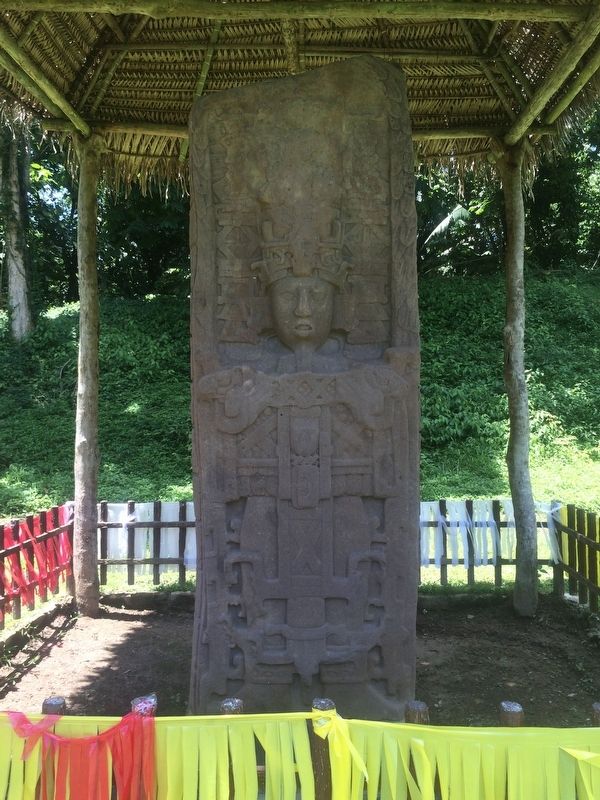
Photographed by J. Makali Bruton, August 16, 2016
3. Stela C at Quiriguá
The marker includes photos of many of the stelaes at Quiriguá. A close-up of this stela is on the bottom-right of the marker. It is Stela C which is dated December 29, 775 and is found at the northern portion of the Archaeological Park.
Credits. This page was last revised on January 31, 2025. It was originally submitted on October 20, 2016, by J. Makali Bruton of Washington, District of Columbia. This page has been viewed 414 times since then and 16 times this year. Photos: 1, 2, 3. submitted on October 20, 2016, by J. Makali Bruton of Washington, District of Columbia.
