Gloucester in Gloucester County, Virginia — The American South (Mid-Atlantic)
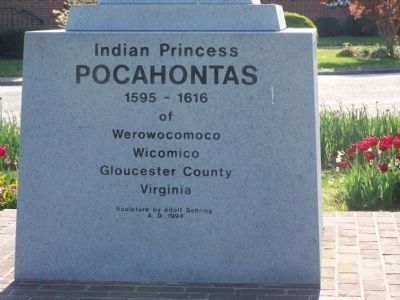
Indian Princess Pocahontas
1595 - 1616
Photographed by Beverly Pfingsten, April 18, 2008
1. Indian Princess Pocahontas Marker
1595 - 1616
of
Weromocomoco
Wicomico
Gloucester County
Virginia
Sculpture by Adolf Sehring
A.D.1994
Erected 1994.
Topics. This historical marker is listed in these topic lists: Colonial Era • Indigenous Peoples and Communities • Women. A significant historical year for this entry is 1994.
Location. 37° 24.983′ N, 76° 32.247′ W. Marker is in Gloucester, Virginia, in Gloucester County. It is at the intersection of Main Street (Business U.S. 17) and Belroi Road, on the left when traveling west on Main Street. Touch for map. Marker is at or near this postal address: 6262 Main St, Gloucester VA 23061, United States of America. Touch for directions.

Regionally, this marker is on the Middle Peninsula and in the Hampton Roads Metropolitan Area. It is also in the American South, specifically in the Upper South, in the Tidewater, in the Chesapeake Bay Region, and on the Eastern Seaboard. Globally, it is in the North Atlantic Region, North America, the Western Hemisphere, the Western World, and the Anglosphere. Historically, it finds itself in what was once the territory of the
this page online
Other nearby markers. At least 8 other markers are within walking distance of this marker: Gloucester Courthouse (a few steps from this marker); Cappahosic (a few steps from this marker); Boutetort Masonic Lodge (approx. 0.4 miles away); a different marker also named Gloucester Courthouse (approx. 0.4 miles away); In Memoriam John Clayton (approx. 0.4 miles away); The Birdsall Building (approx. 0.4 miles away); To the Confederate Dead of Gloucester (approx. 0.4 miles away); A Sacred Place (approx. half a mile away). Touch for a list and map of all markers in Gloucester.
Regarding Indian Princess Pocahontas. This plaque features a factual error -- Pocahontas was not a princess. While she was the daughter of a chief, it is inaccurate to consider her a princess.
Also see . . . Pocahontas. Wikipedia article (Submitted on December 25, 2019, by Devry Becker Jones of Washington, District of Columbia.)
Photographed by Beverly Pfingsten, April 18, 2008
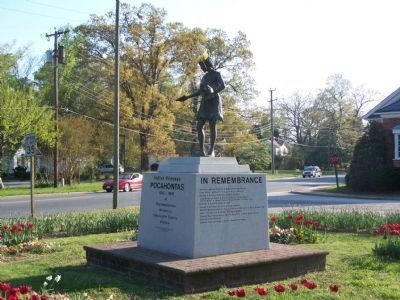
2. Pocahontas Statue
Photographed by Beverly Pfingsten, April 18, 2008
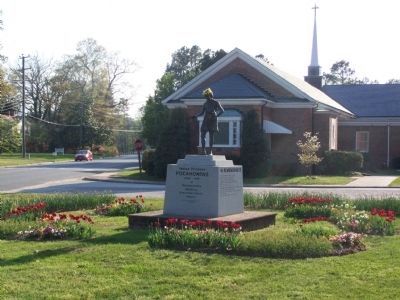
3. Another view of statue
Photographed by Allen C. Browne, February 16, 2015
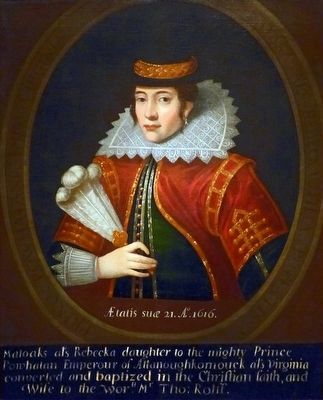
4. Pocahontas, age 21, 1616
This portrait of Pocahontas (Matoaks) after a 1616 engraving by Simon van de Passe hangs in the National Portrait Gallery in Washington DC.
Ætatis suæ 21. Ao. 1616.
Matoaks als Rebecka daughter to the mighty Prince Powhatan Emperour of Attanoughkomouck als Virginia converted and baptized in the Chriƒtian faith, and Wife to the worʰ. Mr Tho: Rolff.
“Pocahontas, the Indian princess who allegedly saved the life of English colonist John Smith, survives and flourishes as an example of an early American heroine. While Smith may have embellished the story of his rescue, the importance of Pocahontas to relations between colonists and Native Americans is undisputed. Following her conversion to Christianity and marriage to Englishman John Rolfe, Pocahontas journeyed to England with her family to demonstrate the ability of new settlers and native tribes to coexist in the Virginia colony. While in England, Pocahontas sat for her portrait, which was later engraved. That print served as the basis for this later portrait. The painter included an inscription beneath the likeness, copied from the engraving, but through an error in transcription it misidentifies her husband as Thomas, the name given to their son.” — National Portrait Gallery
Ætatis suæ 21. Ao. 1616.
Matoaks als Rebecka daughter to the mighty Prince Powhatan Emperour of Attanoughkomouck als Virginia converted and baptized in the Chriƒtian faith, and Wife to the worʰ. Mr Tho: Rolff.
“Pocahontas, the Indian princess who allegedly saved the life of English colonist John Smith, survives and flourishes as an example of an early American heroine. While Smith may have embellished the story of his rescue, the importance of Pocahontas to relations between colonists and Native Americans is undisputed. Following her conversion to Christianity and marriage to Englishman John Rolfe, Pocahontas journeyed to England with her family to demonstrate the ability of new settlers and native tribes to coexist in the Virginia colony. While in England, Pocahontas sat for her portrait, which was later engraved. That print served as the basis for this later portrait. The painter included an inscription beneath the likeness, copied from the engraving, but through an error in transcription it misidentifies her husband as Thomas, the name given to their son.” — National Portrait Gallery
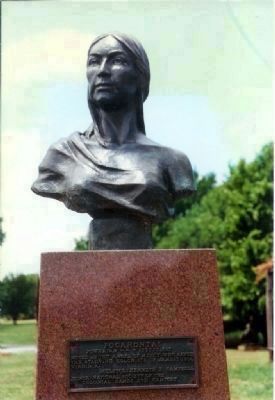
Photographed by Mike Stroud, 1996
5. Bust of Pocahontas at the National Hall of Fame for Famous American Indians, Anadarko, OK
Pocahontas
Powhatan ---1595 to 1617
Noted as the Angel of Mercy who saved the starving colonists of Jamestown, Virginia
Sculptor: Kenneth F. Campbell
Donor: National Society of the Colonial Dames XVII Century
Powhatan ---1595 to 1617
Noted as the Angel of Mercy who saved the starving colonists of Jamestown, Virginia
Sculptor: Kenneth F. Campbell
Donor: National Society of the Colonial Dames XVII Century
Credits. This page was last revised on November 10, 2025. It was originally submitted on May 1, 2008, by Bill Pfingsten of Bel Air, Maryland. This page has been viewed 8,177 times since then and 102 times this year. Last updated on November 8, 2025, by Caleb Kemplin of Virginia Beach, Virginia. Photos: 1, 2, 3. submitted on May 1, 2008, by Bill Pfingsten of Bel Air, Maryland. 4. submitted on October 26, 2015, by Allen C. Browne of Silver Spring, Maryland. 5. submitted on May 5, 2008, by Mike Stroud of Bluffton, South Carolina. • Devry Becker Jones was the editor who published this page.
