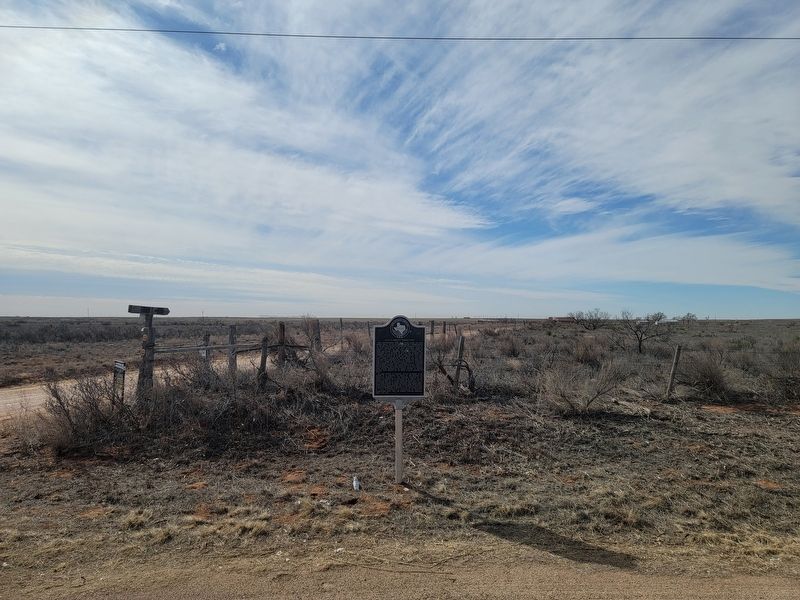
Once encompassing more than 33,000 acres, the area known locally as the Old Surratt Territory is representative of the late-19th century settlement and ranching history of the vast grasslands of the Texas Panhandle. Marshall Surratt (1849-1927), . . . — — Map (db m167632) HM
In March 1892, a delegation of Lubbock residents requested five acres of pasture land from pioneer minister H.M. Bandy for use as a cemetery. At the time, about fifty people were living in the community. That same month, they held the first burial, . . . — — Map (db m301090) HM
The use of this site as a burial ground began in 1923 when a traveling family camped here and their baby became ill and died. Other burials followed, and in 1932 Landowner Morton J. Smith deeded ten acres to the city of Morton for cemetery use. An . . . — — Map (db m155390) HM
In March 1892, a delegation of Lubbock residents requested five acres of pasture land from rancher H.M. Bandy for use as a cemetery. That same month, they held the first burial, that of a Cochran County cowboy, Henry Jenkins, who died of . . . — — Map (db m307821) HM
Built 1926 by realtor Wm. E. Flenniken, this was first brick structure in town. It housed land shoppers when Cochran County was opened to sales of small tracts.
Given 1968 to Girlstown, U.S.A. by J. S. Noel estate, for use of the . . . — — Map (db m73657) HM
A relic from one of America's last frontiers. Built in 1925 on range land of newly organized Cochran County, at Bledsoe, this structure not only served its purpose as a railroad station, but was a meeting hall for churches and social groups. . . . — — Map (db m73612) HM
Thin black lines indicate changes in relevance. Between each pair of lines entries are ordered geographically but all have the same relevance.
* Inflectional forms of words are their plurals, singulars, and possessives as well as gramatical tenses and similar variations.