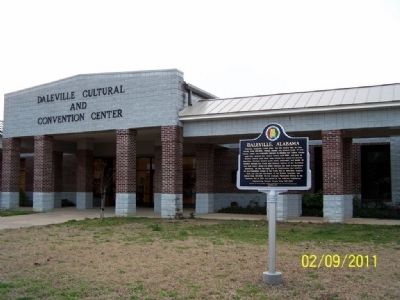
Daleville, originally called Dale, was the county seat of Dale County from 1831-1841. William Harper was probate judge of Dale County, which was originally included in present-day Coffee County until 1841, present-day Geneva County until 1868, and . . . — — Map (db m41145) HM
In 1858, the tiny Poplar Head community requested a post office. Since there was a town called Poplar Spring in the state, the postal authorities arbitrarily assigned the name Dothan to the new post office to prevent misdirected mail. Early maps and . . . — — Map (db m41137) HM
(side 1)
Old Columbia Jail
Erected sometime in the early 1860's, the Old Columbia Jail is today one of the last wooden jails still standing in Alabama. Originally, there were two cells, each measuring 10 x 15 feet. Interior . . . — — Map (db m73368) HM
Alabama native William Elbert "Buck" Mayes, son of the Rev. Isaac C. Mayes and Lucinda Fuller, came to Texas in 1856. He married Sarah (Dickerson) Clark in 1858. After serving in the Civil War Mayes returned to Houston County and became a successful . . . — — Map (db m219493) HM
(side 1)
Big Creek United Methodist Church
One of the oldest churches in southeast Alabama and reportedly the oldest church in Houston County. The first church structure was a log building constructed about 20 yards north of the . . . — — Map (db m73356) HM
Founded in 1820, Columbia was originally located about a mile south, near where the Omussee Creek flows into the Chattahoochee River. It served as the county seat of Henry County from 1826 to 1833. Bordering the State of Georgia and the . . . — — Map (db m73364) HM
Front
The original part of this building was home to one of the oldest
African American schools in Dale County. In 1949 on this site, the
new building for the Pinckard Colored School was constructed and
Mack M. Matthews became its . . . — — Map (db m115029) HM
We do not know the exact date that residents of the community of which Omussee Creek Mound was a part abandoned the mound, but by around 1550 it was definitely in decline. Many believe this may have been part of a broader, regional depopulation due . . . — — Map (db m115034) HM
The Jail at Houston
The Houston Jail is the only surviving log jail in north Alabama. The jail, constructed around 1868 from hand-hewn hardwood logs, replaced an earlier one destroyed by pro-Union men in the county during the Civil War. The . . . — — Map (db m182919) HM
Alabama native William Elbert "Buck" Mayes (1836-1915) came to this area in 1856. After serving in the Civil War, he returned to Houston County and became a successful businessman with interests in banking, real estate, construction and retail . . . — — Map (db m206925) HM
In 1857 Albert Holley (b. 1828), his mother and two brothers, migrated to Houston County from Alabama. While the others journeyed to Texas by boat, he brought the family's supplies overland by wagon with 137 slaves. By 1860 he and his wife Julia . . . — — Map (db m128926) HM
The original builders of the Omussee Creek mound
had abandoned the site by around 1550, but the
area continued to be occupied by Native American
groups well into the early nineteenth century. As early as
the 1630s, Spanish missionaries from . . . — — Map (db m115037) HM
Micam Main of Illinois was granted a league of land by the Mexican government in 1835. One of the area's first brickmakers, Samuel M. Warden, died while working on Main's estate on Christmas Eve in 1847. He was interred on this site. According to . . . — — Map (db m128982) HM
Front
The Columbia Cemetery was started in the 1830s on land given
by Rev. Edmund Talbot. It postdates the abandoned Omussee
Creek Church Cemetery located a mile SW of here. A "public
Meeting house," which served as the Columbia . . . — — Map (db m115031) HM
Thin black lines indicate changes in relevance. Between each pair of lines entries are ordered geographically but all have the same relevance.
* Inflectional forms of words are their plurals, singulars, and possessives as well as gramatical tenses and similar variations.