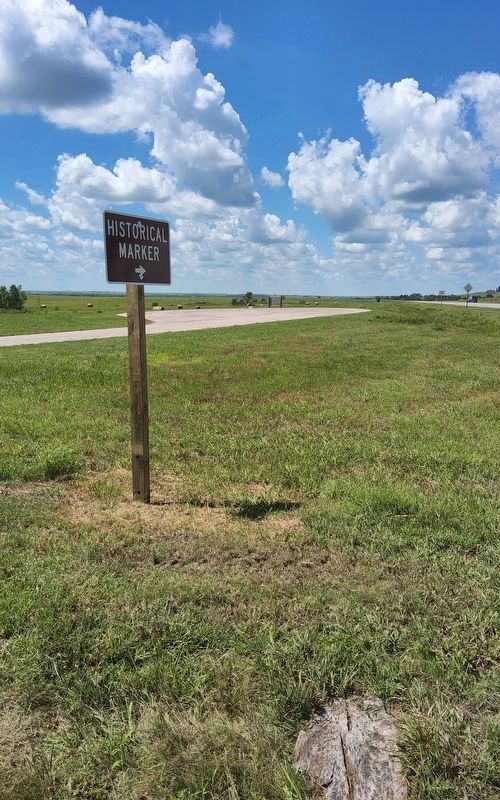
The vast prairie which surrounds this site is typical of the Bluestem pasture region more commonly known as the Flint Hills. Named for its predominant grasses, the area extends from Oklahoma almost to Nebraska in a narrow oval two counties wide . . . — — Map (db m43260) HM
Chase County, named after Salmon P. Chase, who was a United States Senator from Ohio and Chief Justice of the Supreme Court of the United States, was organized in 1859 in the Kansas Territory.
James Fisher, from Columbiana County, Ohio was the . . . — — Map (db m45683) HM
"And for the support of this Declaration, with a firm reliance on the Protection of Divine Providence, we mutually pledge to each other our Lives, our Fortunes and our sacred Honor"
--The Declaration of Independence
The Chase County All . . . — — Map (db m45694) WM
The stone sculptures before you were [?]ed by [?] Richard Stauffer and produced by the 1992 Kansas Sculptors Association Team Carv[?] [?] to illustrated the theme “Prairie Passage,” reflecting Emporia’s role as gateway to the Flint . . . — — Map (db m43258) HM
A trail to connect two communities - what a novel idea! This good idea to connect Cottonwood Falls and Strong City was first suggested in 1904. Of course it was to be a limestone sidewalk. Certainly the limestone was available and the equipment and . . . — — Map (db m45578) HM
Cottonwood Falls has been the Chase county seat since both town and county were established in 1859. The first log cabin-courthouse was replaced in 1873 by this stately building of native limestone and walnut, which today is the oldest Kansas . . . — — Map (db m49505) HM
Originally named Cottonwood Station, Strong City received its current name from W.B. Strong, president of the Atchison, Topeka and Santa Fe Railroad. This was an important railroad town and was also known for its stone quarries and stone . . . — — Map (db m45592) HM
Thin black lines indicate changes in relevance. Between each pair of lines entries are ordered geographically but all have the same relevance.
* Inflectional forms of words are their plurals, singulars, and possessives as well as gramatical tenses and similar variations.