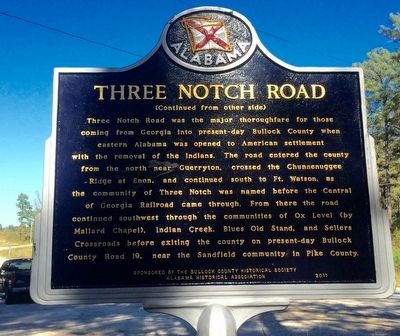
On U.S. 29 at County Road 19, on the right when traveling south on U.S. 29.
Built by U.S. Army engineers over the summer of 1824, Three Notch Road has served as Bullock County’s major transportation route throughout its history. It was constructed to facilitate military communication between Pensacola in Florida and Ft. . . . — — Map (db m89638) HM
On South Hill Street (Georgia Route 155) at East Solomon Street, on the right when traveling north on South Hill Street.
The city of Griffin, Georgia, was founded on June 8, 1840 by General Lewis Lawrence Griffin, a former state legislator, general in the Georgia militia, railroad man and astute business man.
In the 1830's, there were three railroads in Georgia. . . . — — Map (db m190455) HM
On U.S. 82 at County Road 35, on the right when traveling west on U.S. 82.
Side 1
Built by U.S. Army engineers over the summer of 1824, Three Notch Road has served as Bullock County’s major transportation route throughout its history. It was constructed to facilitate military communication between Pensacola . . . — — Map (db m89637) HM
On Trice Road (County Route 199) at Trice Cemetery Road, on the left when traveling east on Trice Road.
Trice cemetery, the largest family burial round in Upson County, Georgia, was established by William and Jane Tamplin Trice whose house once stood 300 yards west of the cemetery. William (1789- 1858) and Jane (1794- 1856), both buried here, were . . . — — Map (db m14560) HM
Barbour County On this site in 1833 was erected the first Barbour County Court House, a round log building 20 feet square. The first county seat was located at Louisville which had previously served as the county seat of Pike. This old Pike . . . — — Map (db m81857) HM
On Alabama Route 51, on the right when traveling south.
One of the oldest towns in southeast Alabama was settled in 1817 by Daniel Lewis who established a trading post and named the community “Louisville” after the first capital of Georgia, his hometown. By 1820 four stores, a Methodist . . . — — Map (db m60768) HM
On 6th Street at East Bank Street, on the right when traveling south on 6th Street.
Spalding County was created by Act of Dec. 20, 1851 from Fayette, Henry and Pike Counties. It was named for Thomas Spalding (1774-1851), native of Frederica. One of the earliest cotton and sugar cane planters in Georgia, he was a legislator, state . . . — — Map (db m59619) HM
On U.S. 19 at Georgia Route 109, on the right when traveling north on U.S. 19.
In 1823, the Pike County Justices of the Inferior Court selected the center lot in the county, near here, as the site for the county seat. The legislature chose Samuel Mitchell; William Mitchell; William Myrick, who was also Clerk of the Inferior . . . — — Map (db m264483) HM
On West State Street at Ellis Street, on the right when traveling east on West State Street.
Following the American Civil War and emancipation of slaves in 1865, it was not until 1871 that African Americans in Texas were able to uniformly register to vote, following the ratification of the 15th Amendment to the U.S. Constitution. . . . — — Map (db m304441) HM
On County Road 2290 0.8 miles north of Little Oak Road (County Road 2238), on the right when traveling north.
A veteran of the War of 1812, Major William Burt Allred and his wife, Jane O. Park Allred, moved from Newton County, GA to Pike County, AL in 1839. Construction began on their new home in 1840 and was completed in 1843. The home is one of the . . . — — Map (db m72056) HM
On Campground Road south of Highway 591, on the left when traveling south.
Pike County was developed in an area which was originally occupied by the Chickasaw, Choctaw and Natchez Indians. The Otapasso tribe gave their name to the creek which is now named Topisaw. The region had been claimed successively by France, . . . — — Map (db m127144) HM
On Gardner Bassett Road (County Road 55) east of Browns Mill Creek Road (County Road 7757), on the right when traveling east.
Born February 21, 1940, John Lewis was raised on this rural Pike County land
by his parents, sharecroppers Eddie and Willie Mae Lewis. In December 1957,
while a student at American Baptist College in Nashville, Lewis applied for
admission to . . . — — Map (db m258082) HM
Thin black lines indicate changes in relevance. Between each pair of lines entries are ordered geographically but all have the same relevance.
* Inflectional forms of words are their plurals, singulars, and possessives as well as gramatical tenses and similar variations.