Rockville in Montgomery County, Maryland — The American Northeast (Mid-Atlantic)
The Confederate Monument
Photographed by Allen C. Browne, June 10, 2007
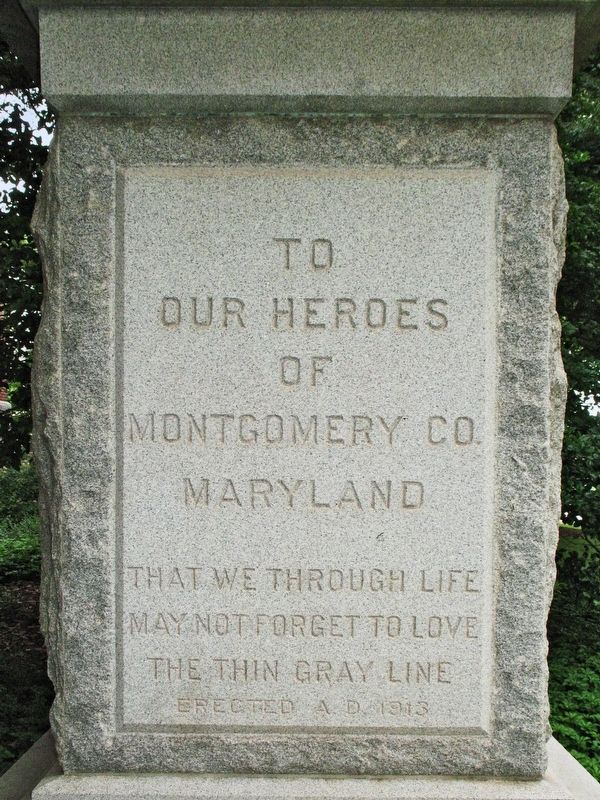
1. The Confederate Monument Marker
Our Heroes
of
Montgomery Co.
Maryland
That We Through Life
May Not Forget to Love
The Thin Gray Line
Erected A.D. 1913
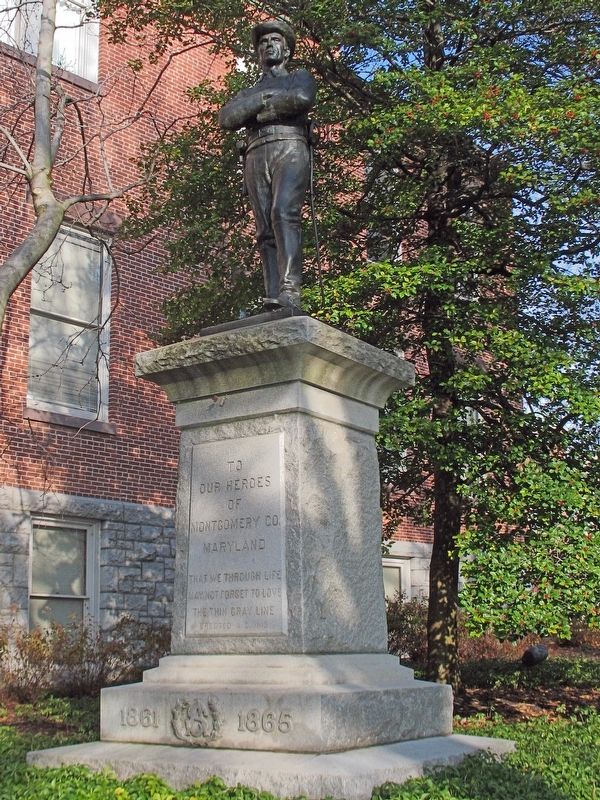
1861 CSA 1865
Erected 1913 by The United Daughters of the Confederacy.
Topics and series. This monument and memorial is listed in this topic list: War, US Civil. In addition, it is included in the United Daughters of the Confederacy series list.
Location. Monument has been permanently removed. It was located near 39° 5.01′ N, 77° 9.083′ W. Monument was in Rockville, Maryland, in Montgomery County. It could be reached from Courthouse Square. Was on the south side of the Old Red Brick Courthouse. MONUMENT WAS MOVED in 2017 and was re-erected on the grounds of White’s Ferry near Dickerson Maryland. Use the Related Marker link below to see it at its new location. Touch for map. Monument was at or near this postal address: 29 Courthouse Square, Rockville MD 20850, United States of America.
We have been informed that this monument is no longer there and will not be replaced. This page is an archival view of what was.
Regionally, this memorial
this page online

Other nearby markers. At least 8 other markers are within walking distance of this location: Maj. Gen. Edward Braddock and His Men (a few steps from this marker); 1891 Red Brick Courthouse (within shouting distance of this marker); Bicentennial of Maryland's Ratification of the Constitution (within shouting distance of this marker); Gettysburg Campaign (within shouting distance of this marker); Witness to History (within shouting distance of this marker); Memorial to the Events of September 11, 2001 (within shouting distance of this marker); Richard Montgomery (within shouting distance of this marker); Rockville (within shouting distance of this marker). Touch for a list and map of all markers in Rockville.
Other markers no longer nearby. Montgomery County Court House (was within shouting distance of this marker but
Photographed by Allen C. Browne, December 14, 2009
2. The Confederate Monument
More about this monument. The monument was originally placed in 1913 at the “town center,” a triangular park across East Montgomery Avenue from the front of the 1891 Romanesque Revival courthouse. It was moved to this location in 1971 when the downtown area was redesigned.
Related marker. Click here for another marker that is related to this marker. This link takes you to the entry showing the marker at its new location.
Also see . . .
1. Confederate Monument. Maryland Historical Trust State Historic Sites Inventory Form. Following is the Summary of Significance:
The Rockville Confederate Monument is significant for its commemoration of the people of Montgomery County who served the Confederacy. It is a customized example of the common soldier memorial, a type first used after the Civil War and popular through the First World War. The monument also represents Rockville’s response to the City Beautiful movement.(Submitted on March 10, 2017, by Allen C. Browne of Silver Spring, Maryland.)
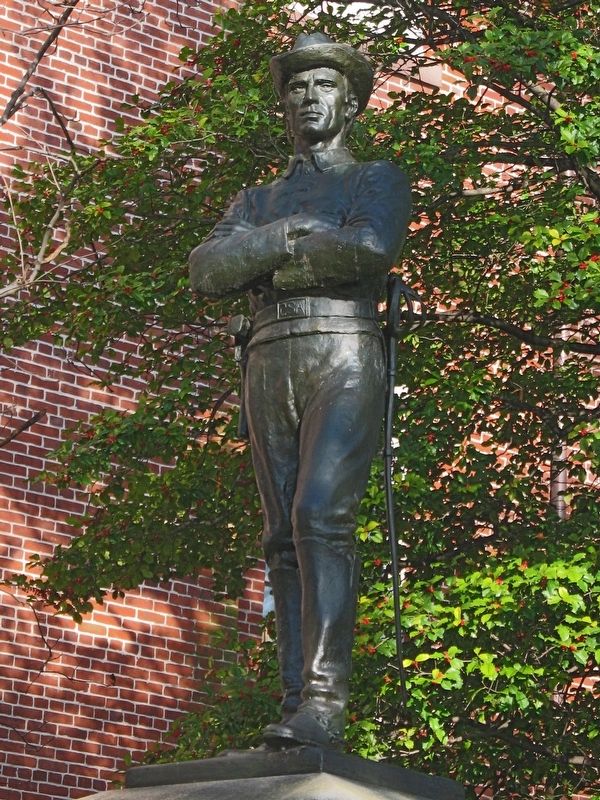
The monument was firstsuggested in 1909 at a memorial service for a veteran at Monocacy Chapel, Beallsville, by Richard Poole Hayes, a veteran of fellow Montgomery countian Lt. Col. Elijah Veirs White’s 35th Battalion, Virginia Cavalry, C.S.A.Photographed by Allen C. Browne, December 14, 20093. The Confederate Soldier Statue
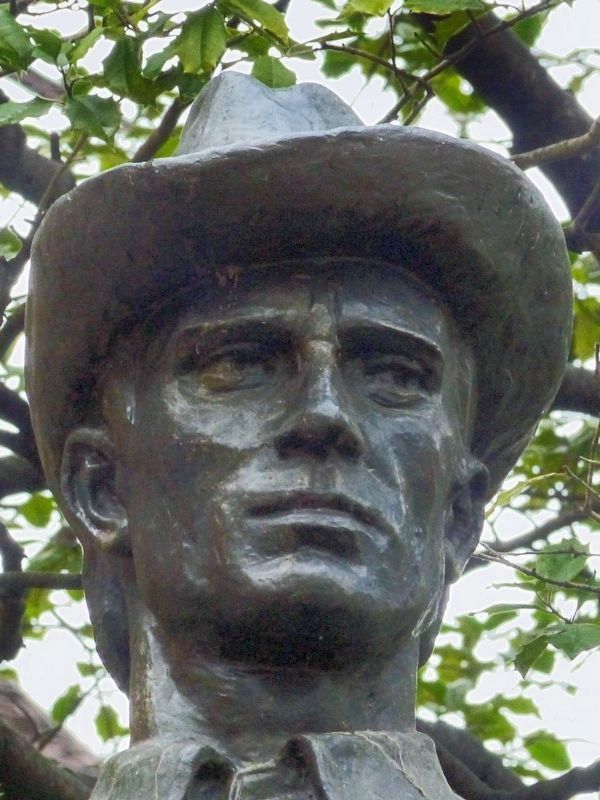
The monument was sponsored by the E. V. White and Ridgely Brown chapters of the United Daughters of the Confederacy and the Ridgely Brown Camp of the United Confederate Veterans. The Washington firm of Michael J. Falvey, Falvey Granite Company, built the statue at a cost of $3,600. Col. Spencer c. Jones, said to have been the model for the head of the statue (no evidence has been found), played a major role in the planning and fund raising, but due to illness was unable to serve as master of ceremonies at the dedication on June 3, 1913. The present owner of the Falvey Company, Merle L. Cox, has suggested that the statue may have been sculpted by Fred E. York, an artist who worked for the company during the 1920s and 1930s, but company records do not exist for the period prior to 1927.
Susan Soderberg has pointed out that the Rockville monument was erected during the second, reconciliation stageof memorialization after the Civil War. It was intended more as a tribute to the soldiers, some of whom had fought in the Spanish American War alongside Union veterans, than to a lost cause; it also coincided with a political trend toward nationalism and patriotism. Although many of the powerful people in the county were Confederate veterans, it was recognized that economic growth and progress required compromise and unity.Photographed by Allen C. Browne, February 12, 20174. The Confederate Soldier StatueThe face of this customized statue is said to have been modeled on local Confederate veteran Col. Spencer C. Jones. Although there is no documentary evidence to support this tradition, Col. Jones did play a major role in planning of the dedication ceremony which took place on June 3, 1913.
By the first decade of this century public preference was turning away from stock, catalogue memorials toward the Beaux-Arts ideal that had been made popular by the “White City” of the Chicago World’s Columbian Exposition of 1892-93. The subsequent City Beautiful movement sought to improve urban areas by integrating parks, monuments and sculpture with public buildings. Equally important to planners was the opportunity to uplift the morals and aesthetic taste of the public. The Rockville monument reflected the town’s response to the City Beautiful movement.
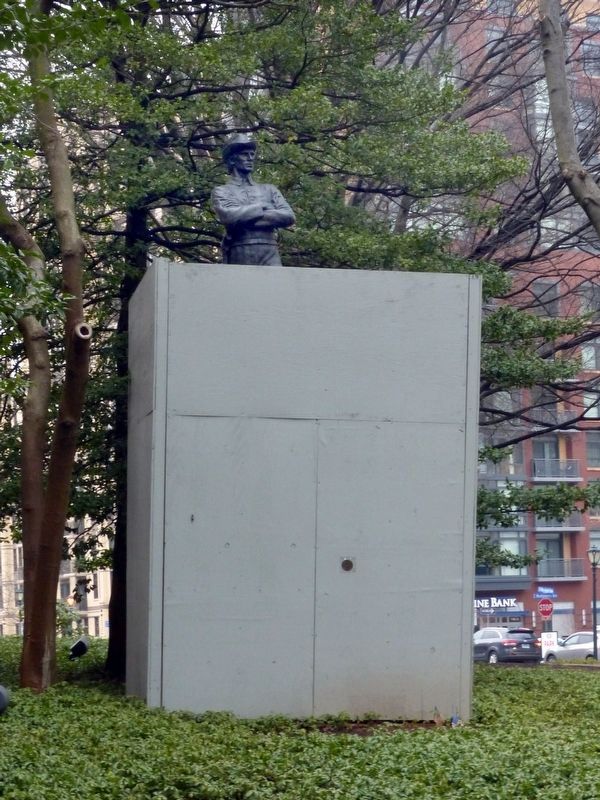
Instead of purchasing a mass-produced common soldier memorial, the citizens of Rockville ordered a custom designed bronze statue, possiblymodeled after a local veteran. The pedestal was designed of rusticated granite in the Romanesque Revival style. The monument was originally sited in a triangular park across East Montgomery Avenue from the front of the 1891 Romanesque Revival courthouse. The relationship of placement and style between statue and courthouse helped to define the town center. The statue was moved to its present location on the east side of the courthouse in 1971, when the street was closed to through traffic and the downtown area was redesigned.Photographed by Allen C. Browne, February 12, 20175. The Confederate Monument Boxed UpCurrently, (March 2017) this controversial monument is surrounded by a locked wooden box to protect it from vandalism. It is intended to be moved from the Courthouse to Whites Ferry.
2. Rockville Confederate Statue Removed. Bethesda Magazine website entry, 2017 (Submitted on June 5, 2022, by Larry Gertner of New York, New York.)
Additional commentary.
1.
On the 8th of May, 2017, Montgomery County transferred ownership of the Rockville Confederate Monument to White's Ferry Inc., for relocation at 24801 Whites Ferry Road, Dickerson, Maryland 20842. Under the terms of the transfer agreement “Buyer agrees to receive the Monument at its Property ... to assume ownership and possession of
Photographed by Allen C. Browne, July 31, 2017
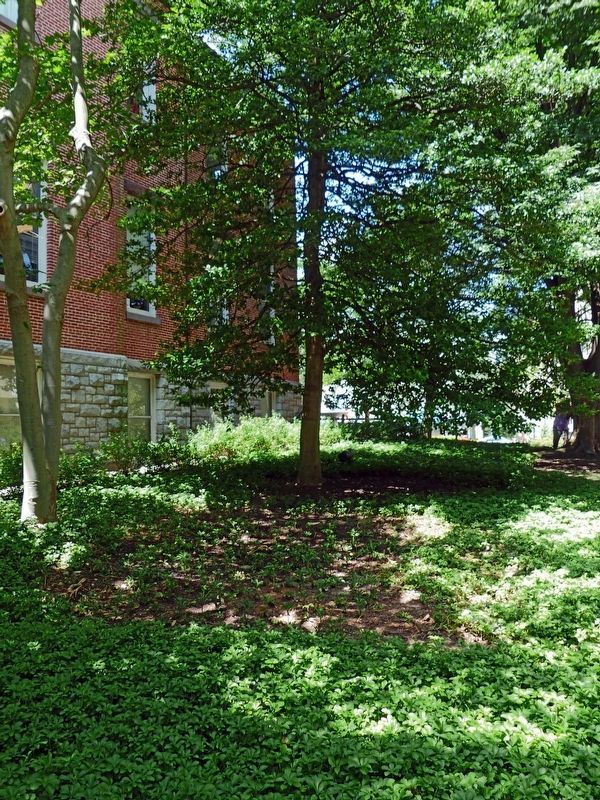
6. The Confederate Monument Removed
The monument has been moved to Whites Ferry. Pachysandra sprigs fill the space where the monument stood.
— Submitted September 12, 2026, by Terry Michael Klima of Perry Hall, Maryland.

Photographed by Terry Michael Klima, August 6, 2017
7. The Rockville Confederate Soldiers Monument
Photograph of the Rockville Confederate Soldiers Monument being installed at Historic White's Ferry, prior to Montgomery County completing the site work and fencing
Photographed by Terry Michael Klima, August 6, 2017
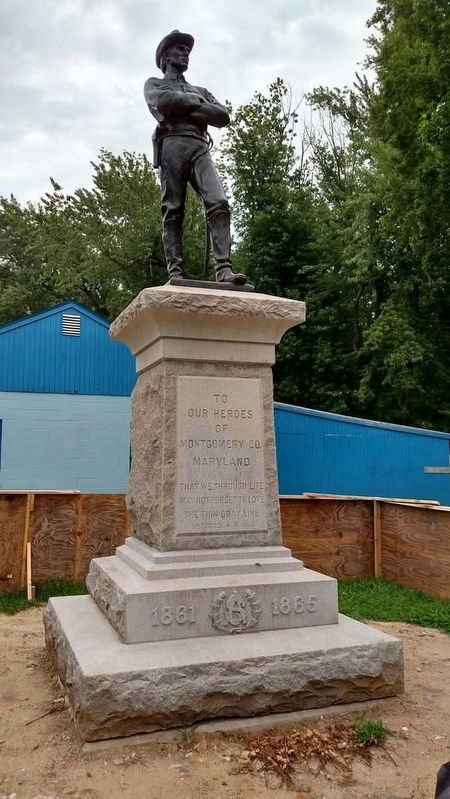
8. The Confederate Monument
photo of the monument following its relocation from the Rockville Courthouse to historic White's Ferry.
Credits. This page was last revised on September 18, 2026. It was originally submitted on March 10, 2017, by Allen C. Browne of Silver Spring, Maryland. This page has been viewed 1,131 times since then and 95 times this year. Last updated on August 1, 2017, by Allen C. Browne of Silver Spring, Maryland. Photos: 1, 2, 3, 4, 5. submitted on March 10, 2017, by Allen C. Browne of Silver Spring, Maryland. 6. submitted on August 1, 2017, by Allen C. Browne of Silver Spring, Maryland. 7, 8. submitted on September 12, 2026, by Terry Michael Klima of Perry Hall, Maryland. • Andrew Ruppenstein was the editor who published this page.
