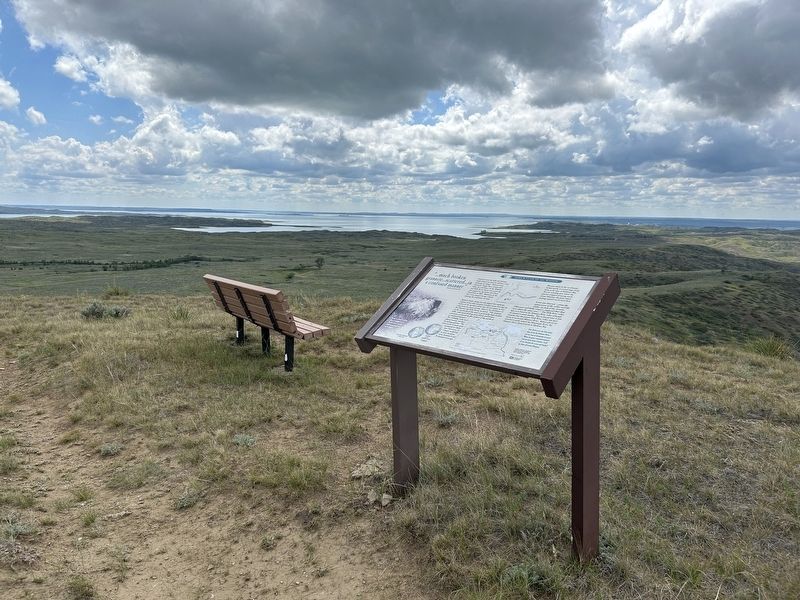
Look out over the hills and bottomlands around you and you will see a vast landscape of change. Natural rivers constantly change their courses, and today, the confluence of the Missouri and Milk Rivers below you is not the one mapped by the Lewis . . . — — Map (db m307697) HM
Lofty, hearty and a marvel of adaptation, the cottonwood contributed more to the success of the Lewis and Clark Expedition than any other western tree. Time and time again, Lewis and Clark described camp sites where clumps of these trees, with their . . . — — Map (db m307838) HM
Lewis and Clark explored the Fort Peck area in early May of 1805 on their way to the Pacific Ocean. For the Expedition, this was totally uncharted territory and the Milk River was an eagerly awaited landmark.
A short hike to the top of the hill . . . — — Map (db m307839) HM
You undoubtedly know that you are in the Fort Peck area, but did you know that to the north of the Missouri and east of the Milk River lies the Fort Peck Reservation, now home to the Assiniboine Indians?
The Assiniboine have been present in the . . . — — Map (db m307842) HM