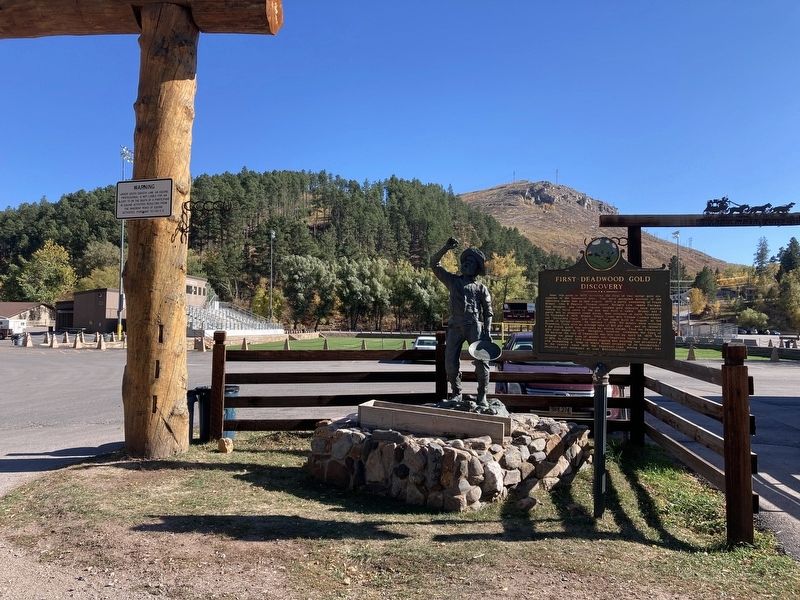
On Crescent Drive at 76th Drive, on the left when traveling south on Crescent Drive.
Near this point in 1875 occurred the first of two initial gold discoveries in the Deadwood area. The more accepted account of the
discovery states that in late August; 1875 a party consisting of Frank
Bryant, John B. Pearson, Thomas Moore, Richard . . . — — Map (db m185224) HM
On CanAm Highway (U.S. 85) north of U.S. 385, on the left when traveling north.
The national Good Roads Movement was a coordinated effort to improve roadways across the United States. The automobile helped define roadways, sometimes referred to as "auto trails". In 1912, the "Black and Yellow Trail", more specifically the . . . — — Map (db m121095) HM
On U.S. 14 at Blacktail Road, on the right when traveling west on U.S. 14.
Near this point in 1875 occurred the second of two initial gold discoveries in the Deadwood area. It was made by the Lardner party of eight prospectors, steered here by John B. Pearson, a man already familiar with Deadwood Gulch. Their "Discovery . . . — — Map (db m185225) HM
On Nemo Road at Merritt Estes Road (County Road 208), on the right when traveling south on Nemo Road.
Camp F-3 (Este): Located 1/2 mile west astride Estes Creek.
Companies: 789 - - 5/18 - 7/30/41
2759V - - (WWI Vets) 7/30/41 - 7/28/42
The Civilian Conservation Corps was a federal relief program during 1933-1942 that gave jobless men . . . — — Map (db m184412) HM
On Williams Street just south of Lee Street, on the right when traveling south.
Appointed by Sheriff Seth Bullock Deadwood’s 1st Sheriff, US Marshal Captain A Troop Grisby’s Cowboy Regiment Spanish American War Built 1882 — — Map (db m305898) HM
On North Main Street south of East Jackson Boulevard, on the right when traveling south.
The Mail Building was constructed for Edward Warren in 1920. Warren had moved to Spearfish with his parents in 1888 with hopes of starting a newspaper. In 1889 they established the Queen City Mail. The Mail Building was built to house the . . . — — Map (db m221777) HM
On Sherman Street (CanAm Highway) (U.S. 85) 0.1 miles south of Pine Street, on the right when traveling south.
Since 1877, four county jails have been constructed within the Deadwood city limits. The first jail was erected in May of 1877 in the Ingleside Townsite (today's Presidential Neighborhood) and consisted of a 30 x 50 foot log structure enclosed by a . . . — — Map (db m120998) HM
On Main Street at Pine Street, on the right when traveling south on Main Street.
The bronze cannon above you, serial number #9220, was cast on May 7, 1862 at the Royal Foundry of Seville, Spain. This cannon was one of six "Cañones rayados cortos de a 12 centímetros,” or short cannon of twelve . . . — — Map (db m183227) HM
On Main Street at Pine Street, on the right when traveling south on Main Street.
The establishment of higher education is an important benchmark in the development of a community, and Deadwood was no exception. In 1881 Deadwood became the second established School District within Lawrence County, Dakota Territory. In the ensuing . . . — — Map (db m183229) HM
On Main Street at Wall St., on the left when traveling west on Main Street.
Lawman, man rancher, Captain in the US Army, and presidential confidant — Deadwood resident
Seth Bullock was the man of his times. Arriving in Deadwood Gulch at age 29, Bullock witnessed and contributed to the development of Deadwood and the . . . — — Map (db m301281) HM
On Main Street 0.2 miles west of Pioneer Way (U.S. 14A/85), on the right when traveling west.
Chinese immigrant Wong Fee Lee was no stranger to the trials and tribulations of the American West. Family oral history recounts that as a young man, Wong emigrated from the Guangdong Province of Southern China to the West Coast of the United . . . — — Map (db m280350) HM
John Richard Brennan
From John Brennan's Journal
February 23, 1876
A party consisting of W.P. Martin, J.W. Allen, Mart Persinger, William Marston, John R. Brennan, Tom Ferguson, and Dick King left Palmer Gulch with a view . . . — — Map (db m187538) HM
Thin black lines indicate changes in relevance. Between each pair of lines entries are ordered geographically but all have the same relevance.
* Inflectional forms of words are their plurals, singulars, and possessives as well as gramatical tenses and similar variations.