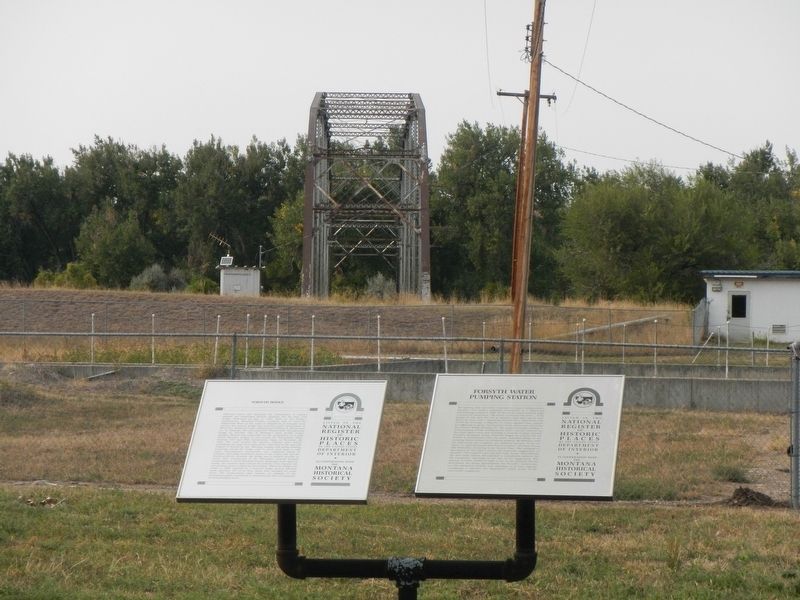
On 3rd Avenue North at Oak Street, on the left when traveling north on 3rd Avenue North.
Although heavy rain disrupted the celebrations, it couldn’t dampen the enthusiasm Forsyth residents felt for their new bridge, dedicated on July 4, 1905. Prior to the bridge’s construction, Rosebud County residents had to ford the Yellowstone River . . . — — Map (db m164782) HM
On Main Street near 12th Avenue, on the right when traveling west.
Scandal and intrigue surrounded the construction of Rosebud County Courthouse in 1914. Rosebud County citizens recognized the need for a new courthouse when they passed a $125,000 bond issue in 1911 to fund the building. To design a suitable . . . — — Map (db m164668) HM
On Front Street near South 5th Avenue, on the right when traveling north.
Hiram Marcyes was born September 11, 1844 in Newberg, Maine. He served in the Civil War as a bugler in the Fourth Minnesota Volunteer Infantry Company with the the Union army. His service took him in battles from Vicksburg to Sherman's March to the . . . — — Map (db m188746) HM
On Interstate 94 near Old U.S. Highway 312, on the right when traveling west.
Montana's small towns have traditionally been places where people by supplies and services, socialize, and ship their products to markets on the railroads or highways. Hysham is typical of those many rural communities scattered across this great . . . — — Map (db m165442) HM
On West 4th Street near North Central Avenue, on the left when traveling west.
Montana created twenty-six counties during its 1910 county-splitting craze. Among them was Big Horn County, carved from portions of Yellowstone and Rosebud Counties in 1913. Private entrepreneurs constructed the new county’s first courthouses. In . . . — — Map (db m189332) HM
On Cedar Street near North 11th Street, on the left when traveling east.
A truncated hipped roof reflects this circa 1895 home’s modest beginnings. Carpenters used shorter, less expensive pieces of lumber for hipped roofs than for triangular-shaped gable roofs. Owners added a full-length front porch (since removed) and a . . . — — Map (db m164924) HM
On North 17th Street at Cedar Street, on the right when traveling north on North 17th Street.
“Remember the Flu epidemic” declared a notice advocating support for Rosebud County Hospital. In 1918 and 1919 influenza killed over 5,000 Montanans. Flu victims in Forsyth received care at the Masonic Hall, temporarily converted into an . . . — — Map (db m164791) HM
Near 2nd Avenue near 3rd Street, on the right when traveling west.
As hundreds of farmers and ranchers homesteaded the arid, treeless plains of northwestern Rosebud County, the townsite of Ingomar was platted along the tracks of the Chicago, Milwaukee & St. Paul Railway in 1912. That year, one teacher and a . . . — — Map (db m189103) HM
On North 13th Avenue near Cedar Street, on the right when traveling north.
The history of Forsyth depends heavily on two men - Thomas Alexander and Hiram Marcyes - very different individuals yet both dedicated to creative and aggressive growth. Thomas Alexander began as a pioneer sheep, cattle and horse rancher and . . . — — Map (db m165231) HM
On Main Street at 12th Avenue, on the right when traveling west on Main Street.
(Three panels make up this marker:) (panel 1)
In 1918, rising flood waters on the Yellowstone River threatened the City of Forsyth, the Forsyth Times-Journal reported "Over 500 men worked for 36 hours to keep . . . — — Map (db m164762) HM
Thin black lines indicate changes in relevance. Between each pair of lines entries are ordered geographically but all have the same relevance.
* Inflectional forms of words are their plurals, singulars, and possessives as well as gramatical tenses and similar variations.