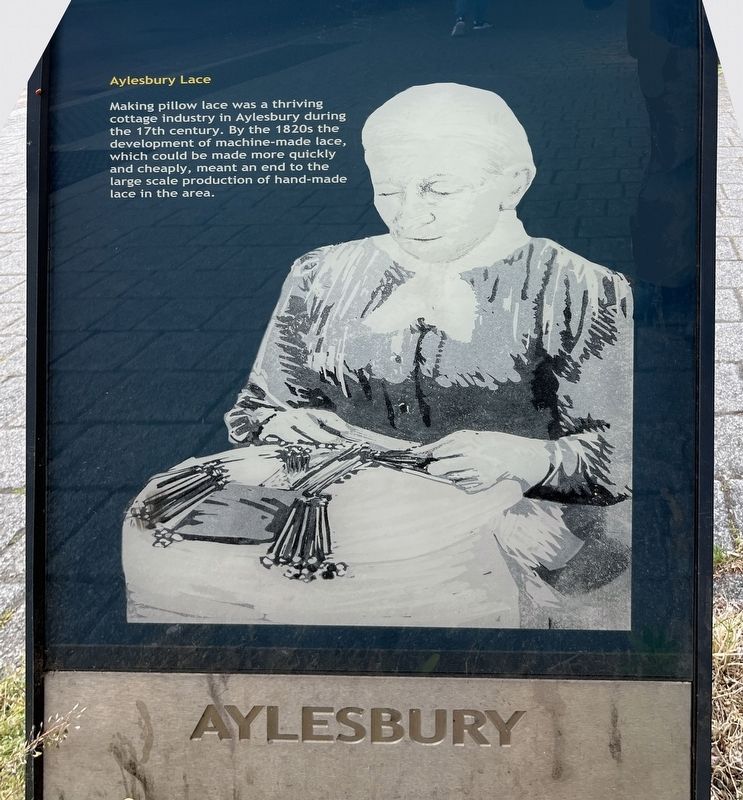
Making pillow lace was a thriving cottage industry in Aylesbury during the 17th century. By the 1820s the development of machine-made lace, which could be made more quickly and cheaply, meant an end to the large scale production of hand-made lace in . . . — — Map (db m312104) HM
Records in the Domesday Book suggest that Aylesbury had a sizeable market as far back as the 11th century. By the 1870s the town centre had 87 inns catering to the needs of a bustling cattle market, with a square much bigger than the one you see . . . — — Map (db m311835) HM
The Aylesbury Arm of the Grand Union Canal opened in 1814 and transported grain, timber, coal and building materials until the 1960s. The canal basin is a great starting point for family walks and to see the bustle of life at the water's edge. — — Map (db m312107) HM
Standing in the centre of the Market Square, the clock tower was unveiled in 1865, built to house a clock presented to Aylesbury by Clerk of the Peace for Buckinghamshire, Acton Tindal. — — Map (db m312106) HM
Cubitt cars were manufactured at the factory on Bicester Road, Aylesbury, between 1919 and 1925. The factory, which is no longer there, produced about 3,000 cars and one of the last few remaining Cubitt cars in the world can be seen at the museum on . . . — — Map (db m311861) HM
The dead house was designed in the Gothic style by architects W.F. Poulton and W.H. Woodman and built in 1856.
In the Victorian era, dead houses served as mortuaries to house the dead until they could be buried.
Before their introduction, . . . — — Map (db m312110) HM
Reading-based architects W.F. Poulton and W.H. Woodman designed the chapels in the gothic style. They won the contract in competition, specialising in Non-Conformist churches, and were successful in competitions for several cemeteries in central . . . — — Map (db m312109) HM
Reading-based architects W.F. Poulton and W.H. Woodman designed the chapels in the gothic style. They won the contract in competition, specialising in Non-Conformist churches, and were successful in competitions for several cemeteries in central . . . — — Map (db m312108) HM
John Hampden was Member of Parliament for Buckinghamshire, and one of the leading politicians who opposed Charles I taxing the people without Parliament's approval. This led to the English Civil War, which established that the monarch cannot govern . . . — — Map (db m311858) HM
Built between 1725 and 1740, the building included a prison and the Crown Court, confirming Aylesbury as the county town of Buckinghamshire. Public hangings took place from a balcony outside the central window until 1840, drawing large numbers of . . . — — Map (db m312105) HM
Ronnie Barker, star of Porridge and The Two Ronnies, began his acting career in Aylesbury, with his 1948 debut at the Old County Theatre in Market Square. A bronze statue of the late comedy legend sits outside the Waterside Theatre. — — Map (db m311865) HM