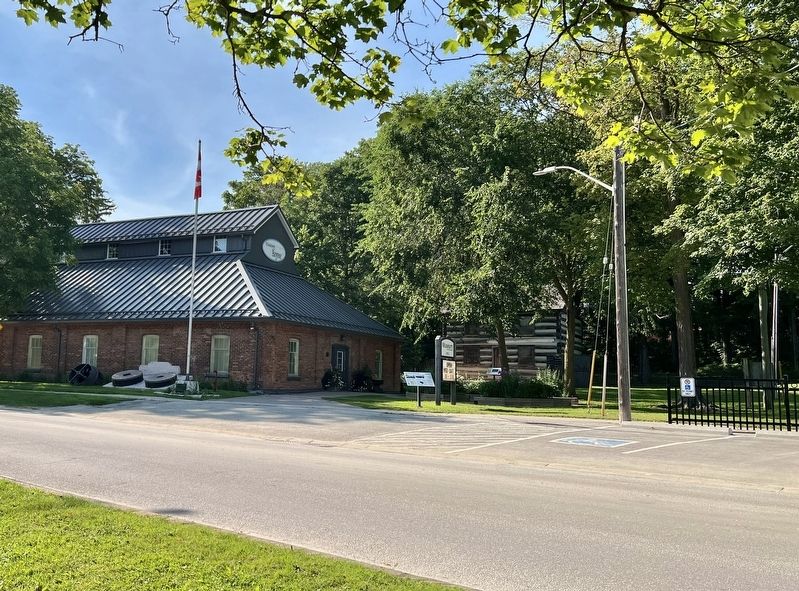
Agricultural Exhibit Hall
The Alliston Agricultural Society built the main building in 1914 as an agricultural exhibit hall where craft and food entries were displayed during the annual fall fair in Riverdale Park. During the First World . . . — — Map (db m306018) HM
Monuments were first made available in Alliston in 1884, when Thomas Johnston opened the first marble works on the northeast corner of Wellington and Ontario streets. Johnston sold his business to Thomas Callaghan in 1887 and he renamed it to . . . — — Map (db m261799) HM
The barn was built in 1858 in Bond Head, Bradford West Gwillimbury. It is completely constructed of white pine, which is Ontario's provincial tree and was a chief export at the time. The inside is held together by wooden pegs with hand forged nails . . . — — Map (db m306027) HM
Frederick Grant Banting, discoverer of insulin, was born Nov. 14, 1891, on the original Banting homestead immediately behind this cairn. In this quiet rural environment he gained a deep understanding of the ways of nature. From his parents he . . . — — Map (db m254291) HM
The Fountain
In July 1919, the Alliston Town Council decided "to be in line with all progressive places and to be merely humane to the equine and accommodating to its driver this Town must have a drinking fountain or two" The fountain was . . . — — Map (db m306033) HM
The 100 acres of the east half of Lot 11, Concession 5 in Essa Township were first leased from the Canada Company in 1859 by Neil McDonald.
Between 1859 and 1914 the property was associated with Neil and his sons Alexander and Angus. The log house . . . — — Map (db m306031) HM
George Fletcher, son of William and Margaret Fletcher (founding family of Alliston) erected this building in 1878-79 at the southwest corner of Centre and Victoria St. It was initially built as a temperance hotel, as his family were ardent . . . — — Map (db m261798) HM
This 10 acre site, originally purchased from James Doyle on April 11, 1834 for 37 pounds and 10 shillings, marks the location of the first Roman Catholic Church and Cemetery in Tecumseth Township. In 1834, under the supervision of Father Murtagh . . . — — Map (db m288381) HM
[English] Soldier, surgeon, and scientist, Banting in 1920 became convinced of the existence of a hormone known as insulin. A laboratory provided by Prof. J. J. R. Macleod of the University of Toronto enabled Banting . . . — — Map (db m254287) HM
Foremost Canadian medical scientist of his time, co-discoverer of insulin and leader in research on the diseases of mankind. While he died in Newfoundland on Feb. 21, 1941, flying vital medical defence information to England, he lives on in the . . . — — Map (db m255248) HM