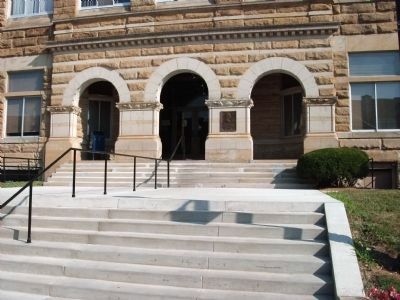
On December 25, 1830, the Illinois General Assembly created Coles County. At this time, Charleston became the county seat and was just a hamlet called "Coles Courthouse." In 1831, a log-cabin courthouse was constructed. About four years later, a . . . — — Map (db m188293) HM
On September 18, 1858, Springfield attorney and former U.S. Congressman Abraham Lincoln debated U.S. Senator Stephen A. Douglas at the Coles County Fairgrounds during the senatorial campaign of that year. The Charleston debate was the fourth of . . . — — Map (db m184632) HM
On March 28, 1864, a gunfight erupted here between Union soldiers and Civil War opponents known as "copperheads." In eastern Illinois the Republicans were uniformly pro-Union, but many Democrats were pro-Southern.
Disturbances had occurred . . . — — Map (db m188295) HM
Left Panel: “This will certify that the foregoing plot of the town of Farmington laid by me as proprietor is correct.
Witness my hand and seal this 30th day of April 1852.”
J. J. . . . — — Map (db m30979) HM
In 1859 the Mattoon Union Agricultural Fairgrounds, encompassing a 90-acre rectangle north and west of this location, was established by the Union Agricultural Fair Association, an organization of Mattoon men. The Union Fairgrounds consisted of . . . — — Map (db m188562) HM
Side OneTop Section
Abraham Lincoln’s last visit to Cole County was indeed of a personal nature. Lincoln was described as he left Springfield by Henry C. Whitney, who accompanied him part of the way on the train: “. . . . . . — — Map (db m30840) HM
The fertile prairies in Illinois attracted the attention of French fur trader Louis Jolliet and Father Jacques Marquette as they explored the Mississippi and Illinois Rivers in 1673. France claimed this region until 1763 when she surrendered it to . . . — — Map (db m131294) HM
"His love of wealth was very weak....he said he had no capacity whatever for speculation and never attempted it." So said attorney friend Joseph Gillespie who once asked Lincoln how much land he owned and why he had never speculated in . . . — — Map (db m57559) HM
Members of Civilian Conservation Corps Co. V-2657 SP-52 built their barracks on this site in August 1935. The WWI veterans who comprised this CCC encampment named it Camp Shiloh after the burial place of Thomas and Sarah Lincoln. Like all CCC camps . . . — — Map (db m229793) HM
(Upper Portion):Tribute of Coles County
in Honor of her Sons who fought for
The Union 1775 - - 1781 1812 - - 1815
1846 - - 1848 1861 - - 1865 1898 - - 1898 (Lower Portion):A house divided against its self cannot stand. I believe . . . — — Map (db m11122) HM
Here on January 31, 1861, President-Elect Abraham Lincoln visited his stepmother, Mrs. Sarah Bush Lincoln and her daughter Mrs. Reuben Moore (Matilda Johnston). This was his last visit to Coles County before leaving Illinois for his inauguration. . . . — — Map (db m30888) HM
From 1831 to 1834 Thomas and Sarah Lincoln, father and stepmother of Abraham Lincoln, lived in a cabin which stood a short distance to the north. It was their first home in Coles County, and their second home in Illinois. — — Map (db m188282) HM
On an eminence overlooking the Sangamon River three miles south of here stood the first home of Lincoln in Illinois. To this site came the Lincoln family in March, 1830. Here they lived until 1831, when the parents removed to Coles County and . . . — — Map (db m55618) HM
Side One
Top Section
Nineteenth-century Illinois political campaigns and rallies were raucous affairs, part entertainment and part serious politics. The candidates were often accompanied or preceded by marchers, fireworks, flag . . . — — Map (db m30866) HM
Thomas Lincoln
Thomas Lincoln was born on January 7, 1778, in Rockingham County, Virginia, to Captain Abraham and Bathsheba Lincoln. He was the youngest of three sons and the fourth of five children. The Lincoln family migrated from . . . — — Map (db m46311) HM
A Prairie Landscape Heritage
Tribes of Pottawatomie, Kickapoo, and Winnebago were known to have inhabited the region, but the first settlers of Mattoon found mostly open prairie. Timber was scarce and early settlers could see for miles, . . . — — Map (db m188951) HM
Left Section
Abraham Lincoln was a frequent visitor to Cole County in the 1840's, traveling on the judicial circuit. In Charleston, according to Amanda Hanks Poorman (the daughter of Dennis Hanks), Lincoln would use the Hanks’s horse . . . — — Map (db m30847) HM
Growth of a Railroad Town
"Where a great way from the northern plain
Meets one from the deltas of cotton and cane;
…
Where the steeds of those great iron highways meet
To unload the wealth of the world at her feet,
The Queen of . . . — — Map (db m189025) HM
Oil Boom
In the 1940s, Mattoon became a hub for the oil industry. Companies large and small opened offices here, attracted by the developing oil fields, the business environment, and the quality of life. The oil business brought new people . . . — — Map (db m189055) HM
The Buckle on the Corn Belt
In the early 1920s Mattoon was proclaimed "The Buckle on the Corn Belt." This slogan was used to encourage people and businesses to settle here. Like any developing city, Mattoon met its share of challenges, . . . — — Map (db m189054) HM
Shortly after Thomas and Nancy Lincoln's wedding in Washington County on June 12, 1806, the couple set up housekeeping in Hardin County where Thomas owned a farm near Elizabethtown on Mill Creek. Nancy gave birth to Lincoln's first child, a daughter . . . — — Map (db m249363) HM
Susan (Susannah) McCord Coon, wife of Isaac Coon, died from the complications of childbirth at this site on August 11, 1860, while on the way to
California from Coles County, Illinois. The child, Robert E. Coon, born on
August 9, survived and . . . — — Map (db m295956) HM
Thin black lines indicate changes in relevance. Between each pair of lines entries are ordered geographically but all have the same relevance.
* Inflectional forms of words are their plurals, singulars, and possessives as well as gramatical tenses and similar variations.