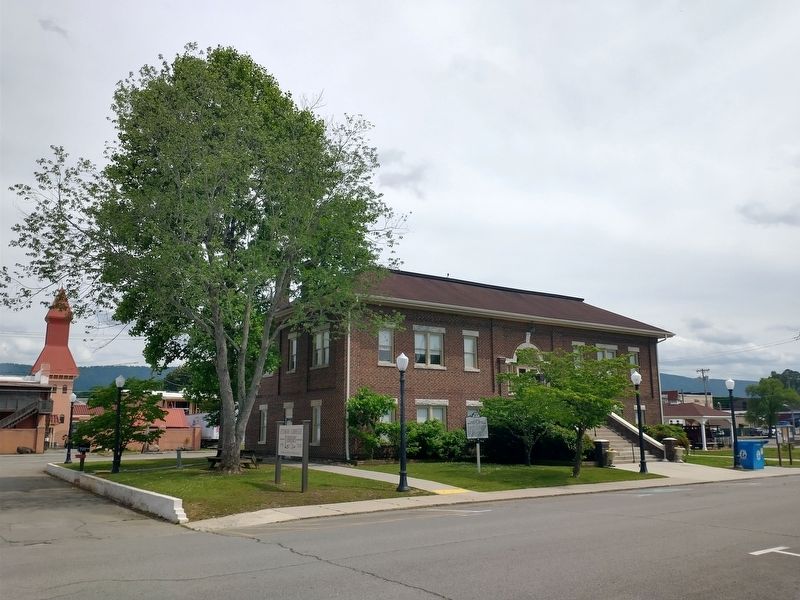
With an $8,000.00 grant from the Carnegie Corporation, founded by philanthropist Andrew Carnegie in 1911, the Etowah Carnegie Library was approved for construction in 1915. Built on
property purchased from the Louisville & Nashville Railroad, it is . . . — — Map (db m299465) HM
The Treaty of 1805 between the United States and the Cherokee Nation established the Old Federal Road. The road extended from the Tellico Blockhouse on the Little Tennessee River to the towns of Madisonville and Columbus, Tennessee. This route . . . — — Map (db m178011) HM
Tennessee became the “Perfect 36” on August 18, 1920
when the state legislature voted to ratify the 19th Amendment, which guarantees that
“the right of citizens of the United States to vote shall not be denied or abridged on account of sex.“ . . . — — Map (db m274049) HM
Born circa 1862 in McMinn County, Tennessee, Moses Brownlow Byington Sr., moved to the Beaver Ridge community circa 1883. He was instrumental in establishing the town of Byington and two major landmarks: the Byington L & N Railroad Station around . . . — — Map (db m114040) HM
In 1902 as the L&N Railroad brought new industry to the east side of McMinn County, Etowah, a new boomtown was born. As thousands of people were arriving in this new frontier, so came the need for services. Entrepreneurs and investors descended . . . — — Map (db m299468) HM
Front:
The town of Athens, Tennessee, was created in 1822, on land obtained from William Lowry and Joseph Calloway. Originally the town boundaries consisted of 35 acres bordering on the Eastnalle Creek, which was used as a source of . . . — — Map (db m249888) HM
McMinn County Courthouse Square
The courthouse square traditionally was the social, economic, and political center of county seats across the South. A succession of enterprises—dry goods stores, a laundry and tailor shop, stagecoach . . . — — Map (db m177734) HM
Thin black lines indicate changes in relevance. Between each pair of lines entries are ordered geographically but all have the same relevance.
* Inflectional forms of words are their plurals, singulars, and possessives as well as gramatical tenses and similar variations.