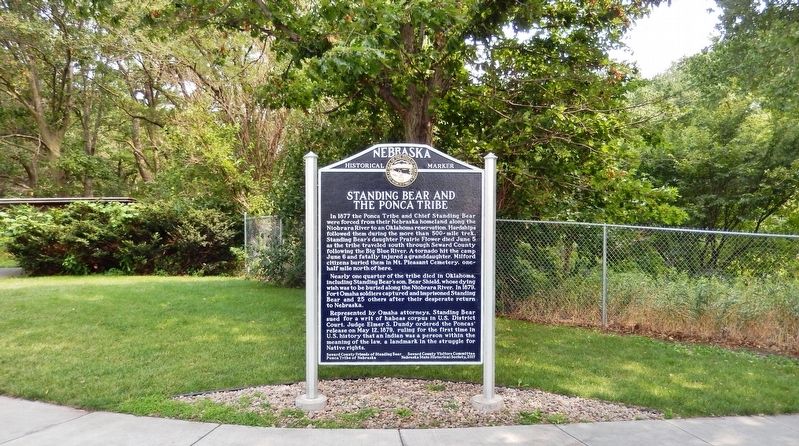
In 1877 the Ponca Tribe and Chief Standing Bear were forced from their Nebraska homeland along the Niobrara River to an Oklahoma reservation. Hardships followed them during the more than 500-mile trek. Standing Bear’s daughter Prairie Flower died . . . — — Map (db m179391) HM
This rest site is near the center of Nebraska's tall-grass prairie on the eastern edge of the hunting grounds once used by the Pawnee Indians. Nebraska's largest tribe, the Pawnee located villages on major area streams, including the Blue, Loup, and . . . — — Map (db m92536) HM
Founded by J. L Davison in 1864 near the limestone ford where the Nebraska City to Fort Kearny "Steam Wagon Road" crossed the Blue River, Milford is the oldest town in Seward County, serving as the first county seat until 1871. Milford was home to . . . — — Map (db m76765) HM
The importance of railroads to the early settlement and prosperity of the West is nowhere better illustrated than in the stories of two Seward county towns. Fargo Springs, founded in 1885 about three miles south of here, was the first town . . . — — Map (db m78811) HM
On January 2, 1863, Robert T. Gale filed the first homestead in Seward County, then “Greene County.”
A surveyor, he chose an irregular tract along Plum Creek that provided shelter from the north winds and fresh spring water . . . — — Map (db m101844) HM
Many Kansas towns originated as potential railroad centers. Three miles west of this marker Arkalon was founded in 1888 at the Cimarron river crossing of the Chicago, Kansas and Nebraska railway, a part of the Rock Island. Town lots were cheap, . . . — — Map (db m223938) HM
The Seward statue is a memorial commissioned by the family of Suzanne Geis Kolterman, who was a lifelong resident of Seward County. This memorial commemorates the 150th anniversary of the City of Seward, Seward County, and the State of . . . — — Map (db m255061) HM
Thin black lines indicate changes in relevance. Between each pair of lines entries are ordered geographically but all have the same relevance.
* Inflectional forms of words are their plurals, singulars, and possessives as well as gramatical tenses and similar variations.