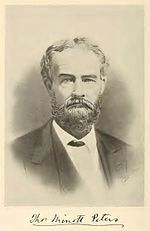
A scientist of national fame, Peters (1810-1888) lived for many years in Moulton with his wife Naomi (Leetch), a relative of President James K. Polk, who possibly visited here. A man of many talents, Peters was a noted linguist, early civil rights . . . — — Map (db m69670) HM
On January 11, 1861 the State of Alabama seceded from the Union. Deeply perturbed, the people of Winston County held a political convention on July 4, 1861 at Looney’s Tavern, near Addison. A resolution was adopted to the effect that Alabama had no . . . — — Map (db m42859) HM
McKendree Cemetery and the Massey Community
In the fall of 1840. Augustine and Emily Hewlett reserved one acre of land to be used for the church then known as McKendree Chapel. A log building was constructed and services were held on this . . . — — Map (db m294775) HM
Named in honor of Judge Frank M. Johnson, Jr. (1918-1999), who served here as U.S. District Judge from 1955-1979, as U.S. Circuit Judge of the United States Court of Appeals for the Fifth Circuit July 12, 1979 - October 1, 1981, and as U.S. . . . — — Map (db m71266) HM
Born in Winston County, Alabama in 1918, Frank M. Johnson, Jr. transcended the prejudices of his time and made his mark as one of the great jurists in American history.
He married his Winston County sweetheart, Ruth Jenkins, in 1938. During . . . — — Map (db m80559) HM
Side 1
February 13, 1818 — Gin Port - west of Amory, MS on Tombigbee River
December 16, 1819 — Henry Grier House, near Columbus, MS - first designated courthouse
Late 1820-1822 — Military Ford Court - under . . . — — Map (db m96791) HM
Willis Farris was appointed the first sheriff of Hancock County, Alabama, serving from August 31, 1850 to September 19, 1853. Hancock County was renamed Winston County in 1858. Farris then served another term as sheriff from 1859 until 1865. He was . . . — — Map (db m182872) HM
Jacob Pruet’s Stand (tavern) was a popular stopping place on the Byler Road in the 1830s and 1840s. A two story poplar log structure with four twenty-foot rooms per floor. It was located near a large spring and netted a handsome profit, as most of . . . — — Map (db m219825) HM
The Jail at Houston
The Houston Jail is the only surviving log jail in north Alabama. The jail, constructed around 1868 from hand-hewn hardwood logs, replaced an earlier one destroyed by pro-Union men in the county during the Civil War. The . . . — — Map (db m182919) HM
Wyatt Cheatham (1769-1856) was one of the early settlers of Lawrence County and bought land near Wren in 1818. The Alabama Legislature on 14 Dec 1824 authorized him, "to open out and make a road leading from at or near the Gum Pond in said county . . . — — Map (db m84310) HM
Born in a home near Double Springs on the Sipsey River, Dr. Benjamin Wallace Roden was the son of William Norris and Letha (Bruce) Roden. He attended schools in Marion County and studied botanical medicine under his father and other doctors, . . . — — Map (db m250573) HM
In 1861 "Uncle Dick” was present at a meeting of 2,500 people at Looney's Tavern. Upon hearing the proposal of Winston County's possibly seceding from the state, he sarcastically exclaimed, "Oh, oh, Winston secedes! The Free State of Winston!” – a . . . — — Map (db m182871) HM
The Cullman County Electric Membership Corporation
the first rural electric cooperative in Alabama to provide
electricity. The cooperative, was organized May 25. 1936,
under an executive order signed by President Franklin D.
Roosevelt. Near . . . — — Map (db m295689) HM
Organized two years after the Byler Road was completed, New Prospect
Baptist Church is reportedly the oldest Baptist church in Winston County
and one of the oldest in the state of Alabama. Located several yards north
of the Byler Road, New . . . — — Map (db m299717) HM
The "Free State” of Winston
In 1862, this county's representatives
opposed secession, voted to remain
neutral, and were labeled as "Torries".
In honor of the first Alabama born
governor, Winston County
received its name. It was . . . — — Map (db m168066) HM
Thin black lines indicate changes in relevance. Between each pair of lines entries are ordered geographically but all have the same relevance.
* Inflectional forms of words are their plurals, singulars, and possessives as well as gramatical tenses and similar variations.