Biloxi in Harrison County, Mississippi — The American South (East South Central)
The Evolution of Biloxi Tourism
—
Historic Biloxi
—
Photographed by Mark Hilton, March 22, 2017
1. The Evolution of Biloxi Tourism Marker
Inscription.
The Evolution of Biloxi Tourism. . During the early 19th Century, the Biloxi peninsula was sparsely populated with a few French speaking families. The 1827 establishment of steamboat service between New Orleans and Mobile, via Lake Pontchartrain, served as a catalyst for the growth of Biloxi and its development as a resort. The summer exodus of the New Orleans wealthy seeking refuge from the city's heat and yellow fever season swelled Biloxi's population. Many built summer homes, and those of entrepreneurial spirit built hotels. Biloxi had become the largest of the "watering places" along the Mississippi Coast by the 1840s. Antebellum tourism thrived until the Federal blockade of the Mississippi Sound during the Civil War., Post-Civil War steamboat service was replaced by the coastal railroad in 1870. Railroad connections via New Orleans and Mobile turned Biloxi into a year-round resort. Fast moving trains brought "snowbirds" from the Northern and Midwestern states to spend winters in Biloxi. In 1906, they formed the Biloxi Tourist Club with membership representing 35 states. Automobile travel spurred a greater surge in tourism. In 1925, Biloxi became part of the Old Spanish Trail National Highway, which connected Florida to California. Pictorial promotion brochures enticed vacationers from across the country. By 1928, several new multi-storied hotels faced the beachfront. Tourism waned after the 1929 stock market disaster and the ensuing Great Depression., Post-World War Biloxi regained its resort status with the simultaneous widening of the beach road into a four-lane superhighway and the creation of the longest man-made sand beach in the world. By the mid-1950s, a blaze of neon advertised hotels, motels, restaurants, nightclubs, and other tourist-oriented businesses filled the city. In 1969, Hurricane Camille brought tourism to a standstill. Biloxi languished in the 70s. Biloxi began emphasizing its history, heritage, and culture to bolster tourism during the 1980s., The 1992 arrival of dockside gaming made tourism Biloxi's main industry. The city entered the 21st Century as a major casino resort destination with visitors numbering more than 3 million annually. In 2005, Biloxi encountered Hurricane Katrina, the most destructive natural disaster in United States history. Katrina's wrath destroyed irreplaceable landmarks and severely crippled the resort industry. Post-Katrina laws allowing on- land casinos proved to be a key factor in the recovery of tourism. The continuous waxing and waning of Biloxi's tourist industry reflects the cyclical nature of all seaside resorts., [Photo captions] , Left middle: This promotion brochure, "Biloxi: The Four Season Resort," was published by the Chamber of Commerce in 1923. Ten thousand of the publications were distributed throughout the country. , Credit: Biloxi Public Library , Right top: One of Biloxi's first grand hotels, the Buena Vista Hotel and Convention Center (1924-late 1980s) is pictured during its mid-20th century heyday. Located on the present site of the MGM Park, it offered fishing, boating, access to golfing, trips to Ship Island and other tourist attractions., Right middle: The many bathing piers along the Biloxi beach were popular with tourists and locals alike, as pictured on this circa 1940s postcard. , Credit: Biloxi Public Library , Right bottom: Gaily decorated shrimp boats take part in Biloxi's Blessing of the Fleet in the 1960s. The event, held under the auspices of St. Michael Catholic Church, has opened the shrimp season since 1929. Over time, the annual festival has become a big Biloxi tourist attractions. , Credit: Biloxi Public Library
During the early 19th Century, the Biloxi peninsula was sparsely populated
with a few French speaking families. The 1827 establishment of steamboat
service between New Orleans and Mobile, via Lake Pontchartrain, served
as a catalyst for the growth of Biloxi and its development as a resort.
The summer exodus of the New Orleans wealthy seeking refuge from the
city's heat and yellow fever season swelled Biloxi's population. Many built
summer homes, and those of entrepreneurial spirit built hotels. Biloxi had
become the largest of the "watering places" along the Mississippi Coast
by the 1840s. Antebellum tourism thrived until the Federal
blockade of the Mississippi Sound during the Civil War.
Post-Civil War steamboat service was replaced by the coastal
railroad in 1870. Railroad connections via New Orleans and
Mobile turned Biloxi into a year-round resort. Fast moving
trains brought "snowbirds" from the Northern and Midwestern
states to spend winters in Biloxi. In 1906, they formed the
Biloxi Tourist Club with membership representing 35 states.
Automobile travel spurred a greater surge in tourism. In 1925,
Biloxi
Click or scan to see this page online
became part of the Old Spanish Trail National Highway,
which connected Florida to California. Pictorial promotion
brochures enticed vacationers from across the country. By
1928, several new multi-storied hotels faced the beachfront.
Tourism waned after the 1929 stock market disaster and the
ensuing Great Depression.
Post-World War Biloxi regained its resort status with the
simultaneous widening of the beach road into a four-lane
superhighway and the creation of the longest man-made
sand beach in the world. By the mid-1950s, a blaze of neon
advertised hotels, motels, restaurants, nightclubs, and other
tourist-oriented businesses filled the city. In 1969, Hurricane
Camille brought tourism to a standstill. Biloxi languished in the
70s. Biloxi began emphasizing its history, heritage, and culture
to bolster tourism during the 1980s.
The 1992 arrival of dockside gaming made tourism Biloxi's main industry.
The city entered the 21st Century as a major casino resort destination
with visitors numbering more than 3 million annually. In 2005, Biloxi
encountered Hurricane Katrina, the most destructive natural disaster in
United
Photographed by Mark Hilton, March 22, 2017
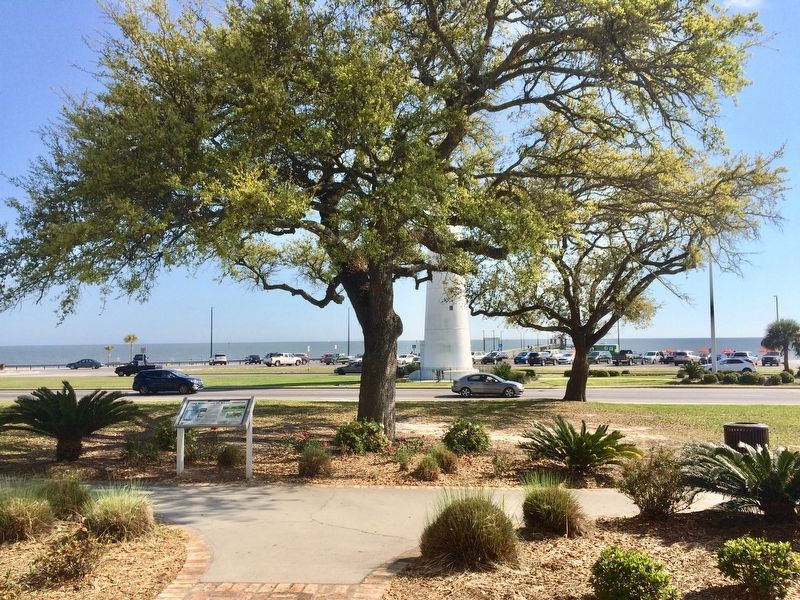
2. View of marker and Biloxi Lighthouse with Gulf of Mexico in background.
States history. Katrina's wrath destroyed irreplaceable landmarks
and severely crippled the resort industry. Post-Katrina laws allowing on-
land casinos proved to be a key factor in the recovery of tourism. The
continuous waxing and waning of Biloxi's tourist industry reflects the
cyclical nature of all seaside resorts.
[Photo captions]
Left middle: This promotion brochure, "Biloxi: The Four Season Resort," was published by the Chamber of Commerce in 1923. Ten thousand of the publications were distributed throughout the country.
Credit: Biloxi Public Library
Right top: One of Biloxi's first grand hotels, the Buena Vista Hotel & Convention Center (1924-late 1980s) is pictured during its mid-20th century heyday. Located on the present site of the MGM Park, it offered fishing, boating, access to golfing, trips to Ship Island and other tourist attractions.
Right middle: The many bathing piers along the Biloxi beach were popular with tourists and locals alike, as pictured on this circa 1940s postcard.
Credit: Biloxi Public Library
Right bottom: Gaily decorated shrimp boats take part in Biloxi's Blessing of the Fleet
Photographed by Mark Hilton, March 22, 2017
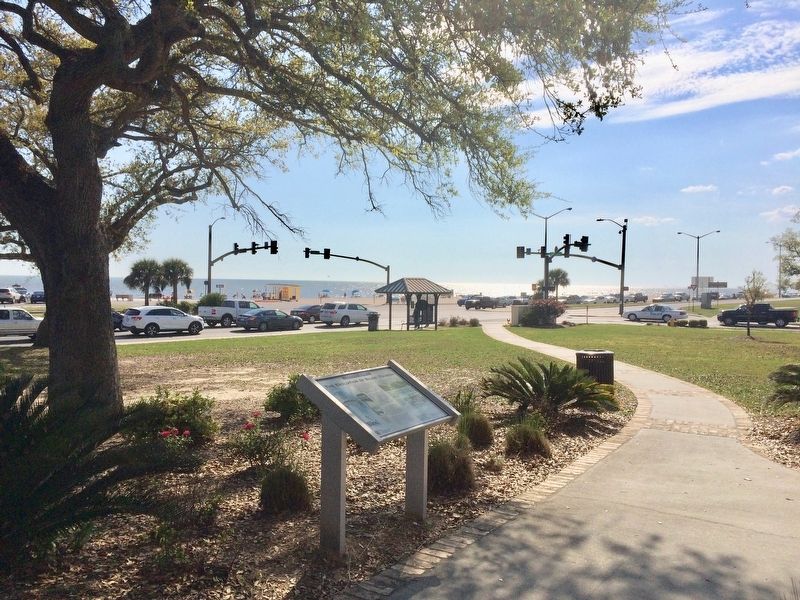
3. View from Biloxi Visitors Center of intersection of Beach Boulevard & Porter Avenue.
in the 1960s. The event, held under the auspices of St. Michael Catholic Church, has opened the shrimp season since 1929. Over time, the annual festival has become a big Biloxi tourist attractions.
Credit: Biloxi Public Library
Location. 30° 23.691′ N, 88° 54.069′ W. Marker is in Biloxi, Mississippi, in Harrison County. It can be reached from the intersection of Beach Boulevard (U.S. 90) and Porter Avenue. Located on the grounds of the Biloxi Visitors Center. Touch for map. Marker is at or near this postal address: 1050 Beach Boulevard, Biloxi MS 39530, United States of America. Touch for directions.
Regionally, this marker is in the American South, specifically in the Deep South, and on the Gulf Coast. Globally, it is in North America,
Photographed by Mark Hilton, March 22, 2017
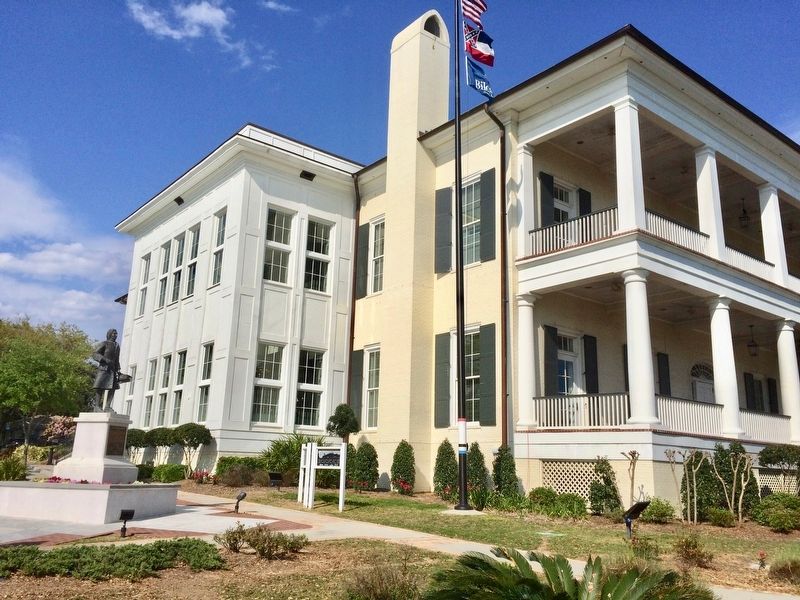
4. Biloxi Vistors Center
a Gulf of Mexico state, the Western Hemisphere, the Western World, and the Anglosphere. Historically, it finds itself in what was once New Spain, the Viceroyalty of New France, the territory of the Mississippian Culture, one of the Confederate States of America, and the Antebellum South.
Credits. This page was last revised on July 11, 2021. It was originally submitted on March 24, 2017, by Mark Hilton of Montgomery, Alabama. This page has been viewed 795 times since then and 82 times this year. Photos:1, 2, 3, 4. submitted on March 24, 2017, by Mark Hilton of Montgomery, Alabama.