The National Mall in Southwest Washington in Washington, District of Columbia — The American Northeast (Mid-Atlantic)
Upland Hardwood Forest
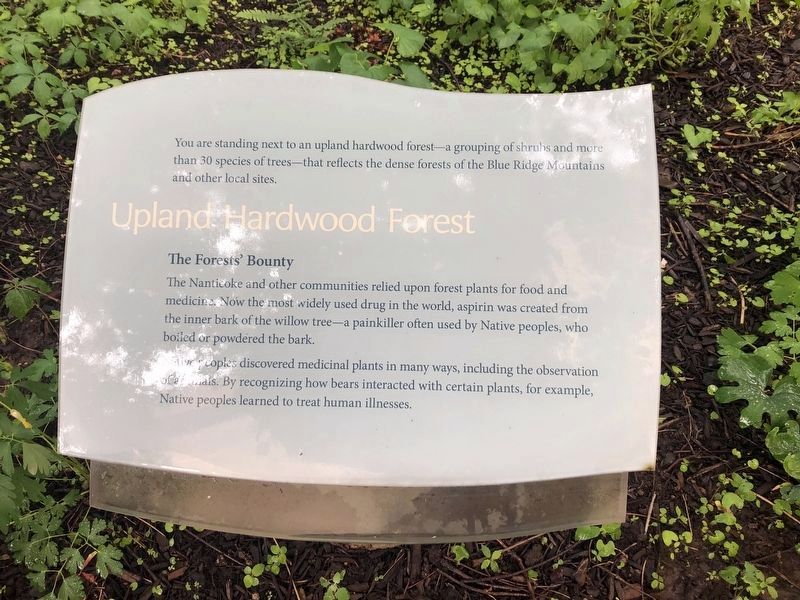
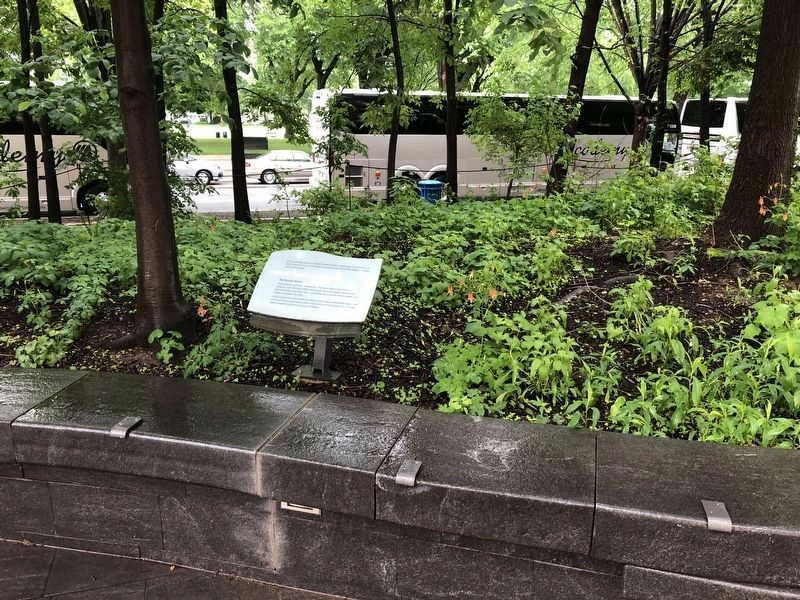
You are standing next to an upland hardwood forest—a group of shrubs and more than 30 species of trees—that reflects the dense forests of the Blue Ridge Mountains and other local sites.
The Forests' Bounty
The Nanticoke and other communities relied upon forest plants for food and medicine. Now the most widely used drug in the world, aspirin was created from the inner bark of the willow tree—a painkiller often used by Native peoples, who boiled or powdered the bark.
Native peoples discovered medicinal plants in many ways, including the observation of animals. By recognizing how bears interacted with certain plants, for example, Native peoples learned to treat human illnesses.
Erected by Smithsonian Institution.
Topics. This historical marker is listed in these topic lists: Anthropology & Archaeology • Environment • Indigenous Peoples and Communities • Science & Medicine.
Location. This marker has been replaced by another marker nearby. It was located near 38° 53.314′ N, 77° 1.006′ W. Marker was in Southwest Washington in Washington,
this page online

Regionally, this marker was in the Washington Metropolitan Area. It was also in the American Northeast, in the Upper South, in the Mid-Atlantic, in the Tidewater, and in the Chesapeake Bay Region. Globally, it was in North America, the Western Hemisphere, the Western World, and the Anglosphere.
Other nearby markers. At least 5 other markers are within walking distance of this location: Rick Bartow (within shouting distance of this marker); Cardinal Direction Marker: North (within shouting distance of this marker); George Rivera (within shouting distance of this marker); a different marker also named Traditional Croplands (within shouting distance of this marker); a different marker also named Cardinal Direction Marker: West (within shouting
Other markers no longer nearby. Sassafras • Wináhk (Wee-nock) (was a few steps from this marker but has been permanently removed); Rick Bartow (1946-2016) (was within shouting distance of this marker but has been replaced with another marker now near it); Can you hear the echo of the water bouncing off the rock? (was within shouting distance of this marker but has been permanently removed); Wingapo (was within shouting distance of this marker but has been permanently removed); Cardinal Direction Markers (was within shouting distance of this marker but has been permanently removed); Eastern Redcedar • Muráhk (mah-dok) (was within shouting distance of this marker but has been permanently removed); Cardinal Direction Marker: West (was within shouting distance of this marker but has been replaced with another marker now near it); Traditional Croplands (was within shouting distance of this marker but has been replaced with another marker now near it); What is a Grandfather Rock? (was within shouting distance of this marker but has
Photographed by Devry Becker Jones (CC0), December 3, 2020
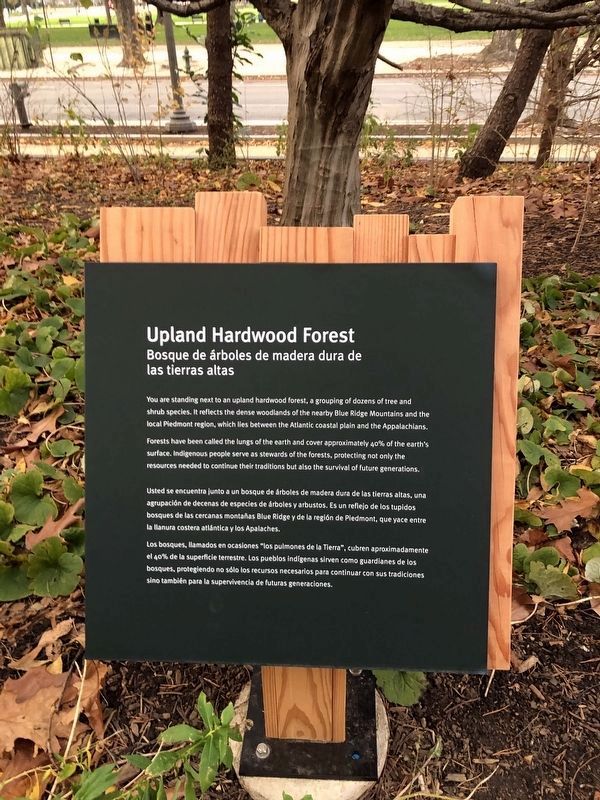
3. The marker has been replaced with this signage
Credits. This page was last revised on January 30, 2023. It was originally submitted on November 14, 2017, by Devry Becker Jones of Washington, District of Columbia. This page has been viewed 320 times since then and 17 times this year. Last updated on February 10, 2018, by Devry Becker Jones of Washington, District of Columbia. Photos: 1, 2. submitted on May 13, 2019, by Devry Becker Jones of Washington, District of Columbia. 3. submitted on December 3, 2020, by Devry Becker Jones of Washington, District of Columbia. • Andrew Ruppenstein was the editor who published this page.
