Trailing Along
Wyoming Valley Levee System
"And when I had asked the name of the river from the brakeman, and heard that it was called Susquehanna, the beauty of the name seemed to be part and parcel of the beauty of the land."
Robert Louis Stevenson, Across the Plains, 1879
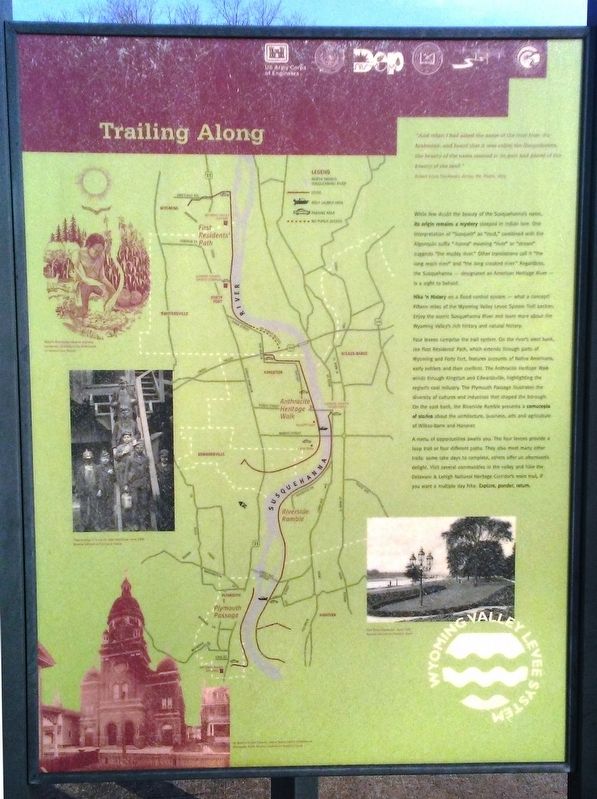
While few doubt the beauty of the Susquehanna's name, its origin remains a mystery steeped in Indian lore. One interpretation of "Susqueh" as "mud," combined with the Algonquin suffix "-hanna" meaning "river" or "stream" suggests "the muddy river." Other translations call it "the long reach river" and "the long crooked river." Regardless, the Susquehanna — designated an American Heritage River — is a sight to behold.
Hike 'n History on a flood control system — what a concept! Fifteen miles of the Wyoming Valley Levee System Trail beckon. Enjoy the scenic Susquehanna River and learn more about the Wyoming Valley's rich history and natural history.
Four levees comprise the trail system. On the river's west bank, the First Residents' Path, which extends through parts of Wyoming and Forty Fort, features accounts of Native Americans, early settlers and their conflicts. The
this page online
A menu of opportunities awaits you. The four levees provide a loop trail or four different paths. They also meet many other trails: some take days to complete, others offer an afternoon's delight. Visit several communities in the valley and hike the Delaware & Lehigh National Heritage Corridor's main trail, if you want a multiple day hike. Explore, ponder, return.
[Levee Trails system map]
[Illustrations, top to bottom, left to right, read]
• Native American tobacco burning ceremony
• Coal mining - a job for men and boys, circa 1900
• St. Mary's Polish Church, one of many ethnic churches in Plymouth, 1918.
• The River Commons, circa 1900
Erected by Delaware & Lehigh National Heritage Corridor and Others.
Topics. This historical marker is listed in these topic
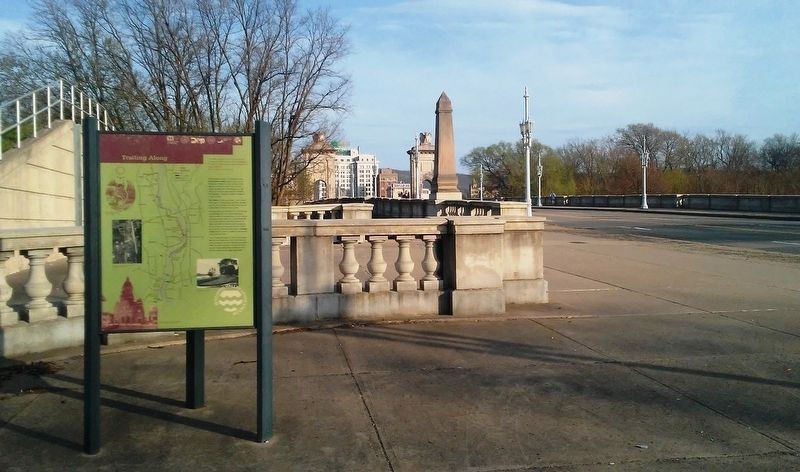
Location. 41° 15.09′ N, 75° 53.223′ W. Marker is in Kingston, Pennsylvania, in Luzerne County. It is at the intersection of Market Street and the west approach to the Market Street Bridge, on the left when traveling east on Market Street. Touch for map. Marker is in this post office area: Kingston PA 18704, United States of America. Touch for directions.

Regionally, this marker is in Pennsylvania’s Anthracite Coal Region, in the Wyoming Valley, and in Greater Scranton and Wilkes-Barre. It is also in the American Northeast, in the Mid-Atlantic, in Appalachia, and specifically in Northern Appalachia. Globally, it is in North America, the Western Hemisphere, the Western World, and the Anglosphere. Historically, it finds itself in what was once the Haudenosaunee (Iroquois) Confederacy and also one of the original Thirteen Colonies.
Other nearby markers. At least 8 other markers are within walking distance of this marker: Bridging Two Cities (here, next to this marker); What on Earth is a Levee? (here, next to this marker); War Memorial (a few steps from this marker); A Formal Promenade Across the River (within shouting distance of this marker); a different marker also named What on Earth is a Levee? (within shouting distance of this marker); a different marker also named Trailing Along (within shouting distance of this marker); Wilkes-Barre (about 700 feet away, measured in a direct line); 109th Field Artillery Battalion Memorial (approx. ¼ mile away). Touch for a list and map of all markers in Kingston.
More about this marker. An identical marker is southwest across Market Street.
Also see . . .
1. Delaware & Lehigh National Heritage Corridor. Website homepage (Submitted on May 6, 2018, by William Fischer, Jr. of Reynoldsburg, Ohio.)
2. Luzerne County Levee Trail. Trail Link website entry (Submitted on May 6, 2018, by William Fischer, Jr. of Reynoldsburg, Ohio.)
3. Wyoming Valley Levee System. The Citizens' Voice website entry (2012) (Submitted on May 6, 2018, by William Fischer, Jr. of Reynoldsburg, Ohio.)
Credits. This page was last revised on November 12, 2024. It was originally submitted on May 6, 2018, by William Fischer, Jr. of Reynoldsburg, Ohio. This page has been viewed 299 times since then and 22 times this year. Photos: 1, 2. submitted on May 6, 2018, by William Fischer, Jr. of Reynoldsburg, Ohio.
