Near Winchester in Frederick County, Virginia — The American South (Mid-Atlantic)
The Great Indian (and Wagon) Road

October 4, 2008
1. The Great Indian (and Wagon) Road Marker
The Great Indian Road, called Philadelphia Wagon Road by many settlers, was developed by Iroquois (Haudenosaunee) warriors traveling in the 1700s through the Great Valley of the Appalachians (which they called Jonontore) from Cohongaronto (north of the Potomac), to raid the Catawba in the Carolinas. In 1743, Iroquois headmen complained that Europeans had settled along the road, a treaty violation. The Lancaster Treaty of 1744 clarified the road’s direction and acknowledged the Iroquois’ right to travel through Frederick County to New River settlements and farther south. This road later brought immigrants to the Valley in Conestoga wagons. Today U.S. Route 11 generally follows the historic road.
Erected 2008 by Department of Historic Resources. (Marker Number Q-4.)
Topics and series. This historical marker is listed in these topic lists: Colonial Era • Indigenous Peoples and Communities • Roads & Vehicles • Settlements & Settlers. In addition, it is included in the Virginia Department of Historic Resources (DHR) series list. A significant historical year for this entry is 1743.
Location. 39° 13.242′ N, 78° 7.877′ W.
this page online

Regionally, this marker is in the Shenandoah Valley. It is also in the American South, specifically in the Upper South, and in the Mid-Atlantic. Globally, it is in North America, the Western Hemisphere, the Western World, and the Anglosphere. Historically, it finds itself in what was once the territory of the Mississippian Culture, one of the original Thirteen Colonies, one of the Confederate States of America, and the Antebellum South.
Other nearby markers. At least 8 other markers are within walking distance of this marker: Hackwood Park (here, next to this marker); Action of Rutherford’s Farm (here, next to this marker); "Run or Die" (here, next to this marker); Interrupted by War (a few steps from this marker); a different marker also named Three Battlefields (approx. 0.7 miles away); The First Battle of Kernstown (approx. 0.7 miles away); The First Battle of Winchester
October 4, 2008
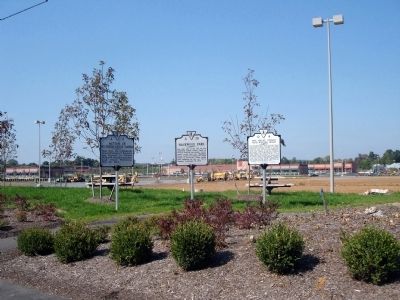
2. The Great Indian (and Wagon) Road Marker
Other markers no longer nearby. Battle of Rutherford's Farm (was within shouting distance of this marker but has been replaced with another marker now near it); Rutherford's Farm (was within shouting distance of this marker but has been replaced with another marker now near it); John Rutherford's Farm (was within shouting distance of this marker but has been replaced with another marker now near it); Three Battlefields (was approx. 0.7 miles away but has been replaced with another marker now near it).
Also see . . .
1. Lancaster Treaty of 1744. American Indian Treaties Portal website entry (Submitted on October 5, 2008.)
2. Mapping the Great Wagon Road. NCpedia website entry (Submitted on October 5, 2008.)
Credits. This page was last revised on September 17, 2025. It was originally submitted on October 5, 2008. This page has been viewed 2,392 times since then and 80 times this year. Photos: 1, 2. submitted on October 5, 2008. • Bill Pfingsten was the editor who published this page.
