Mackinaw City in Cheboygan County, Michigan — The American Midwest (Great Lakes)
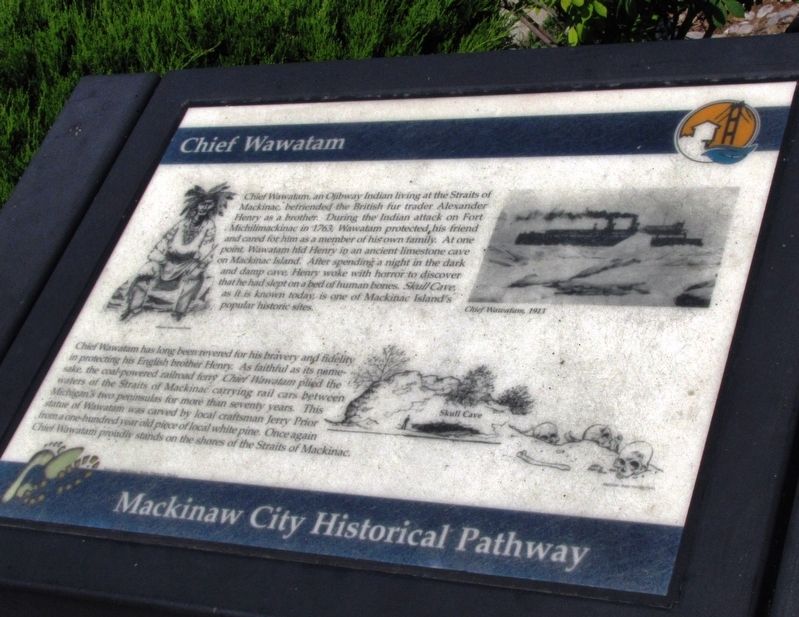
Chief Wawatam
| — | Mackinaw City Historical Pathway | — |
Photographed by Cosmos Mariner, July 19, 2011
1. Chief Wawatam Marker
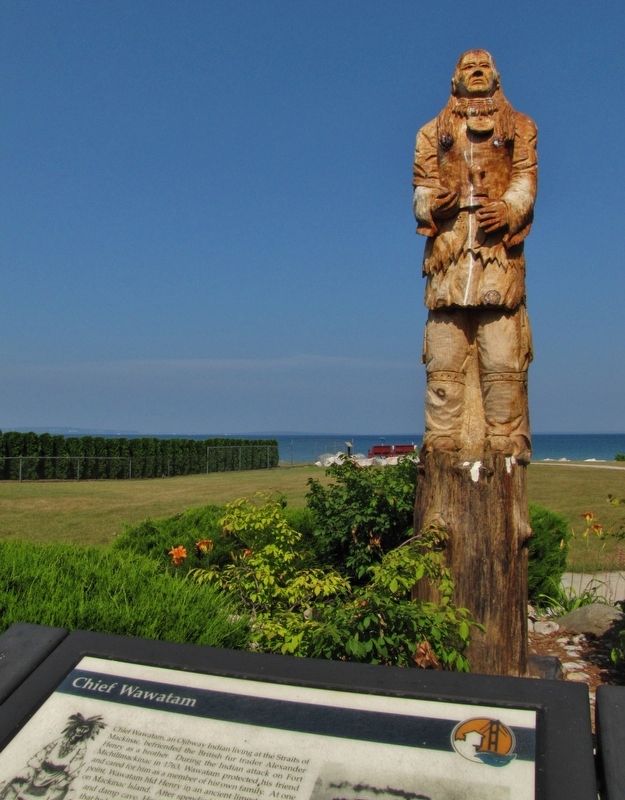
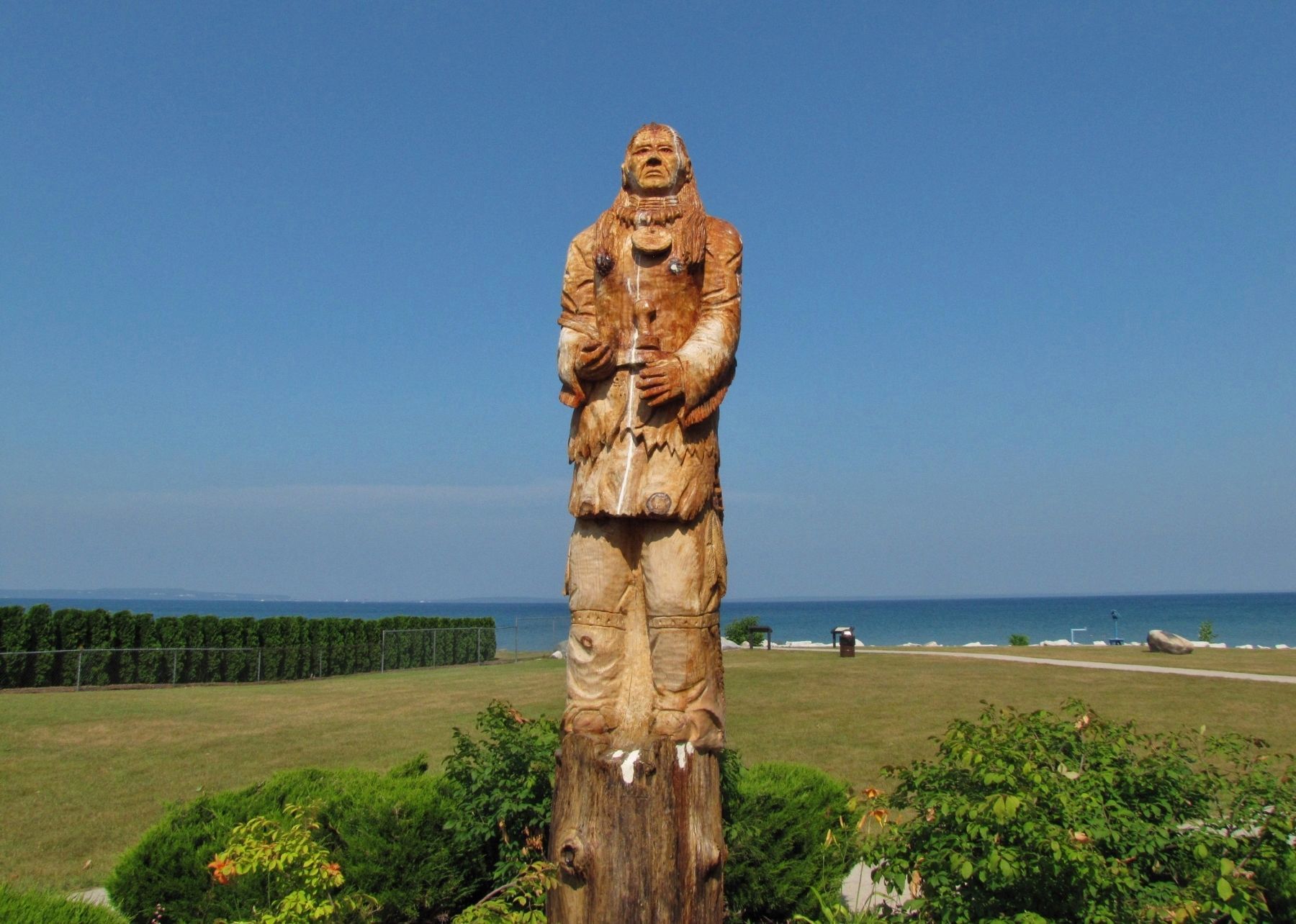
Chief Wawatam has long been revered for his bravery and fidelity in protecting his English brother Henry. As faithful as its namesake, the coal-powered railroad ferry Chief Wawatam plied the waters of the Straits of Mackinac carrying rail cars between Michigan’s two peninsulas for more than seventy years. This statue of Wawatam was carved by local craftsman Jerry Prior from a one-hundred year old piece of local white pine. Once again, Chief Wawatam proudly stands on the shores of the Straits of Mackinac.
Erected by Mackinaw City Historical Pathway.
Topics.
this page online
Location. 45° 47.017′ N, 84° 43.422′ W. Marker is in Mackinaw City, Michigan, in Cheboygan County. It can be reached from the intersection of North Huron Avenue and East Jamet Street, on the right when traveling north. Marker and Chief Wawatam tree trunk sculpture are located beside the sidewalk, at the center of Mackinaw City's Wawatam Park. Touch for map. Marker is in this post office area: Mackinaw City MI 49701, United States of America. Touch for directions.

Regionally, this marker is in Northern Michigan Lower Peninsula, on the Straits of Mackinac, and in one of the Lake Huron Shore counties. It is also in the American Midwest. Globally, it is in North America, in the Great North Woods, on the Great Lakes, in the Western Hemisphere, in the Western World, and in the Anglosphere. Historically, it finds itself in what was once the Northwest Territory.
Other nearby markers. At least 8 other markers are within walking
Photographed by Cosmos Mariner, July 19, 2011
2. Chief Wawatam Marker (tall view)
Other markers no longer nearby. Island-Hopping the Straits (was within shouting distance of this marker but has been replaced with another marker now near it); Lake Level Research on the Great Lakes (was within shouting distance of this marker but has been replaced with another marker now near it).
Also see . . .
1. Wawatam (Wikipedia). Wawatam (little goose) was an 18th-century Odawa chief who lived in the northern region of present-day Michigan's Lower Peninsula in an area along the Lake Michigan
Photographed by Cosmos Mariner, July 19, 2011
3. Chief Wawatam Park (wide view looking east; Straits of Mackinac/Lake Huron in background)
2. History Carved in Wood. Scattered around Mackinaw City are several wooden sculptures carved by local resident Jerry Prior, each depicting a person of historical importance in town. His sculptures are part of the Mackinac City Historical Pathway. (Submitted on April 4, 2019, by Cosmos Mariner of Cape Canaveral, Florida.)
3. 48. Wooden carvings. Web page with audio tour file — an interview with Jerry Prior whose carvings of Mackinaw City historical figures started with that of Chief Wawatam. (Submitted on October 10, 2019, by Joel Seewald of Madison Heights, Michigan.)
Credits. This page was last revised on August 23, 2024. It was originally submitted on April 1, 2019, by Cosmos Mariner of Cape Canaveral, Florida. This page has been viewed 1,563 times since then and 86 times this year. Photos: 1, 2, 3. submitted on April 4, 2019, by Cosmos Mariner of Cape Canaveral, Florida.
