
St. Charles in St. Charles County, Missouri — The American Midwest (Upper Plains)
Potato
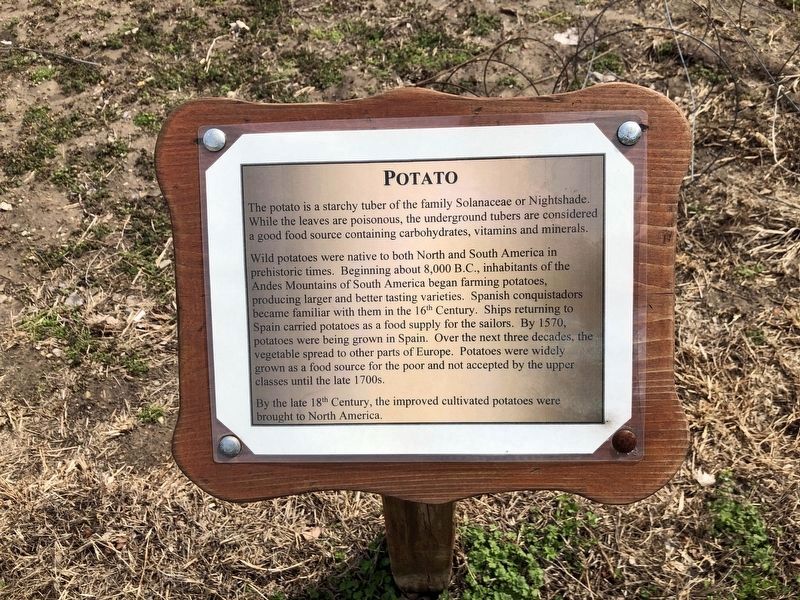
The potato is a starchy tuber of the family Polonaise or Nightshade. While the leaves are poisonous, the underground tubers are considered a good food source containing carbohydrates, vitamins and minerals.
Wild potatoes were native to both North and South America in prehistoric times. Beginning about 8,000 B.C., inhabitants of the Andes Mountains of South America began farming potatoes, producing larger and better tasting varieties. Spanish conquistadors became familiar with them in the 16th Century. Ships returning to Spain carried potatoes as a food supply for the sailors. By 1570, potatoes were being grown in Spain. Over the next three decades, the vegetable spread to other parts of Europe. Potatoes were widely grown as a food source for the poor and not accepted by the upper classes until the late 1700s.
By the late 18th Century, the improved cultivated potatoes were brought to North America.
Topics. This historical marker is listed in these topic lists: Agriculture • Colonial Era • Hispanic Americans • Indigenous Peoples and Communities. A significant historical year for this entry is 1570.
Location. 38° 46.381′ N,
this page online

Regionally, this marker is in the Missouri River Corridor and in Greater St. Louis. It is also in the American Midwest, in the Lewis & Clark Corridor, in the Corn Belt, and in the Great River Road Region. Globally, it is in North America, the Western Hemisphere, the Western World, and the Anglosphere. Historically, it finds itself in what was once the territory of the Mississippian Culture, the Louisiana Purchase, and the Antebellum South.
Other nearby markers. At least 8 other markers are within walking distance of this marker: Onions (here, next to this marker); Corn, Pole Beans, Squash / Habanero & Jalapeno Peppers / Tomato (here, next to this marker); The Lewis and Clark Expedition Across Missouri (a few steps from this marker); The Experiment (a few steps from this marker); Marsh Mallows (a few steps from this marker); May 21, 1804 (a few steps from this marker); Bishop's Landing (within shouting distance of this marker); Tracking the Boats (within shouting distance of this marker). Touch for a list and map of all markers in St. Charles.
Another marker is no longer nearby. Sunflower (was a few steps from this marker but has been confirmed missing).
Credits. This page was last revised on February 11, 2026. It was originally submitted on March 23, 2021, by Devry Becker Jones of Washington, District of Columbia. This page has been viewed 294 times since then and 18 times this year. Last updated on March 27, 2021, by Bradley Owen of Morgantown, West Virginia. Photo 1. submitted on March 27, 2021, by Devry Becker Jones of Washington, District of Columbia.
