South Shore in Codington County, South Dakota — The American Midwest (Upper Plains)
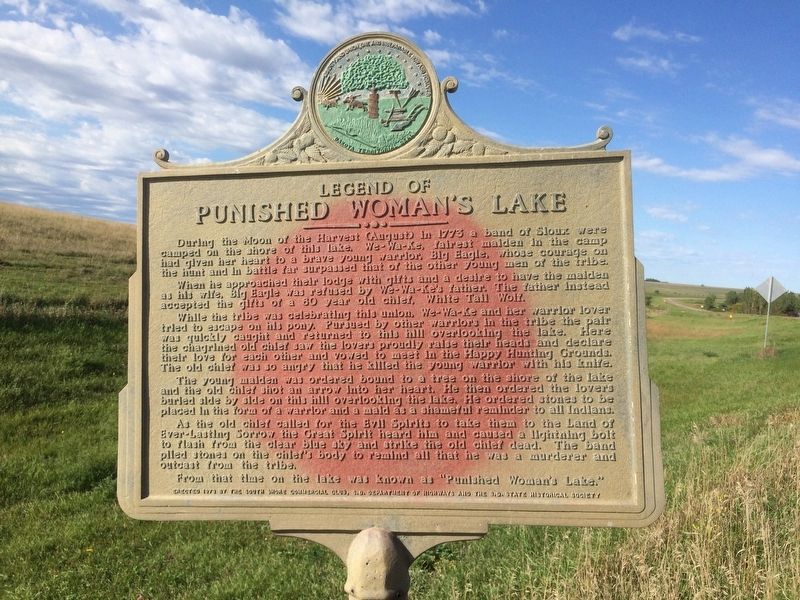
Legend of Punished Woman's Lake
Photographed by Ruth VanSteenwyk, September 20, 2016
1. Punished Woman's Lake Marker
During the Moon of the Harvest (August) in 1773 a band of Sioux were camped on the shore of this lake. We-Wa-Ke, fairest maiden in the camp had given her heart to a brave young warrior, Big Eagle, whose courage on the hunt and in battle far surpassed that of the other young men of the tribe.
When he approached their lodge with gifts and a desire to have the maiden as his wife, Big Eagle was refused by We-Wa-Ke's father. The father instead accepted the gifts of a 60 year old chief, White Tail Wolf.
While the tribe was celebrating this union, We-Wa-Ke and her warrior lover tried to escape on his pony. Pursued by other warriors in the tribe the pair was quickly caught and returned to this hill overlooking the lake. Here the chagrined old chief saw the lovers proudly raise their heads and declare their love for each other and vowed to meet in the Happy Hunting Grounds. The old chief was so angry that he killed the young warrior with his knife.
The young maiden was ordered bound to a tree on the shore of the lake and the old chief shot an arrow into her heart. He then ordered the lovers buried side by side on this
this page online
As the old chief called for the Evil Spirits to take them to the Land of Ever-Lasting Sorrow the Great Spirit heard him and caused a lightning bolt to flash from the clear blue sky and strike the old chief dead. The band piled stones on the chief's body to remind all that he was a murderer and outcast from the tribe.
From that time on the lake was known as "Punished Woman's Lake."
Erected 1973 by South Shore Commercial Club, S.D. Department of Highways and the S.D. State Historical Society. (Marker Number 452.)
Topics and series. This historical marker is listed in these topic lists: Anthropology & Archaeology • Indigenous Peoples and Communities • Waterways & Vessels • Women. In addition, it is included in the South Dakota State Historical Society Markers series list. A significant historical year for this entry is 1773.
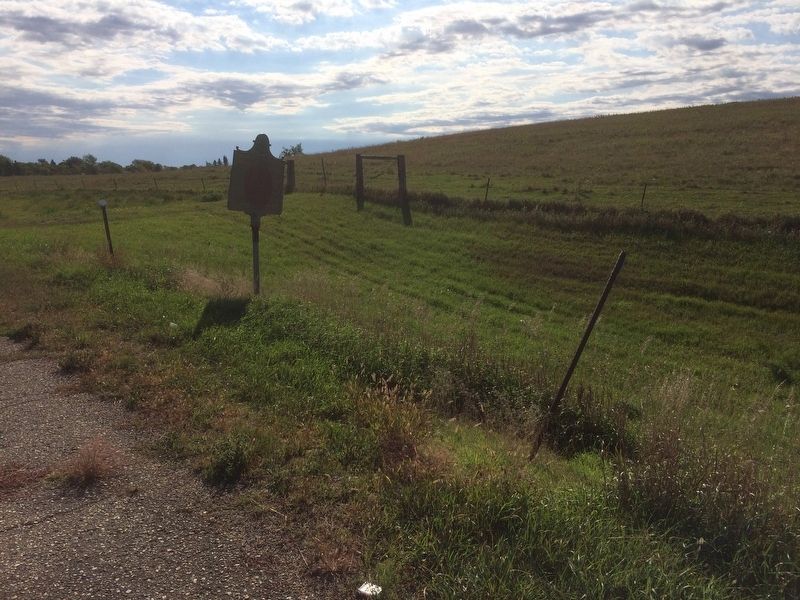
Location. 45° 6.336′ N, 96° 56.407′ W. Marker is in South Shore, South Dakota, in Codington County. It is on South Dakota Route 20 one mile east of 462nd Avenue,
Photographed by Ruth VanSteenwyk, September 20, 2016
2. Punished Woman's Lake Marker

Regionally, this marker is in the Sisseton-Wahpeton Oyate and in East River. It is also in the American Midwest, in the Lewis & Clark Corridor, in the Corn Belt, on the prairies, and on the Northern Plains. Globally, it is in North America, the Western Hemisphere, the Western World, and the Anglosphere. Historically, it finds itself in what was once Rupert’s Land and also the Louisiana Purchase.
Other nearby markers. At least 8 other markers are within 17 miles of this marker, measured as the crow flies: Brown Earth Church (approx. 8.3 miles away); Brown Earth Indian Church (approx. 8.7 miles away); Roberts County / Grant County (approx. 14.2 miles away); Mount Hope Cemetery Mausoleum (approx. 15.2 miles away); Dedicated to Veterans (approx. 15.3 miles away); Freeman Thayer Post Memorial (approx. 15.3 miles away); North End Neighborhood (approx. 16.1 miles away); Mellette Hill (approx. 16.2 miles away).
Photographed by Roger Dean Meyer, July 16, 2022
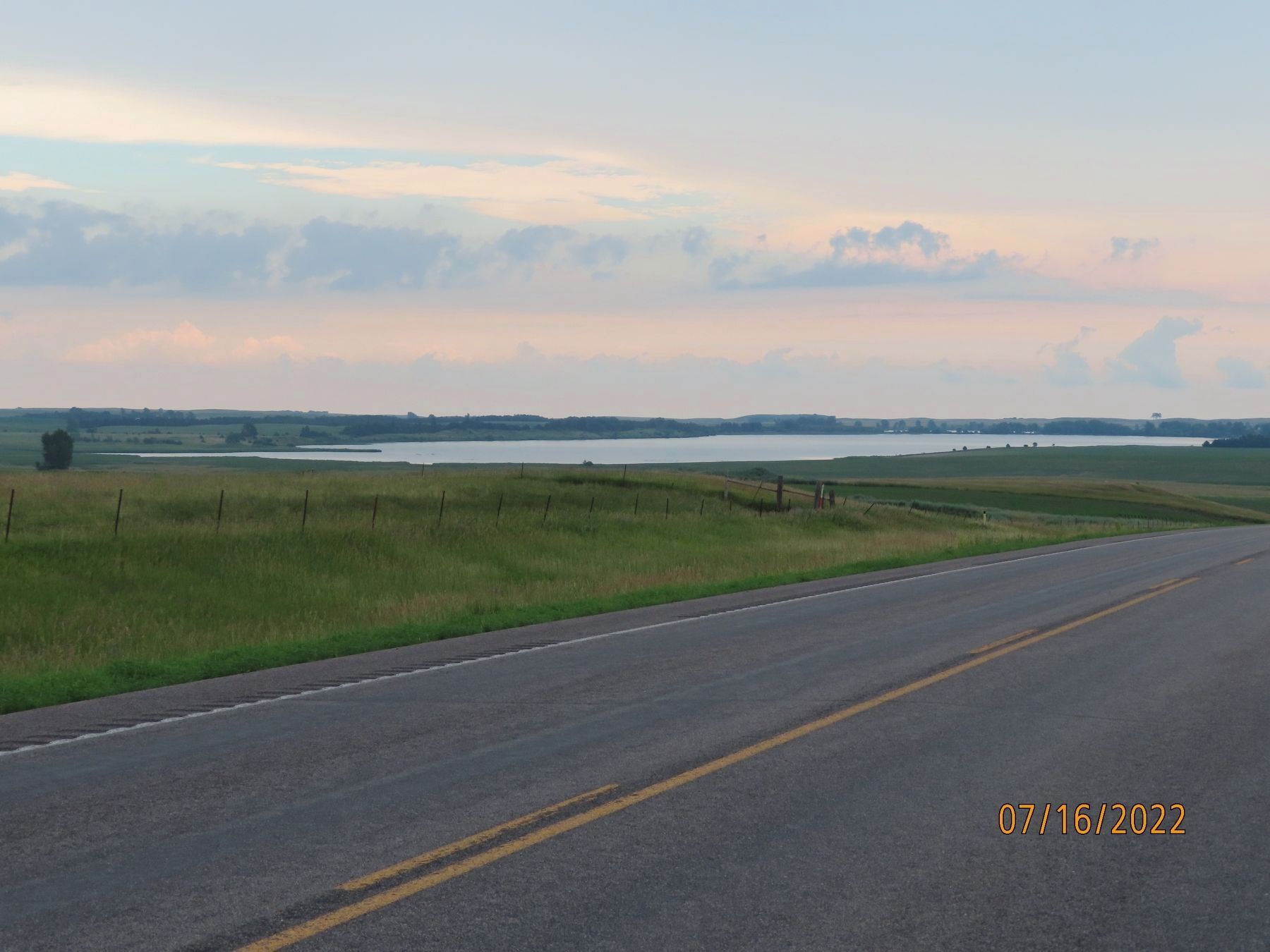
3. Punished Woman's Lake
Credits. This page was last revised on February 15, 2026. It was originally submitted on February 5, 2017, by Ruth VanSteenwyk of Aberdeen, South Dakota. This page has been viewed 6,256 times since then and 837 times this year. Last updated on September 4, 2021, by Ruth VanSteenwyk of Aberdeen, South Dakota. Photos: 1, 2. submitted on February 5, 2017, by Ruth VanSteenwyk of Aberdeen, South Dakota. 3. submitted on May 21, 2023, by Roger Dean Meyer of Yankton, South Dakota. • Mark Hilton was the editor who published this page.
