Hitch Village/Fred Wessels Homes in Savannah in Chatham County, Georgia — The American South (South Atlantic)
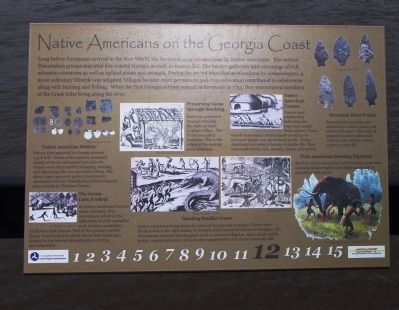
Native Americans on the Georgia Coast
Photographed by Mike Stroud, 2009
1. Native Americans on the Georgia Coast Marker
Native American Pottery
The Green Corn
Preserving Game through Smoking
Native American Canoes
Savannah River points
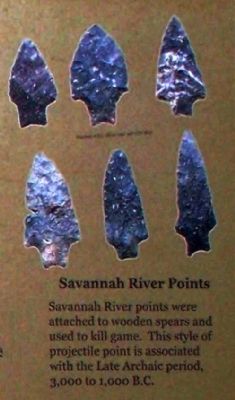
Savannah River points were attached to wooden spears and used to kill game. This style of projectile point is associated with the Late Archaic period, 3,000 to 1,000 B.C.
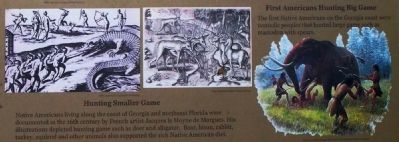
First Americans Hunting Big Game
The first Native Americans on the Georgia coast were nomadic peoples that hunted large game such as mastodon with spears.
Hunting Smaller Game
Native
this page online
Erected 2009 by U.S. Dept. Of Transportation Federal Highway Administration, Georgia Dept. of Transportation. (Marker Number 12.)
Topics. This historical marker is listed in these topic lists: Agriculture • Indigenous Peoples and Communities • Settlements & Settlers • Waterways & Vessels. A significant historical year for this entry is 1733.
Location. 32° 4.792′ N, 81° 5.007′ W. Marker is in Savannah, Georgia, in Chatham County. It is in Hitch Village/Fred Wessels Homes. It is on East River Street, on the right when traveling south. West of the E. Broad St. Ramp at Riverside. Touch for map. Marker is in this post office area: Savannah GA 31401, United States of America. Touch for directions.

Regionally, this marker is on the Coastal Plain and on the Georgia Coast and the Golden Isles. It
Native Americans on the Georgia Coast Marker
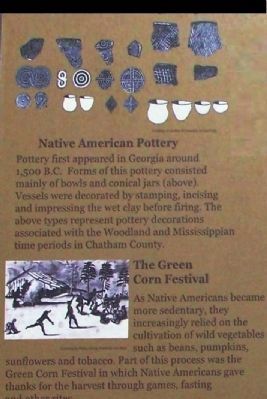
2. Native American Pottery
Pottery first appeared in Georgia around 1,500 B.C.
Forms of this pottery consisted mainly of bowls and
conical jars (above). Vessels were decorated by
stamping, incising and impressing the wet clay
before firing. The above types represent pottery
decorations associated with the Woodland and
Mississippian time periods in Chatham County .
The Green Corn
As Native Americans became more sedentary, they increasingly relied on the cultivation of wild vegetables such as beans, pumpkins, sunflowers and tabacco. Part of this process was the Green Corn Festival in which Native Americans gave thanks for the harvest through games, fasting and other rites.
The Green Corn
As Native Americans became more sedentary, they increasingly relied on the cultivation of wild vegetables such as beans, pumpkins, sunflowers and tabacco. Part of this process was the Green Corn Festival in which Native Americans gave thanks for the harvest through games, fasting and other rites.
Other nearby markers. At least 8 other markers are within walking distance of this marker: 1996 Olympic Yachting Cauldron (within shouting distance of this marker); Savannah's Early Economy (within shouting distance of this marker); Crossing the Savannah (within shouting distance of this marker); “Liberty” 1775 (about 300 feet away, measured in a direct line); Savannah's Liberty Ships and the Atlantic Bridge (about 300 feet away); Old Harbor Light (about 400 feet away); Ironclads and Gunboats of the Savannah River Squadron (about 400 feet away); The Liberty (about 400 feet away). Touch for a list and map of all markers in Savannah.
Native Americans on the Georgia Coast Marker
3. Savannah River points
Native Americans on the Georgia Coast Marker
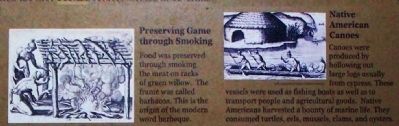
4. Preserving Game through Smoking
Food was preserved through smoking the meat
on racks of green willow. The frame was called
barbacoa. This is the origin of the modern word
barbeque.
Native American Canoes
Canoes were produced by hollowing out large logs usually from cypress. These vessels were used as fishing boats as well as to transport people and agricultural goods. Native Americans harvested a bounty of marine life. They consumed turtles, eels, mussels, clams, and oysters.
Native American Canoes
Canoes were produced by hollowing out large logs usually from cypress. These vessels were used as fishing boats as well as to transport people and agricultural goods. Native Americans harvested a bounty of marine life. They consumed turtles, eels, mussels, clams, and oysters.
Native Americans on the Georgia Coast Marker
5. First Americans Hunting Big Game and Hunting Smaller Game
Photographed by Mike Stroud, May 24, 2009
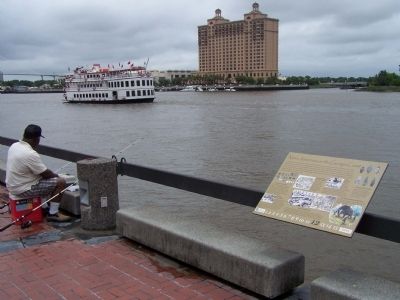
6. Native Americans on the Georgia Coast Marker as seen along the Savannah River
Credits. This page was last revised on February 8, 2023. It was originally submitted on May 26, 2009, by Mike Stroud of Bluffton, South Carolina. This page has been viewed 5,193 times since then and 113 times this year. Photos: 1, 2, 3, 4, 5, 6. submitted on May 26, 2009, by Mike Stroud of Bluffton, South Carolina. • Craig Swain was the editor who published this page.
