Lorton in Fairfax County, Virginia — The American South (Mid-Atlantic)
Building a Political Movement
⎯⎯⎯
Testing Constitutional Amendments
Photographed by Devry Becker Jones (CC0), May 6, 2022
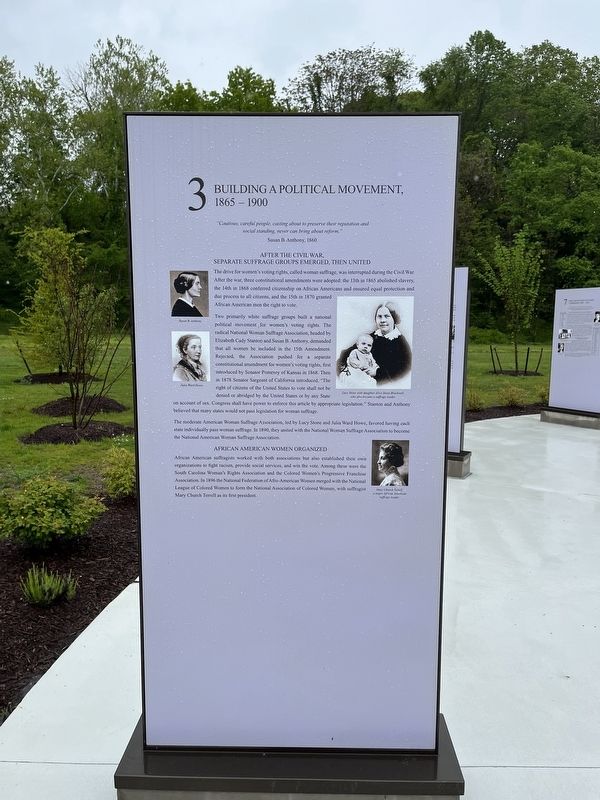
1. Building a Political Movement side of the marker
Building a Political Movement, 1865-1900
"Cautious, careful people, casting about to preserve their reputation and social standing, never can bring about reform."
Susan B. Anthony, 1860
After the Civil War, Separate Suffrage Groups Emerged, Then United
The drive for women's voting rights, called woman suffrage, was interrupted during the Civil War. After the war, three constitutional amendments were adopted: the 13th in 1865 abolished slavery, the 14th in 1868 conferred citizenship on African Americans and ensured equal protection and due process to all citizens, and the 15th in 1870 granted African American men the right to vote.
Two primarily white suffrage groups built a national political movement for women's voting rights. The radical National Woman Suffrage Association, headed by Elizabeth Cady Stanton and Susan B. Anthony, demanded that all women be included in the 15th Amendment Rejected, the Association pushed for a separate constitutional amendment for women's voting rights, first introduced by Senator Pomeroy of Kansas in 1868. Then in 1878 Senator Sargeant of California introduced, "The right of
this page online
The moderate American Woman Suffrage Association, led by Lucy Stone and Julia Ward Howe, favored having each state individually pass woman suffrage. In 1890, they united with the National Woman Suffrage Association to become the National American Woman Suffrage Association.
African American Women Organized
African American suffragists worked with both associations but also established their own organizations to fight racism, provided social services, and win the vote. Among these were the South Carolina Women's Rights Association and the Colored Women's Progressive Franchise Association. In 1896 the National Federation of Afro-American Women merged with the National League of Colored Women to form the National Association of Colored Women, with suffragist Mary Church Terrell as its first president.
[Captions:]
Lucy Stone with daughter Alice Stone Blackwell, who also became a suffrage leader.
Mary Church Terrell, a major African American suffrage leader.
Testing Constitutional Amendments: Court Cases Denied Women's Rights, 1872-1874
"That God designed the sexes to occupy different spheres of action, and that it belonged to men to make, apply, and execute the laws…"
FromFradwell v. Illinois, Illinois Supreme Court decision, 1872Photographed by Devry Becker Jones (CC0), May 6, 20222. Building a Political Movement / Testing Constitutional Amendments Marker
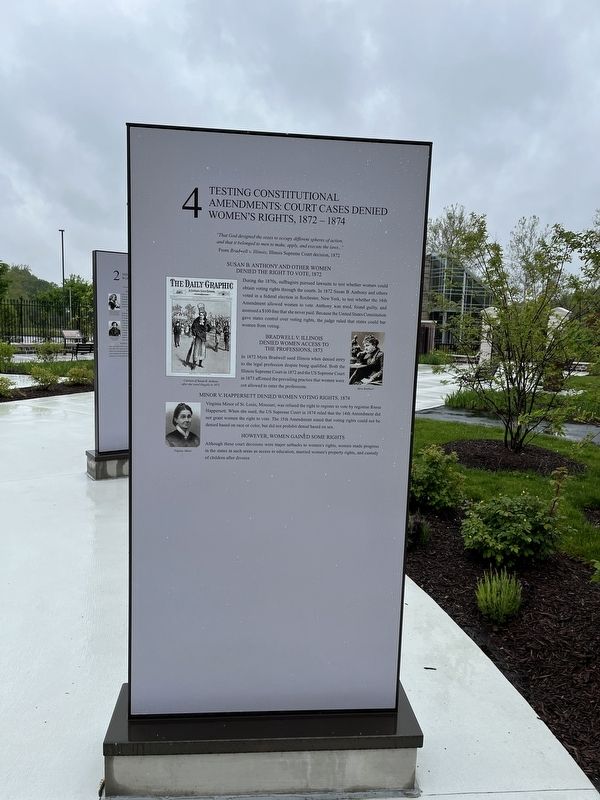
Susan B. Anthony and Other Women Denied the Right to Vote, 1872
During the 1870s, suffragists pursued lawsuits to test whether women could obtain voting rights through the courts. In 1872 Susan B. Anthony and others voted in a federal election in Rochester, New York, to test whether the 14th Amendment allowed women to vote. Anthony was tried, found guilty, and assessed a $100 fine that she never paid. Because the United States Constitution gave states control over voting rights, the judge ruled that states could bar women from voting.
Bradwell v. Illinois Denied Women Access to the Professions, 1873
In 1872 Myra Bradwell sued Illinois when denied entry to the legal profession despite being qualified. Both the Illinois Supreme Court in 1872 and the US Supreme Court in 1873 affirmed the prevailing practice that women were not allowed to enter the professions.
Minor v. Happersett Denied Women Voting Rights, 1874
Virginia Minor of St. Louis, Missouri, was refused the right to register to vote by registrar Reese Happersett. When she sued, the US Supreme Court in 1874
However, Women Gained Some Rights
Although these court decisions were major setbacks to women's rights, women made progress in the states in such areas as access to education, married women's property rights, and custody of children after divorce.
Erected 2021 by Turning Point Suffragist Memorial Association. (Marker Number 3/4.)
Topics and series. This historical marker is listed in these topic lists: African Americans • Civil Rights • Government & Politics • War, US Civil • Women. In addition, it is included in the Elizabeth Cady Stanton, the Mary Church Terrell, and the Susan B. Anthony series lists. A significant historical year for this entry is 1860.
Location. 38° 40.934′ N, 77° 15.178′ W. Marker is in Lorton, Virginia, in Fairfax County. It is on Lorton Road one mile south of Ox Road (Virginia Route 123), on the left when traveling east. Touch for map. Marker is at or near this postal address: 9751 Ox Rd, Lorton VA 22079, United States of America. Touch for directions.

Regionally, this marker is in the Washington Metropolitan Area and in Northern Virginia. It is also in the American South, specifically in the Upper South, in the Mid-Atlantic, and on the Eastern Seaboard. Globally, it is in the North Atlantic Region, North America, the Western Hemisphere, the Western World, and the Anglosphere. Historically, it finds itself in what was once the territory of the Mississippian Culture, one of the original Thirteen Colonies, one of the Confederate States of America, and the Antebellum South.
Other nearby markers. At least 8 other markers are within walking distance of this marker: Suffrage Campaigns State By State / New Leaders, New Approaches (here, next to this marker); "Forward Out of Darkness" / Issuing a Call for Women's Rights (here, next to this marker); New Life in State by State Campaigns / The 1913 Suffrage Parade Captured National Attention (a few steps from this marker); 1916 / Nonviolent Protests at the White House Gates (a few steps from this marker); Hard-Fought Ratification Campaigns in the States / The Continued Struggle for Voting Rights (a few steps from this marker); "Forward Into Light," Toward Equality, 1920 - Present / The 19th Amendment (a few steps from this marker); Victories in 1917 / Suffragists Demonstrated Until Congress Passed the 19th Amendment (a few steps from this marker); Worsening Conditions / Violent Repression (a few steps from this marker). Touch for a list and map of all markers in Lorton.
Additional commentary.
1. About the 13th Amendment
The 13th Amendment did not completely abolish slavery in the United States. It left open a loophole for enslavement "as a punishment for crime whereof the party shall have been duly convicted". This legal loophole has been used for years to criminalize non-violent behavior that wasn't criminal prior to the U.S. Civil War, such as loitering.
It can be easily argued that sending the suffragists to a working prison was a form of enslavement.
— Submitted May 6, 2022, by Devry Becker Jones of Washington, District of Columbia.
2. Moderate Feminists
In academic feminism (or Women's Studies, as it's called), the term moderate is not used in discussing feminism. Instead the use liberal feminism is used, similarly to classical liberalism.
This is not to be conflated with political liberalism. There are individuals who can be described as liberal, or even radical, feminists across the entire political spectrum.
There are some ideas in the history of feminism that were been considered radical for their times that are part of the mainstream political fabric today, including:
• The right to vote
• The right of a woman to have employment without the written permission of her husband
• The right of a woman not to marry
• In cases where a woman gives birth and is not married, to not have "illegitimate" or "bastard" to be stamped on the newborn's birth certificate
• When poor women, especially women of color, are treated, they are not given hysterectomies without their consent
— Submitted May 6, 2022, by Devry Becker Jones of Washington, District of Columbia.
Credits. This page was last revised on November 6, 2023. It was originally submitted on May 6, 2022, by Devry Becker Jones of Washington, District of Columbia. This page has been viewed 270 times since then and 13 times this year. Photos: 1, 2, 3. submitted on May 6, 2022, by Devry Becker Jones of Washington, District of Columbia.
