Chantilly in Fairfax County, Virginia — The American South (Mid-Atlantic)
Travelling Back in Time
Sully Historic Site
| — | Cain's Branch Archaeological Trail | — |
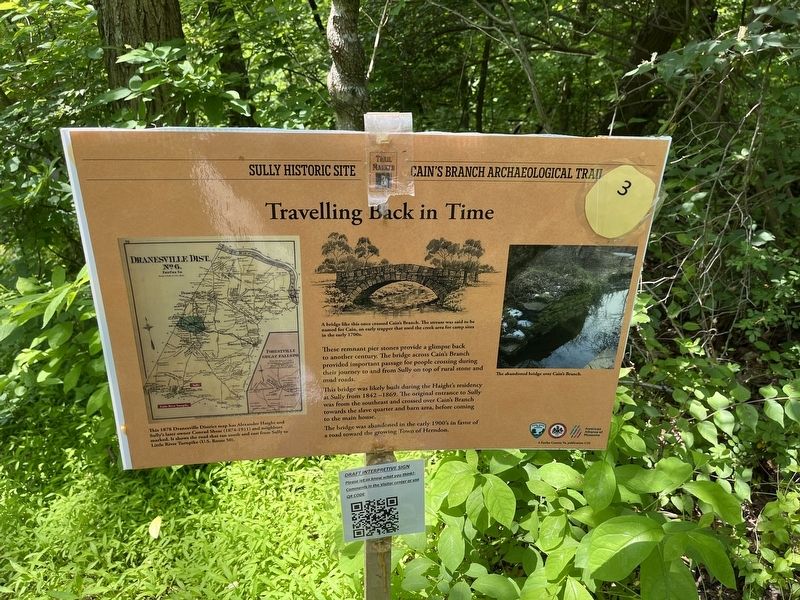
These remnant pier stones provide a glimpse back to another century. The bridge across Cain's Branch provided important passage for people crossing during their journey to and from Sully on top of rural stone and mud roads.
This bridge was likely built during the Haight's residency at Sully from 1842 - 1869. The original entrance to Sully was from the southeast and crossed over Cain's Branch towards the slave quarter and barn area, before coming to the main house.
The bridge was abandoned in the early 1900's in favor of a road toward the growing Town of Herndon.
[Captions:]
This 1878 Dranesville District map has Alexander Haight and Sully's later owner Conrad Shear (1874-1911) and neighbors marked. It shows the road that ran south and east from Sully to Little River Turnpike (U.S. Route 50).
A bridge like this one once crossed Cain's Branch. The stream was said to be named for Cain, an early trapper that used the creek area for camp sites in the early 1700s.
The abandoned bridge over Cain's Branch.
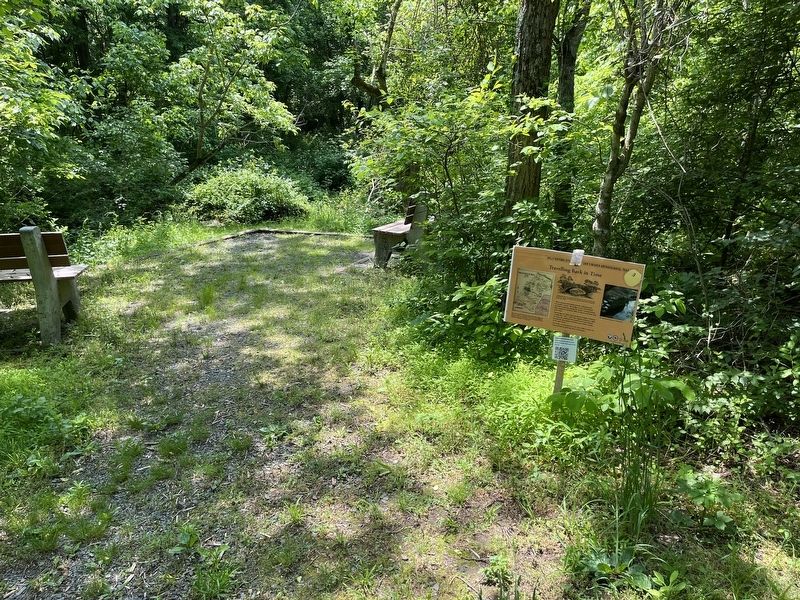
Erected 2022 by Fairfax County Park Authority. (Marker Number 3.)
Topics. This historical marker
this page online
Location. 38° 54.36′ N, 77° 25.768′ W. Marker is in Chantilly, Virginia, in Fairfax County. It can be reached from Historic Sully Way 0.8 miles south of Air and Space Museum Parkway, on the left when traveling south. Touch for map. Marker is at or near this postal address: 3650 Historic Sully Way, Chantilly VA 20151, United States of America. Touch for directions.

Regionally, this marker is in the Washington Metropolitan Area and in Northern Virginia. It is also in the American South, specifically in the Upper South, in the Mid-Atlantic, and on the Eastern Seaboard. Globally, it is in the North Atlantic Region, North America, the Western Hemisphere, the Western World, and the Anglosphere. Historically, it finds itself in what was once the territory of the Mississippian Culture, one of the original Thirteen Colonies, one of the Confederate States of America, and the Antebellum South.
Other nearby markers. At
Credits. This page was last revised on May 21, 2022. It was originally submitted on May 21, 2022, by Devry Becker Jones of Washington, District of Columbia. This page has been viewed 504 times since then and 37 times this year. Photos: 1, 2. submitted on May 21, 2022, by Devry Becker Jones of Washington, District of Columbia.
